All species › Passerines › Waxbills › Indian Silverbill
Indian Silverbill | Euodice malabarica
Loodbekje | Capuchino picoplata
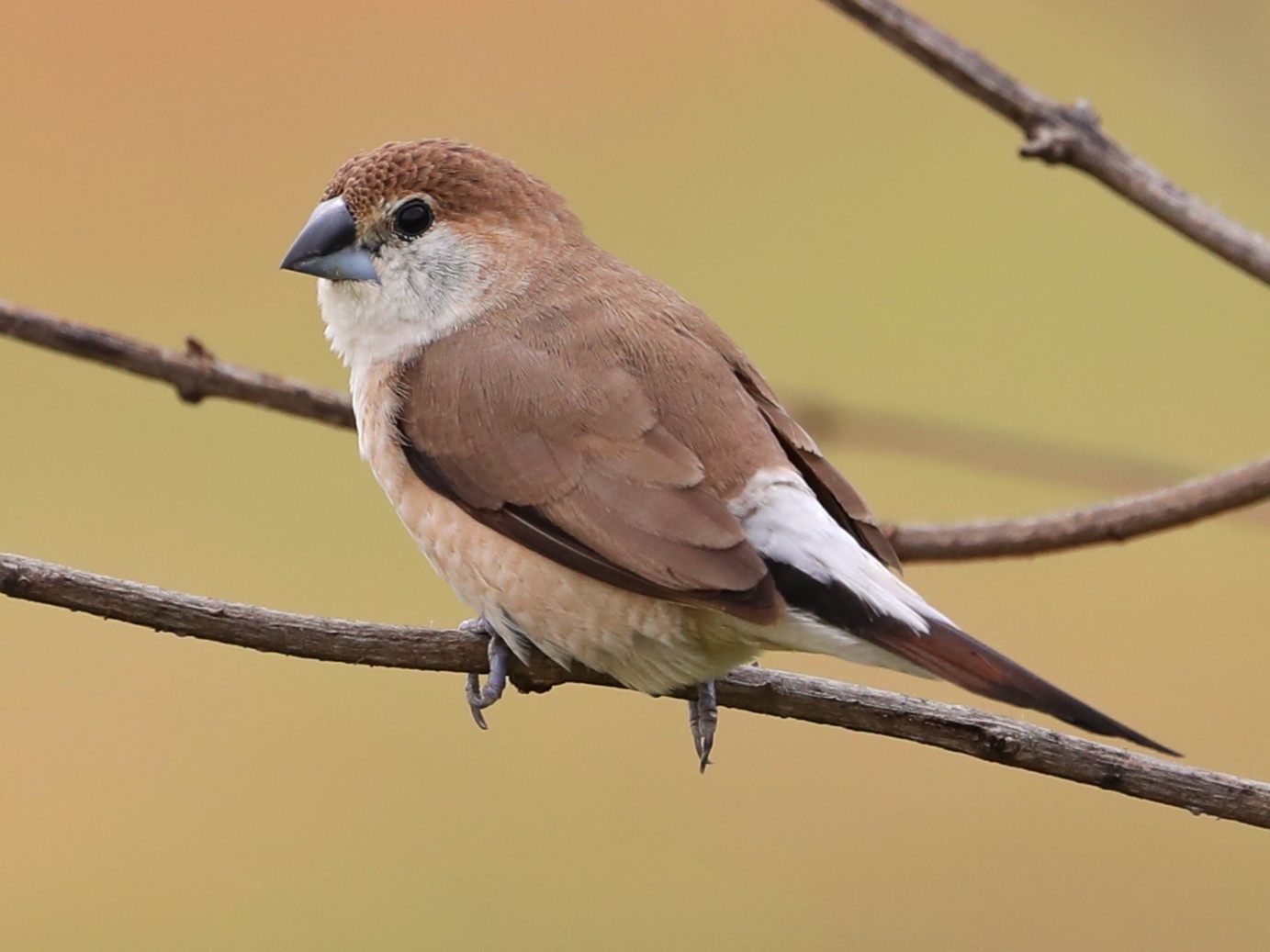
The Indian Silverbill is a plain, sandy-coloured estrildid finch from South Asia and the Middle East, named after its thick, silver-grey bill. It is a popular cage bird. On Puerto Rico it was first recorded in 1971 and it is now locally common, especially along the dry south-west coast and around San Juan.
Voice
Foraging groups give a constant low, soft chip or chirp. The song is a short, quiet series of trills.
Recording: David Darrell-Lambert — CC BY-NC-SA 4.0 · converted to mono · xeno-canto
Identification
11–11.5 cm, slim, with a long, pointed black tail and a thick, conical silver-grey bill. The upperparts are plain sandy brown, the wings darker brown. The rump is white and stands out against the black tail, especially in flight. The underparts are white to cream, with soft brown flanks. The sexes are alike. Juveniles have pale buff underparts and a shorter tail.
Confusion species
The other munias in the region have blunt tails without a white rump. Young Scaly-breasted Munias Lonchura punctulata and young Tricolored Munias Lonchura malacca are also plain brown, but darker and warmer, with a dark bill. Young Bronze Mannikins Spermestes cucullata are smaller and short-tailed. Female grassquits such as Blue-black Grassquit Volatinia jacarina and Black-faced Grassquit Melanospiza bicolor are olive-brown and lack the white rump and the thick pale bill.
Habitat
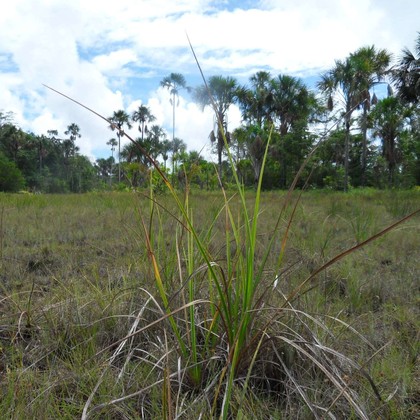
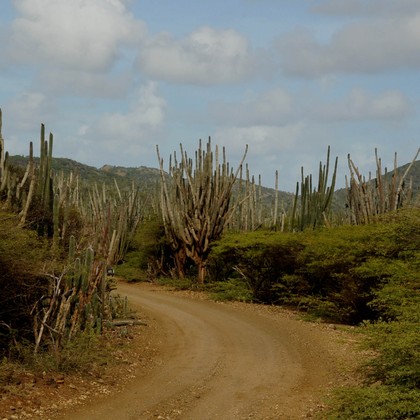
Dry, open country with scrub and grasses: thorn scrub, coastal scrub, dry pastures, fallow land, and gardens and yards where grass is seeding. In the native range also dry plains and farmland, sometimes near water. It forages in small flocks, mainly on grass seeds, occasionally on insects and nectar. The nest is a loose ball of grass with a side entrance in a shrub or thorn tree.
Where the bird is most at home, classified by the vegetation types of the Caribbean.



Range and movements
Introduced and established on Puerto Rico, mainly along the south-western coast and in the San Juan metropolitan area. Also introduced on St Croix in the US Virgin Islands, where the population may have died out. Native from the eastern Arabian Peninsula and Iran through Pakistan, India and Nepal to Bangladesh and Sri Lanka. Introduced elsewhere too, including Hawaii and parts of the Middle East.
- Resident
- dark = core range, pale = thinly spread
How and when to look
Best looked for in dry grassy areas along the south-west coast of Puerto Rico and in the suburbs of San Juan. In flight the white rump against the black, pointed tail is the best feature; groups are often heard first by their chirping contact calls.
Conservation status
Not threatened globally. On Puerto Rico an established alien that is not on any list of protected or threatened species.
Scientific name
Euodice malabarica | (Linnaeus, 1758)
Linnaeus described the species in 1758 as Loxia malabarica; because it was later moved to another genus, the author and year stand in brackets. The genus Euodice was introduced in 1863 by Reichenbach. Euodice is Greek, from eu 'good' and ōdikos 'singing', so roughly 'good singer'. malabarica refers to Malabar, the coastal region of south-western India. The specimen the first description was based on came from Malabar, India.