All species › Passerines › Waxbills › Bronze Mannikin
Bronze Mannikin | Spermestes cucullata
Gewoon ekstertje | Capuchino Bronceado
The Bronze Mannikin is a small estrildid finch from sub-Saharan Africa and one of the smallest munias. Puerto Rico has long held an established population, where it is one of the commonest introduced seed-eaters of open country. It lives in groups all year, and these also sleep together in a ball-shaped roosting nest.
Voice
A soft, buzzing rreep or rreep-rreep contact call, mainly in flight, and various squeaky and wheezy notes from a perch. The song is a short, quiet series of repeated notes.
Recording: African Bioacoustics Community — CC BY-NC-SA 4.0 · shortened to the first 60 s, mono · xeno-canto
Identification
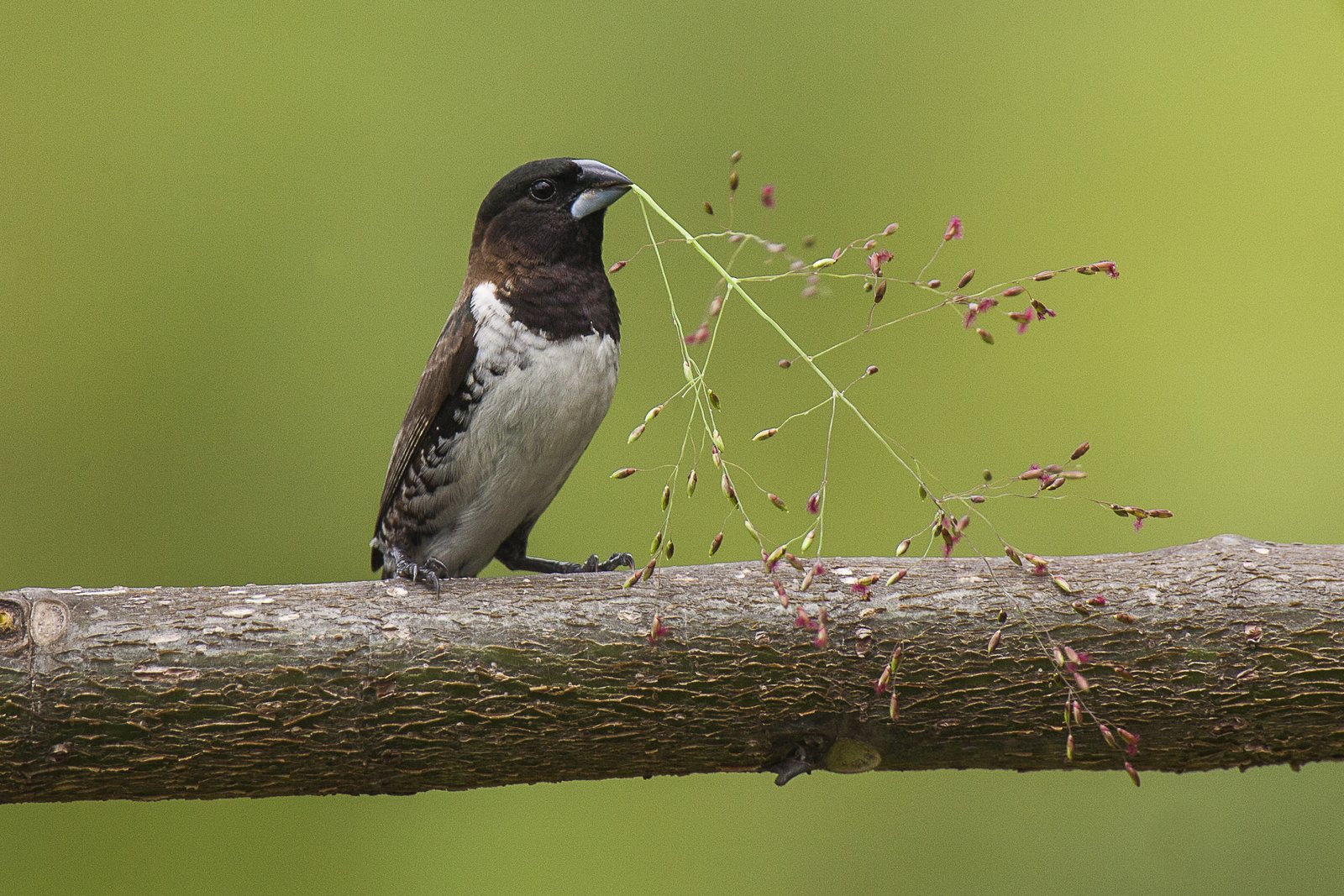
9–10 cm, small and compact, with a short tail and a two-toned bill: blackish upper mandible and blue-grey lower mandible. Head, throat and upper breast are blackish-brown with a green and purple gloss. The upperparts are grey-brown, the rump and uppertail coverts barred black and white, and the tail black. The underparts are white, with brown barring on the flanks and a glossy green patch on the shoulder and the side of the breast. The sexes are alike. Juveniles are plain pale brown, paler below and without the dark head, with a dark bill; they take a few months to acquire adult plumage.
Confusion species
Adults are identified by the combination of dark head, white belly and barred flanks. Scaly-breasted Munia Lonchura punctulata is larger, with a brown head and scaly underparts; Tricolored Munia Lonchura malacca has a chestnut back and black belly. Male Black-faced Grassquit Melanospiza bicolor also has a black head and breast, but an olive back, a pointed black bill and no white belly. Juveniles closely resemble young Scaly-breasted Munias and are best told by size and the company they keep.
Habitat
Open and semi-open lowlands: grassy verges, pastures, fallow land, the edges of cane fields, parks and gardens, including in towns. In Africa it inhabits moist savanna and forest edge. It feeds mainly on grass seeds, picked from the heads or taken from the ground, as well as termites and nectar. It builds a domed grass nest with a side entrance in a shrub or tree, and also makes roosting nests that are rebuilt again and again. It can raise several broods a year.
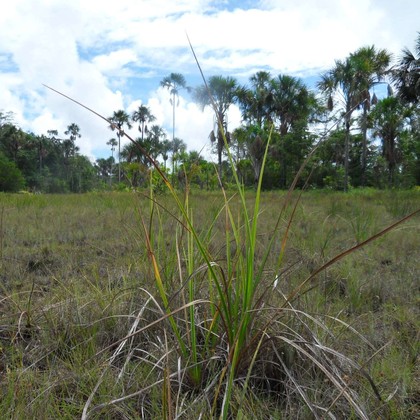
Where the bird is most at home, classified by the vegetation types of the Caribbean.



Range and movements
Introduced and established on Puerto Rico, where it occurs over much of the lowlands. Elsewhere there are only a few isolated reports, including from Martinique and Cuba, with no known population. Native to sub-Saharan Africa, from Senegal to Ethiopia and south to South Africa, and on islands such as Bioko, Pemba, Zanzibar and the Comoros.
- Resident
- dark = core range, pale = thinly spread
How and when to look
On Puerto Rico almost anywhere with seeding grassy verges and waste ground, including town parks and industrial areas. Groups are often noticed by their buzzing flight call; they like to perch in a row on grass stems or a fence.
Conservation status
Not threatened globally and common in much of Africa. On Puerto Rico an established alien; harmful effects on native species have not been demonstrated.
Scientific name
Spermestes cucullata | Swainson, 1837 (GBIF: Lonchura cucullata)
Swainson described the species in 1837 and placed it straight away in the genus where it still stands. He introduced the genus Spermestes in that same work. Spermestes comes from the Greek sperma, 'seed', and -estēs, 'eater' (from esthiō, 'to eat') — for the diet of grass seeds. cucullata is Latin for 'hooded' — for the dark head, which contrasts like a hood with the rest of the plumage. The specimen the first description was based on came from Senegal.