All species › Gamebirds › Pheasants and partridges › Red Junglefowl
Red Junglefowl | Gallus gallus
Bankivahoen | Gallo bankiva
The Red Junglefowl is the wild ancestor of the chicken. It is not native to the Caribbean: the free-living birds here are feral chickens, descendants of domestic fowl brought to the islands since colonial times. On many islands they roam freely in villages and farmyards; locally they live without human care in forest edge and scrub.
Voice
The cock crows a cock-a-doodle-doo; in the wild form it is shorter and hoarse, with a clipped last syllable. Hens cackle and cluck.
Recording: Aku Kalliomäki — CC BY-NC-SA 4.0 · converted to mono · xeno-canto
Identification
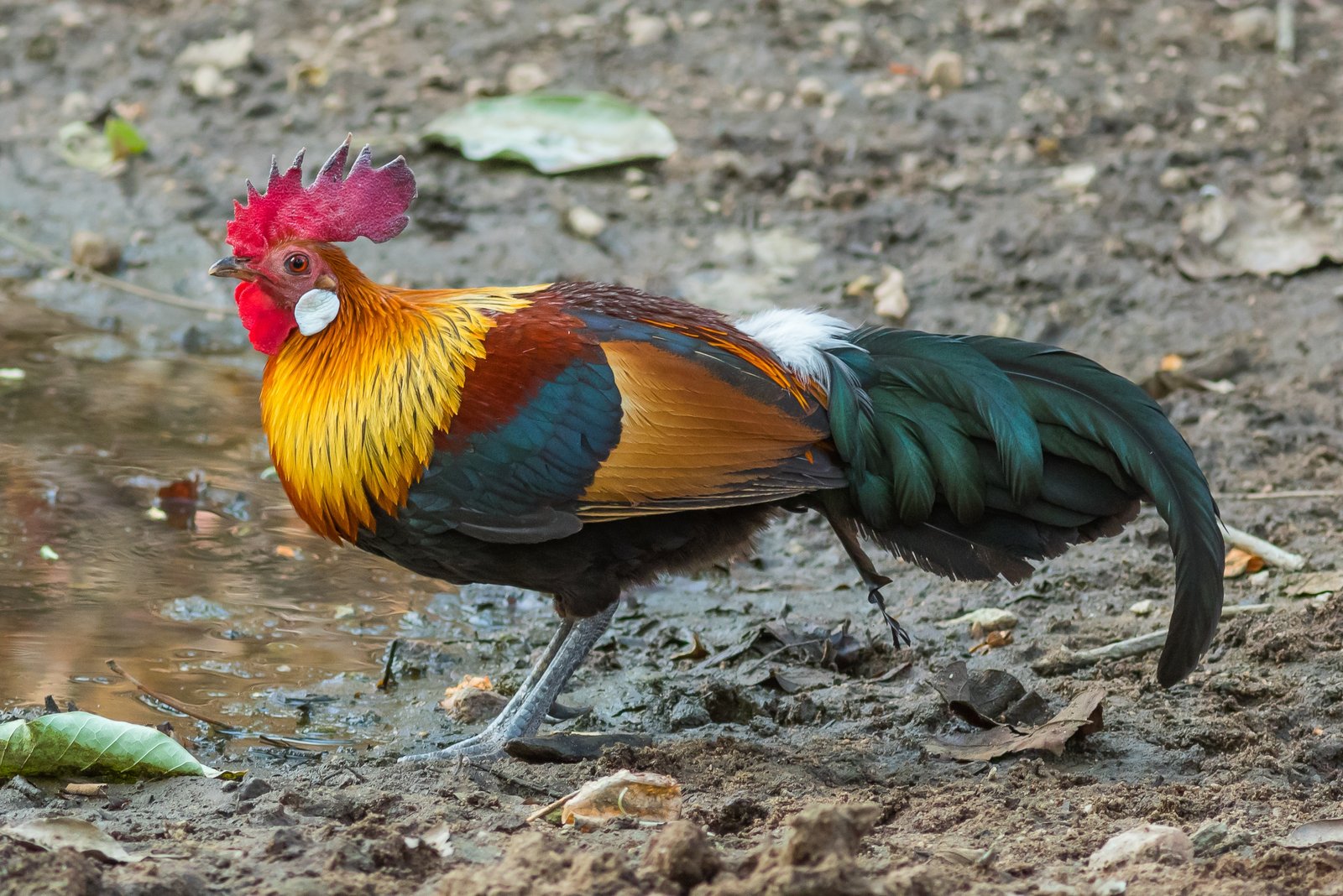
41–78 cm; the cock is much larger than the hen. The cock of the wild form has a red comb and red wattles, golden-orange to rufous neck and saddle feathers, a dark glossy breast and belly and a long, arched, greenish-black tail. The hen is brown and finely marked, with golden-edged neck feathers and a small comb. Feral chickens in the region often differ from the wild form: they are larger, and white, black, pied or speckled.
Confusion species
Not to be confused with any other wild bird in the region. Telling feral chickens from the pure wild form is often impossible in the field.
Habitat
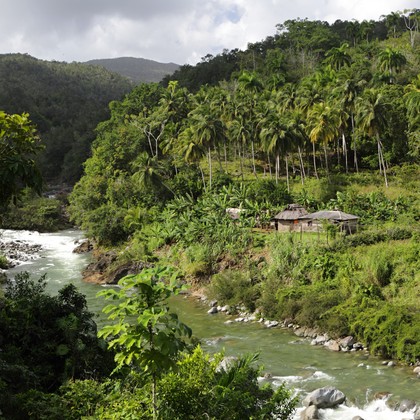
Villages and farmyards, gardens, farmland and plantations, and locally forest edge and scrub near habitation. It scratches on the ground for seeds, insects and scraps and roosts in trees or bushes.
Where the bird is most at home, classified by the vegetation types of the Caribbean.



Range and movements
Free-ranging and feral chickens occur on almost every island in the region. Feral populations have been described from the west of the Dominican Republic and, in smaller numbers, from Puerto Rico; many free-living chickens have also been reported from the Virgin Islands, the Bahamas, the Cayman Islands and Guadeloupe. Native to South and South-East Asia, from northern India to southern China and Indonesia.
- Resident
- dark = core range, pale = thinly spread
How and when to look
Free-living chickens can be seen on most islands in villages and at beaches and restaurants. Birds that resemble the wild form are best recognised by the cock's hoarse, shorter crow.
Conservation status
Not threatened globally. In the Caribbean an alien. On islands feral chickens can compete with native ground birds and eat eggs or small animals; little is known about the extent of such effects in the region.
Scientific name
Gallus gallus | (Linnaeus, 1758)
Linnaeus described the species in 1758 as Phasianus Gallus; because it was later moved to another genus, the author and year stand in brackets. The genus Gallus was introduced in 1760 by Brisson. Gallus is the Latin word for 'cock, rooster'. gallus is Latin for 'cock'; the species name repeats the genus name. The specimen the first description was based on came from Côn Sơn (Pulo Condor), Vietnam.