All species › Nightjars › Nightjars › Hispaniolan Nightjar
Hispaniolan Nightjar | Antrostomus ekmani
Hispaniolanachtzwaluw | Pitanguá
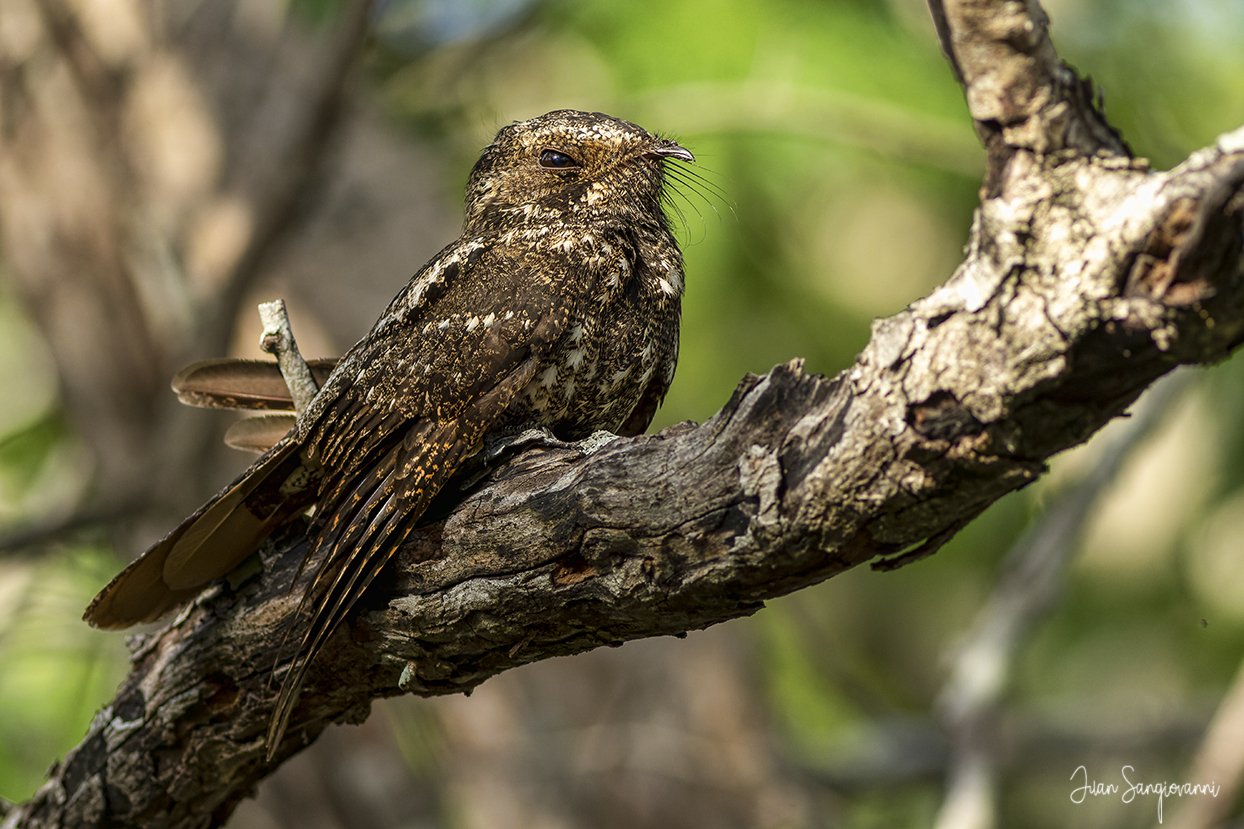
The Hispaniolan Nightjar is the large Antrostomus nightjar of Hispaniola, closely related to Cuban Nightjar Antrostomus cubanensis. The two were long treated as one species, and the American Ornithological Society still combines them as Greater Antillean Nightjar. In the Dominican Republic it is called pitanguá. It lives hidden in forest and scrub and is known mainly from its song after sunset.
Voice
The song is a single harsh, buzzy call that starts with a click and rises in pitch. When disturbed it gives short, low calls, roughly kwat.
Recording: George Wagner — CC BY-NC-SA 4.0 · converted to mono · xeno-canto
Identification
26–30 cm, large and dark, with a broad flat head and a long tail. The upperparts are dark brown with greyish and pale buff speckling; the crown has broad black streaks. The face is tawny, chin and throat dark brown with cinnamon speckles, the breast dark brown with buffy-white spots; belly and flanks are dark brown with grey speckling. There is no white wing patch. The male has white tips to the outer tail feathers, the female buff ones.
Confusion species
Least Poorwill Siphonorhis brewsteri is much smaller, with a short tail with a white terminal band, and lives mainly in dry lowlands. Chuck-will's-widow Antrostomus carolinensis winters on Hispaniola, is slightly larger and warmer rufous-brown, and rarely sings in winter. Antillean Nighthawk Chordeiles gundlachii has pointed wings with a white bar and hunts high over open ground.
Habitat
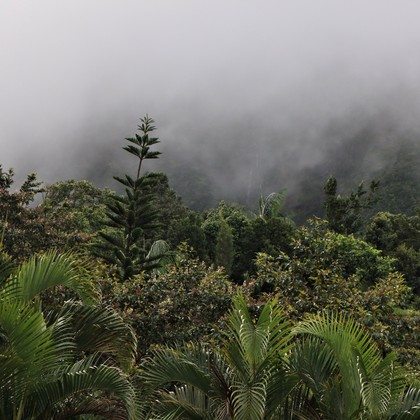
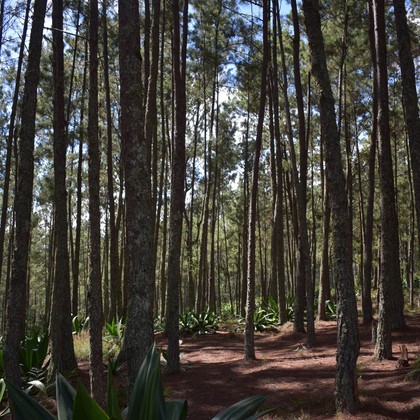
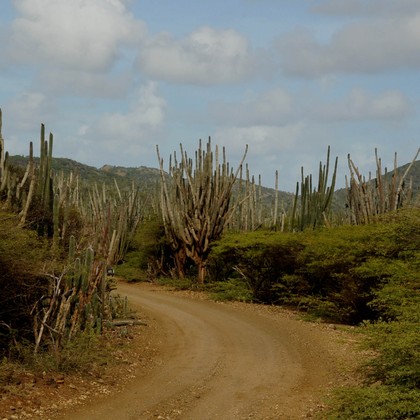
Broadleaf forest at middle elevations, thorn scrub in the lowlands and pine forest in the mountains, up to about 1,800 m. It hunts insects at dusk and at night. Breeding is from April to July; usually two eggs are laid on the ground without a nest, and both parents incubate.
Where the bird is most at home, classified by the vegetation types of the Caribbean.


Range and movements
Only on Hispaniola. Widespread in the Dominican Republic, especially in the western third of the country; very rare in Haiti and confined to the remaining forest areas. The species does not occur outside Hispaniola.
- Resident
- dark = core range, pale = thinly spread
How and when to look
Best at dusk in the Sierra de Bahoruco, where the song can be heard both in the dry lowlands and in the pine forest higher up the slopes. Searching forest tracks with a torch sometimes reveals a bird on a low branch or on the ground.
Conservation status
Not threatened; the population is thought to be stable. Deforestation, especially in Haiti, and introduced predators are the main risks to this ground-nesting bird.
Scientific name
Antrostomus ekmani | Lönnberg, 1929
Lönnberg described the species in 1929 and placed it straight away in the genus where it still stands. The genus Antrostomus was introduced in 1838 by Bonaparte. Antrostomus is Greek, from antron 'cave' and stoma 'mouth': 'cave-mouth', after the enormous gape. ekmani honours the Swedish botanist Erik Leonard Ekman (1883–1931), who collected the type specimen in Haiti. The specimen the first description was based on came from near Jérémie, Haiti.