All species › Woodpeckers and allies › Woodpeckers › Hairy Woodpecker
Hairy Woodpecker | Leuconotopicus villosus
Haarspecht | Carpintero velloso
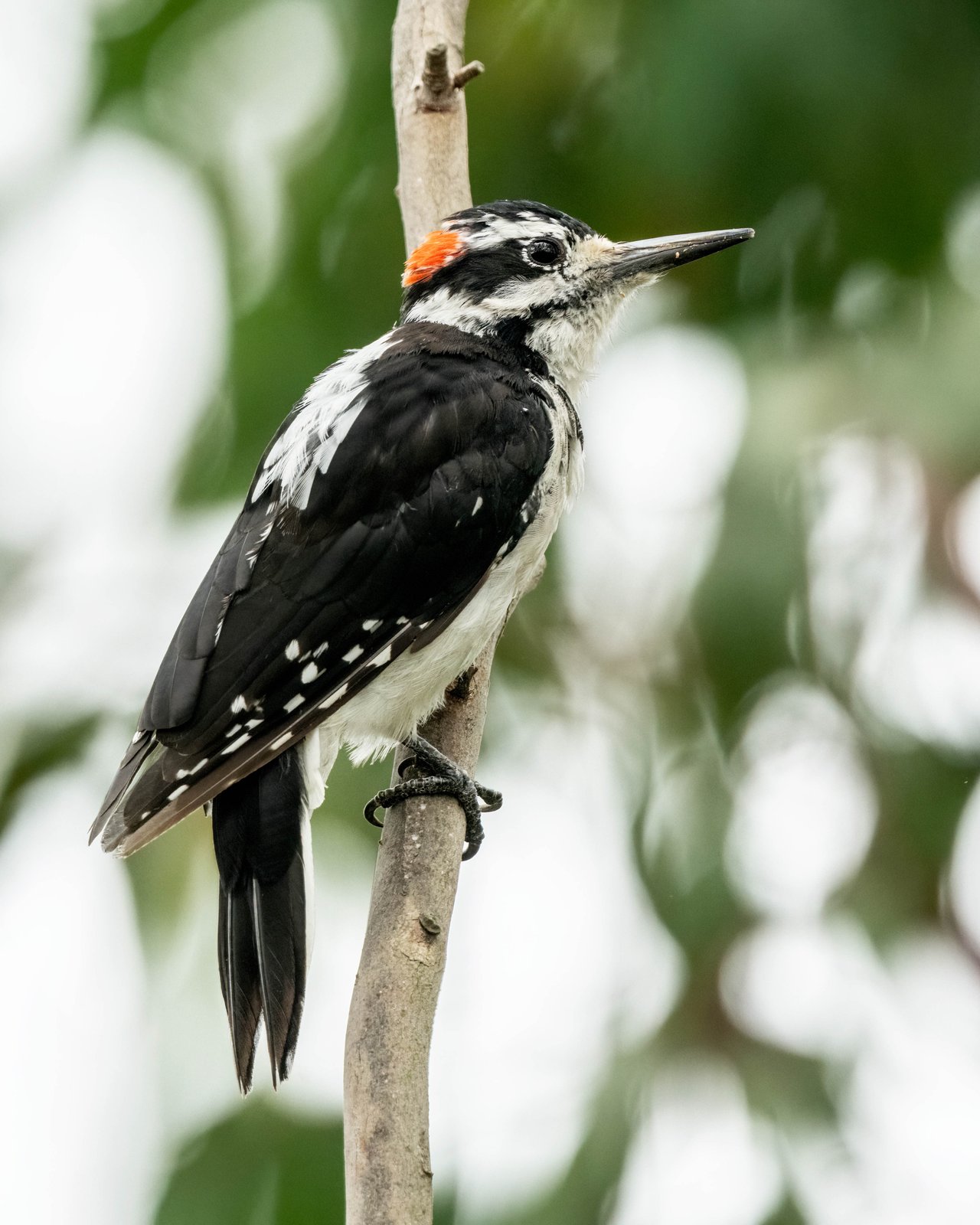
The Hairy Woodpecker is a North American woodpecker that in the Caribbean breeds only in the northern Bahamas, in the pine forests of Grand Bahama, Abaco, Andros and New Providence. The birds there belong to two subspecies of their own, among the smallest forms of the species. They are shy and usually seen in pairs.
Voice
A sharp, short peek and a rapid rattling series of such notes. It drums fast and hard on dead wood.
Recording: Valerie Heemstra — CC BY-NC-SA 4.0 · converted to mono · xeno-canto
Identification
20–23 cm, clearly smaller than North American birds. The upperparts are black, with a broad white stripe down the centre of the back and white spots on the wings. The head is striped black and white: a white line above and one below the eye, a black eye stripe and a black moustachial stripe. The underparts are white to off-white. The bill is strong and about as long as the head. The outer tail feathers are white; in Bahamian birds they carry black spots. The male has a red patch on the hindcrown, which the female lacks.
Confusion species
Yellow-bellied Sapsucker Sphyrapicus varius, which also winters in the Bahamas, has a barred back without a white central stripe, a long white wing stripe, a red forecrown and a yellowish belly. West Indian Woodpecker Melanerpes superciliaris, on Abaco, is much larger, with a finely barred black-and-white back, grey underparts and red on the head and belly.
Habitat
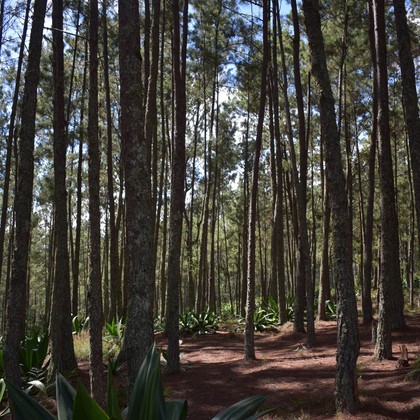
Mainly the open forests of Caribbean pine on the northern islands; it sometimes forages in other woodland such as dry broadleaf forest. It digs insect larvae out of trunks and branches. It breeds from March to July in a cavity in a dead tree, often a palm. The clutch is three or four white eggs; both adults incubate.
Where the bird is most at home, classified by the vegetation types of the Caribbean.

Range and movements
Resident in the Bahamas: Leuconotopicus villosus piger on Grand Bahama and Abaco, Leuconotopicus villosus maynardi on Andros and New Providence. It is absent from the other Bahamian islands and the rest of the Caribbean. Outside the region from Alaska and Canada through the United States and the mountains of Mexico and Central America to Panama.
- Resident
- dark = core range, pale = thinly spread
How and when to look
In the pine forests of Abaco, Grand Bahama and Andros. The birds are shy; the call and tapping on trunks lead to the pair. In winter the white back stripe is the quickest difference from Yellow-bellied Sapsucker.
Conservation status
Not threatened. A fairly common resident in the northern Bahamas, whose future there depends on the pine forests.
Scientific name
Leuconotopicus villosus | (Linnaeus, 1766)
Linnaeus described the species in 1766 as Picus villosus; because it was later moved to another genus, the author and year stand in brackets. The genus Leuconotopicus was introduced in 1845 by Malherbe. Leuconotopicus combines Greek leukos 'white' and nōtos 'back' with Latin picus 'woodpecker': 'white-backed woodpecker'. villosus is Latin for 'hairy, shaggy', after the long, hair-like white feathers down the middle of the back. The specimen the first description was based on came from Raccoon, New Jersey (USA).