All species › Woodpeckers and allies › Woodpeckers › Red-rumped Woodpecker
Red-rumped Woodpecker | Veniliornis kirkii
Roodstuitspecht | Carpintero lomirrojo
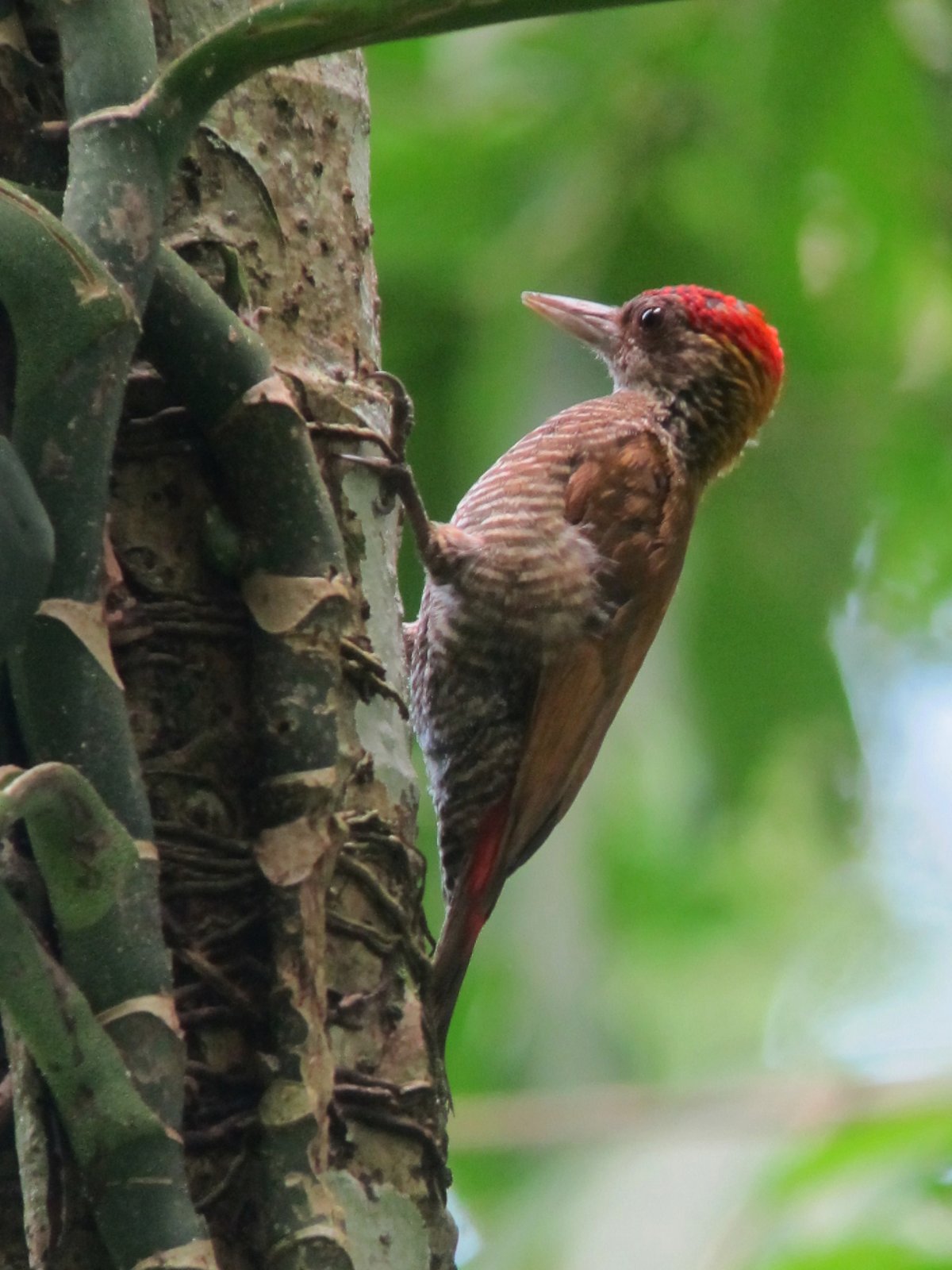
The Red-rumped Woodpecker is a small, olive-brown woodpecker of the Neotropical lowlands that in the Caribbean lives on Trinidad and Tobago. It is unobtrusive and often noticed only by its nasal call series or its drumming. The name refers to the red rump, seen mainly in flight.
Voice
A rather slow series of nasal, emphatic calls, kenh kenh kenh kenh; also a nasal keer and a repeated kee-yik kee-yik. The drum is rapid, loud and often prolonged.
Recording: Jerome Fischer — CC BY-NC-SA 4.0 · converted to mono · xeno-canto
Identification
15–16 cm. The upperparts are golden olive-brown with yellow and red feather tips, the rump crimson. The face is olive-brown with fine whitish streaks. The underparts are densely barred dark brown and whitish. The flight feathers are dark brown with olive-green edges. The male has a red crown and nape with dark feather tips; the female has a dark brown crown without red.
Confusion species
Golden-olive Woodpecker Colaptes rubiginosus is larger, with a grey crown bordered red, a pale cheek and yellow, barred underparts without a red rump. On Tobago, Red-crowned Woodpecker Melanerpes rubricapillus has a black-and-white barred back, a white rump and plain greyish-buff underparts.
Habitat
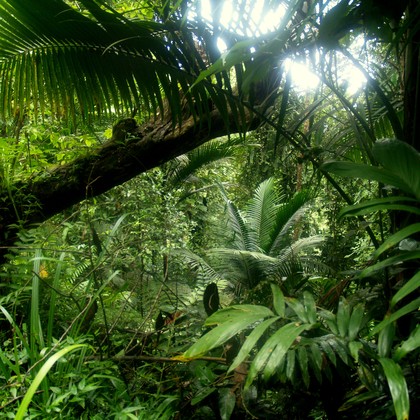
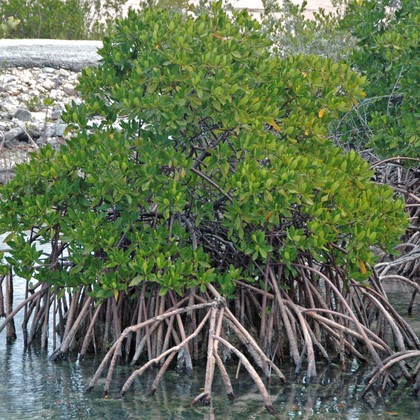
Moist forest, secondary forest, forest edges, mangrove edges, dry forest and scrub, and coconut plantations. It forages for insects on trunks and branches. It excavates the nest hole in a living tree or palm, 3–8 m up; the clutch is two or three eggs.
Where the bird is most at home, classified by the vegetation types of the Caribbean.



Range and movements
Resident on Trinidad and Tobago (nominate Veniliornis kirkii kirkii). It is absent from the rest of the Caribbean. Outside the region from Costa Rica and Panama through north-western South America to Ecuador and Peru, and via Venezuela to Guyana.
- Resident
- dark = core range, pale = thinly spread
How and when to look
In forest and along forest edges on both islands, for example in the Northern Range on Trinidad and the Main Ridge forest on Tobago. The nasal call series is the best lead; the red rump is usually seen only when the bird flies off.
Conservation status
Not threatened. The species has a large range and also occurs in secondary forest and plantations.
Scientific name
Veniliornis kirkii | (Malherbe, 1845)
Malherbe described the species in 1845 as Picus (Chloropicus) Kirkii; because it was later moved to another genus, the author and year stand in brackets. The genus Veniliornis was introduced in 1854 by Bonaparte. Veniliornis combines Venilia, a Roman nymph from the myth of the woodpecker-king Picus, with Greek ornis 'bird'. kirkii probably honours John Kirk, who collected birds on Tobago around 1845, where the type came from. The specimen the first description was based on came from Tobago.