All species › Birds of prey › Hawks, eagles and kites › Grey-lined Hawk
Grey-lined Hawk | Buteo nitidus
Grijsgestreepte buizerd | Aguililla gris
The Grey-lined Hawk is a medium-sized, compact buteo of forest edge and semi-open country in Central and South America. For a long time it was lumped with the northern Grey Hawk Buteo plagiatus; since the split the Trinidad population belongs to the southern species. Within the region it occurs only in Trinidad.
Voice
A plaintive, drawn-out whistle that drops in pitch, roughly hoo-reeeeuw, often given in soaring flight or from a lookout; also a series of high, clear kee-kee-kee calls near the nest.
Recording: JAYRSON ARAUJO DE OLIVEIRA — CC BY-NC-SA 4.0 · converted to mono · xeno-canto
Identification
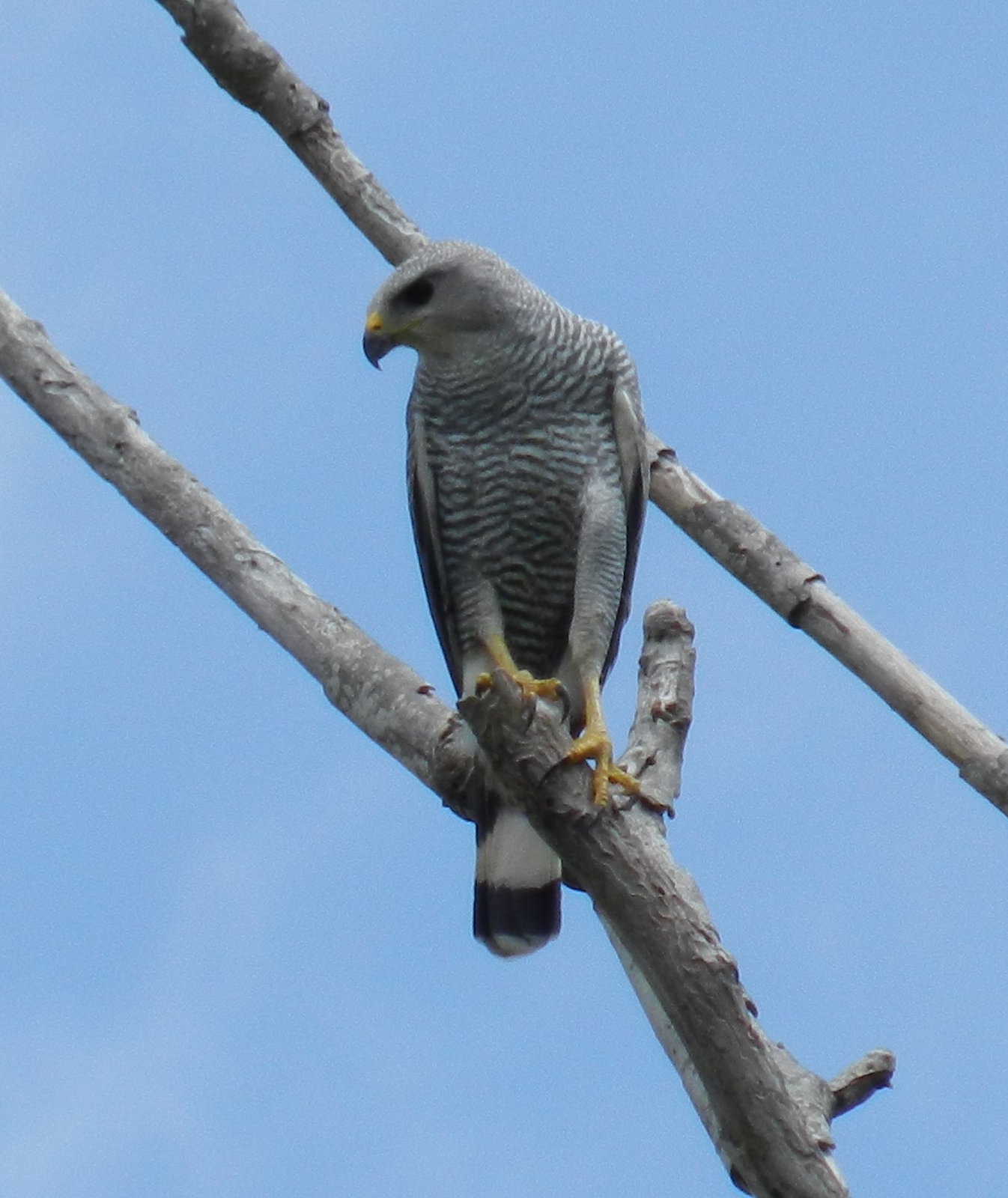
38–43 cm, with fairly short, broad wings and a medium-length tail. Adults are pale grey above, finely barred white on the mantle and scapulars; the underparts are white, densely and finely barred grey. The tail is black with two or three white bands, and the legs and cere are orange-yellow. In flight the underwings are pale and finely barred. The sexes are alike; females are larger. Juveniles are differently patterned: dark brown above, with a brown-streaked pale head, a dark malar stripe, white underparts with bold brown teardrop spots, and a brown tail with many narrow pale bars.
Confusion species
No other raptor in Trinidad is so evenly and finely barred grey. Light-morph Short-tailed Hawk Buteo brachyurus has unmarked white underparts and a dark head. Juveniles resemble young Broad-winged Hawks Buteo platypterus, which are rare in Trinidad; young Grey-lined Hawks show a bolder face pattern and a more clearly barred tail with a broader terminal band. Savanna Hawk Buteogallus meridionalis is rufous.
Habitat
Forest edge, open woodland, riverine forest, shaded cacao and coffee plantations and semi-open farmland with scattered tall trees, mainly in the lowlands and lower mountain slopes. It hunts from a perch in the canopy or at a forest edge, taking lizards, snakes, small mammals, birds and large insects. The nest is placed high in a tree.
Where the bird is most at home, classified by the vegetation types of the Caribbean.




Range and movements
In Trinidad a fairly common resident across the island, with most records from the Northern Range and the wooded parts of the centre and south. Not known as a resident in Tobago. Outside the region from Costa Rica through northern South America to Bolivia, Paraguay and northern Argentina.
- Resident
- dark = core range, pale = thinly spread
How and when to look
Best in the morning along forest edges and clearings in the Arima Valley and the Northern Range, where the bird sits on a bare branch in the canopy or soars low over the trees. The plaintive call often gives it away before it is seen.
Conservation status
Not threatened. The species has a large range and tolerates degraded and partly cleared forest well.
Scientific name
Buteo nitidus | (Latham, 1790)
Latham described the species in 1790 as Falco nitidus; because it was later moved to another genus, the author and year stand in brackets. The genus Buteo was introduced in 1799 by De Lacépède. Buteo is the Latin word for a buzzard. nitidus is Latin for 'shining, elegant', after the handsome, finely barred grey plumage. The specimen the first description was based on came from Cayenne, French Guiana.