All species › Birds of prey › Hawks, eagles and kites › White-tailed Hawk
White-tailed Hawk | Geranoaetus albicaudatus
Witstaartbuizerd | Gavilán coliblanco
The White-tailed Hawk is a large, long-winged buteonine of open, dry country in the southern United States, Central and South America. In the Caribbean it is the characteristic large raptor of the cactus plains of the ABC Islands, where it is known as partawela or falki. It is now placed in Geranoaetus, alongside the buzzard-eagles of South America, rather than in Buteo.
Voice
Fairly vocal near the nest: a high, cackling series ke-ke-ke-ke or kla-kla-kla, with a tinkling quality reminiscent of a bleating goat or a laughing gull.
Recording: JAYRSON ARAUJO DE OLIVEIRA — CC BY-NC-SA 4.0 · shortened to the first 60 s, mono · xeno-canto
Identification
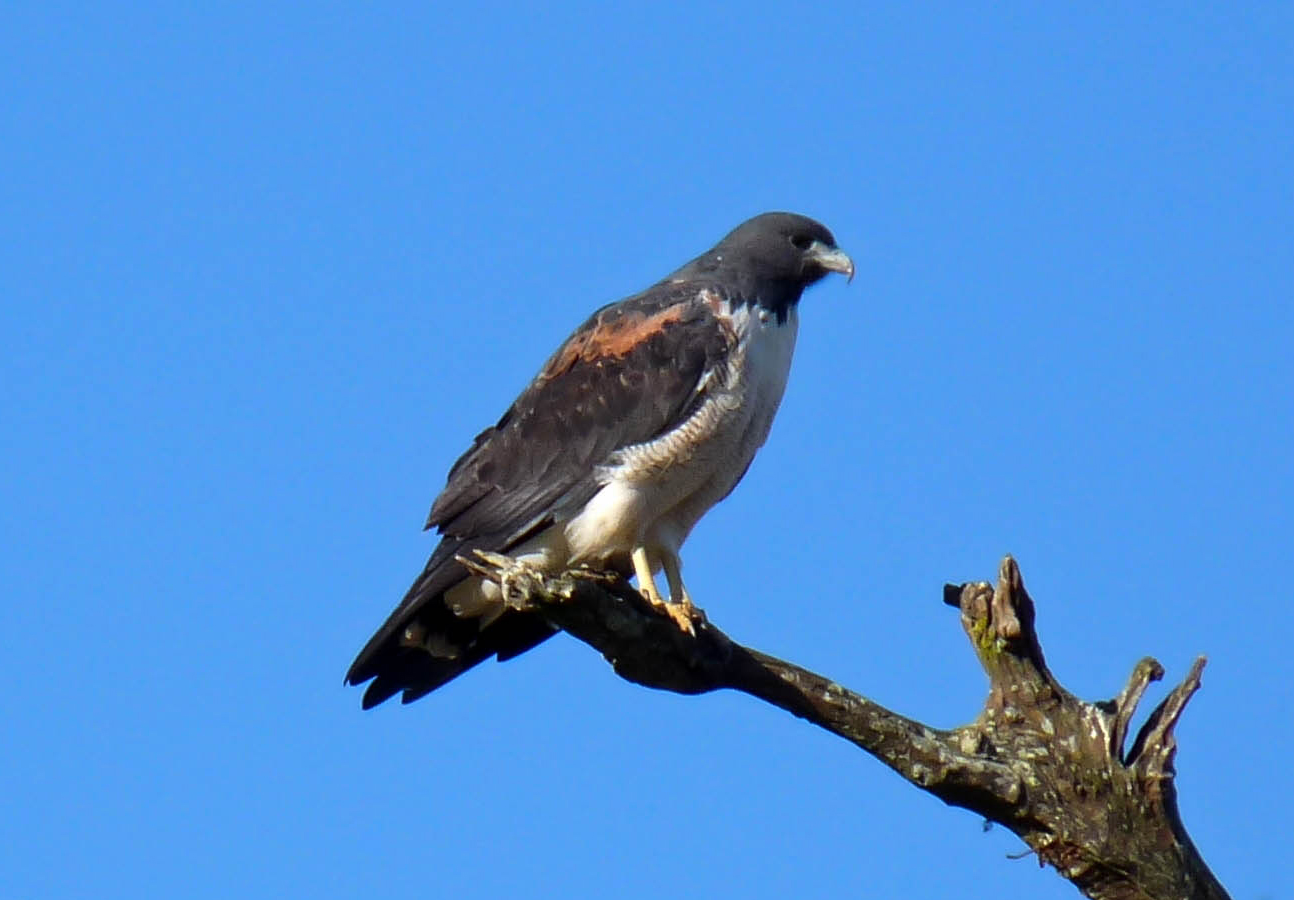
44–60 cm, with long, broad wings that reach beyond the short tail when perched. Adults are dark slate grey above, with a rufous shoulder patch most visible on perched birds. Underparts and underwing coverts are white; the flight feathers are grey with dark tips. The tail is white with fine grey barring and a broad black subterminal band. A dark morph, grey to blackish with a white tail, occurs in South America. Juveniles are blackish-brown with a white breast patch, white-spotted underwing coverts and a greyish, finely barred tail without a clear band; adult plumage is reached only after several years. In flight the wings taper towards the tips and are held in a shallow V.
Confusion species
Savanna Hawk Buteogallus meridionalis is rufous with long legs and a black tail crossed by a white band. Osprey Pandion haliaetus has a white head with a black eye-stripe and angled wings. Young White-tailed Hawks can recall Zone-tailed Hawk Buteo albonotatus or dark-morph Short-tailed Hawk Buteo brachyurus, but neither occurs in the ABC Islands; the wing shape, with a long inner wing and narrow hand, is distinctive.
Habitat
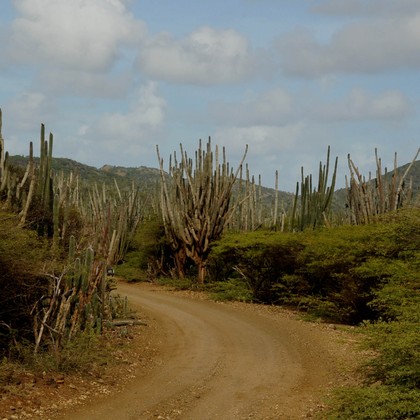
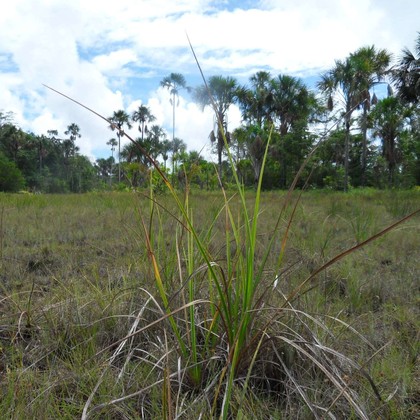
Open and semi-open dry country: cactus and thorn scrub, bare hills, dry savanna, pasture and the edges of dry forest, from sea level to the island summits. It hunts from soaring flight or by hanging into the wind, taking lizards, rodents, birds and large insects, and gathers at grass fires to catch fleeing prey. The nest is a pile of sticks on top of a tree or tall cactus.
Where the bird is most at home, classified by the vegetation types of the Caribbean.


Range and movements
Resident in Aruba, Curaçao and Bonaire, where the subspecies colonus breeds in small numbers. In Trinidad a rare, non-breeding visitor from the South American mainland. Outside the region from Texas through Mexico and Central America to Argentina, in open country throughout.
- Resident
- dark = core range, pale = thinly spread
How and when to look
In Curaçao and Aruba best in the hill country and national parks, where birds rise on thermals in the morning or hang motionless over a slope in the trade wind. A perched bird stands out by its white underparts and rufous shoulder patch.
Conservation status
Not threatened. The range is large and the species locally benefits from forest clearance. In the ABC Islands the population is small, so disturbance of nest sites, persecution and electrocution on power poles weigh more heavily there.
Scientific name
Geranoaetus albicaudatus | (Vieillot, 1816) (GBIF: Buteo albicaudatus)
Vieillot described the species in 1816 as Buteo albicaudatus; because it was later moved to another genus, the author and year stand in brackets. The genus Geranoaetus was introduced in 1844 by Kaup. Geranoaetus is Greek, from geranos 'crane' (here: grey) and aetos 'eagle': 'grey eagle'. albicaudatus is Latin, from albus 'white' and caudatus 'tailed': 'white-tailed', after the white tail with a black terminal band. The specimen the first description was based on came from South America; later fixed as Rio de Janeiro, Brazil.