All species › Passerines › New World blackbirds › Greater Antillean Grackle
Greater Antillean Grackle | Quiscalus niger
Antilliaanse troepiaal | Zanate antillano
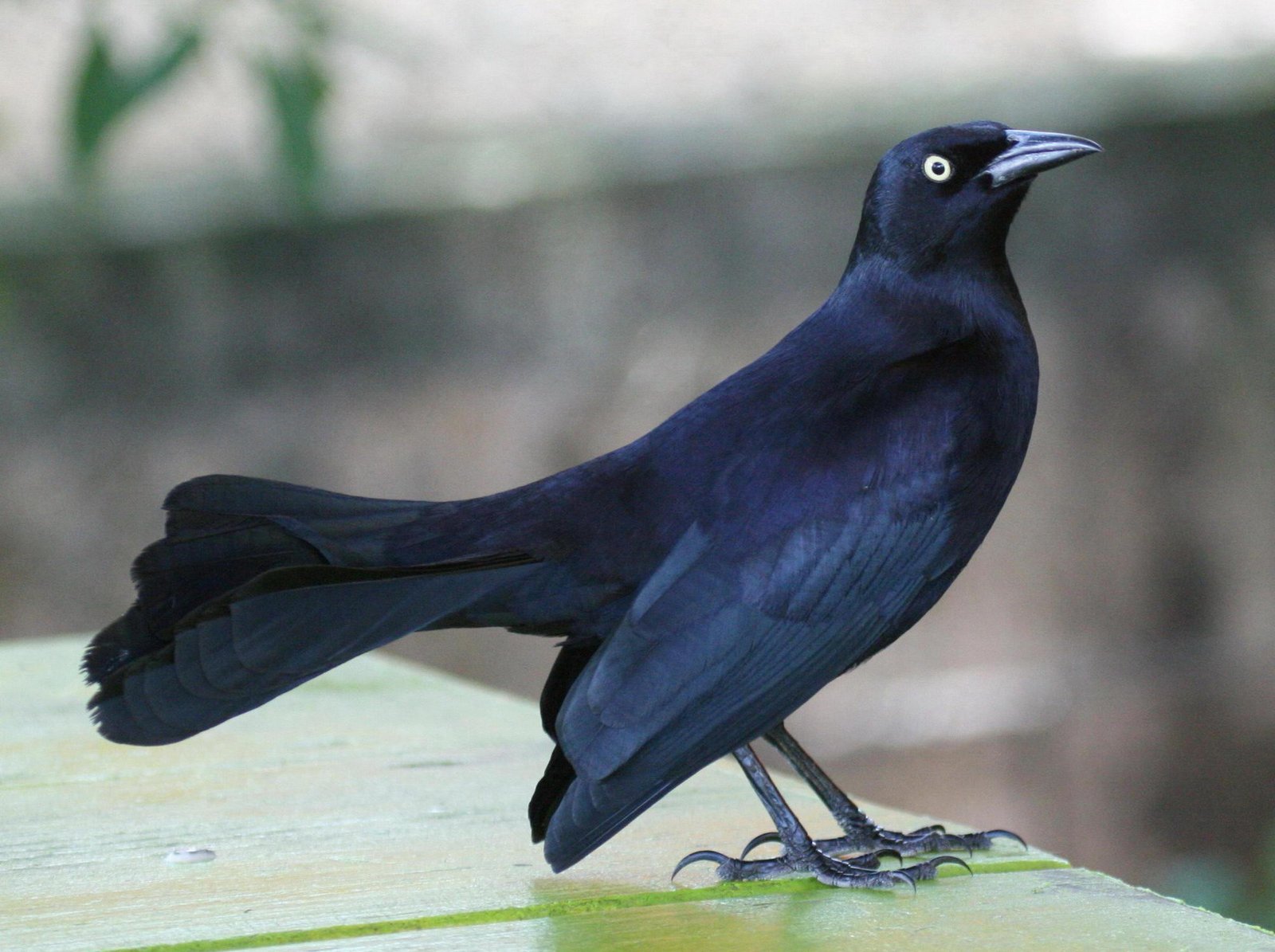
The Greater Antillean Grackle is the common black bird of towns, villages and open country in the Greater Antilles. It has its own name on each island: chinchilín in Cuba and the Dominican Republic, chango in Puerto Rico and kling-kling in Jamaica. Seven subspecies are recognised, spread across Cuba, the Cayman Islands, Jamaica, Hispaniola and Puerto Rico.
Voice
A metallic, ringing cling-cling-cling and whistled notes in the song, plus calls such as chuk, chuk-chuk and chin-chin-chilin, high wee-see-see notes and harsh sounds. Groups at roosts are very noisy.
Recording: FREDERIC Lionel — CC BY-NC-SA 4.0 · converted to mono · xeno-canto
Identification
25–30 cm, slim, with a long, pointed, slightly curved bill and a long tail that forms a keel or V in flight and, in the male, also at rest. The male is glossy black with a blue-purple to steel-blue sheen. The female is smaller and duller, with a shorter, less keeled tail. Both sexes have a bright yellow iris. Juveniles are dull black to brownish black with a dark iris. The Jamaican subspecies has a heavier bill.
Confusion species
Cuban Blackbird Ptiloxena atroviolacea is sturdier, with a dark iris and a flat tail. Shiny Cowbird Molothrus bonariensis is smaller, with a short, conical bill, a dark eye and a flat tail. Jamaican Blackbird Nesopsar nigerrimus has a dark eye and lives in montane forest. Great-tailed Grackle Quiscalus mexicanus, now established in Jamaica, Hispaniola and Puerto Rico, is much larger, with a far longer tail; females are brown.
Habitat
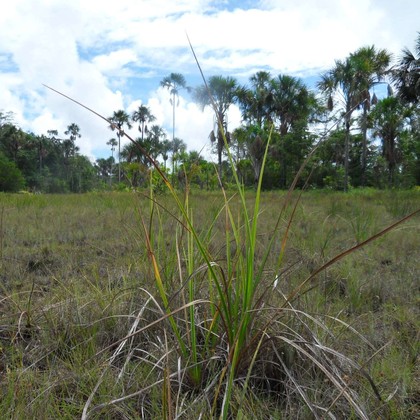
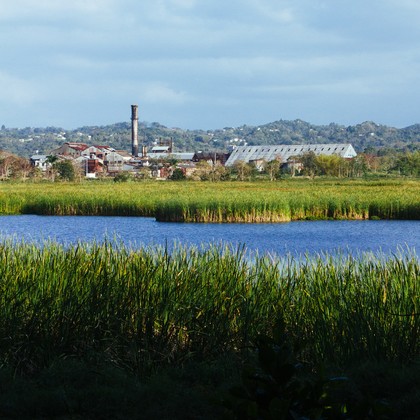
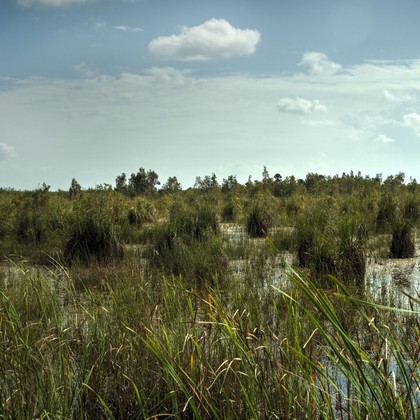
Open landscapes with trees: savanna, pasture, farmland, light woodland, scrub, marshes, mangroves, parks and gardens, and above all towns and villages. It forages on the ground and in trees for insects, seeds, fruit, small lizards and scraps. It nests in colonies, with open cup nests of plant fibre and mud in mangroves or palms, usually 5–16 m up. In towns it roosts in groups of sometimes thousands of birds.
Where the bird is most at home, classified by the vegetation types of the Caribbean.



Range and movements
Resident in Cuba, the Isla de la Juventud and the cays, Grand Cayman and Little Cayman, Jamaica, Hispaniola (Haiti and the Dominican Republic) and Puerto Rico with Vieques. Only single records from the US and British Virgin Islands and farther east. Absent from the Bahamas. It does not occur outside the Caribbean.
- Resident
- dark = core range, pale = thinly spread
How and when to look
In almost every town square, hotel and village in the Greater Antilles. The yellow iris and keel-shaped tail are the best features. In the evening the birds gather at roosts in town parks.
Conservation status
Not threatened. Numerous and well adapted to people. On some islands it is regarded as a pest in rice and maize fields. The arrival of Great-tailed Grackle may lead to competition in the long run.
Scientific name
Quiscalus niger | (Boddaert, 1783)
Boddaert described the species in 1783 as Oriolus niger; because it was later moved to another genus, the author and year stand in brackets. The genus Quiscalus was introduced in 1816 by Vieillot. Quiscalus goes back to Linnaeus's species name Gracula quiscula; where he got the word is uncertain, possibly from Taíno quisqueya, a name for Hispaniola. niger is Latin for 'black', after the glossy black plumage. The specimen the first description was based on came from Port-au-Prince, Haiti.