All species › Cuckoos › Cuckoos › Great Lizard Cuckoo
Great Lizard Cuckoo | Coccyzus merlini
Grote hagedissenkoekoek | Cuco lagartero mayor
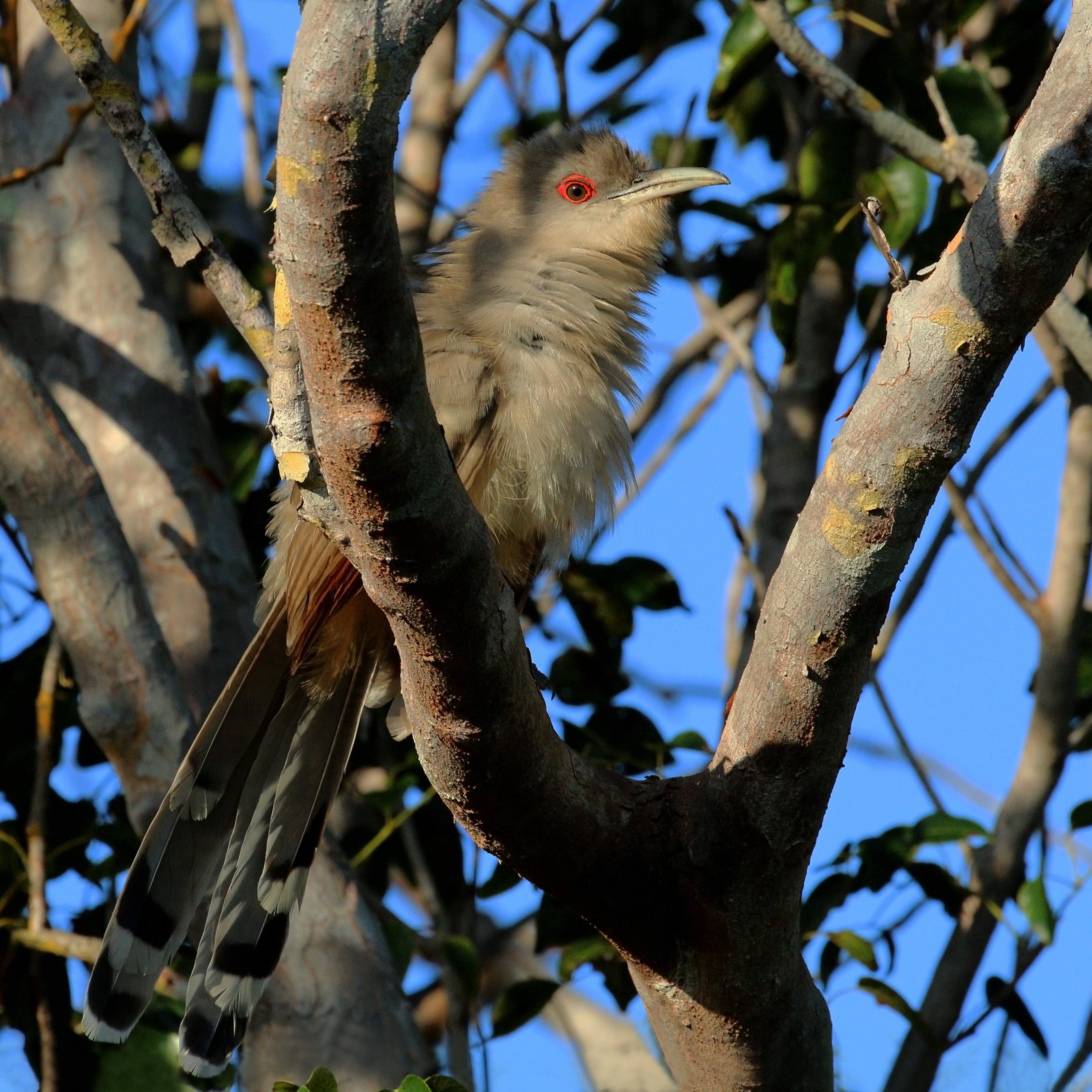
The Great Lizard Cuckoo, called arriero in Cuba, is the largest of the four Antillean lizard cuckoos. It lives in Cuba, on the Isla de la Juventud and some of the Cuban cays, and on a few islands of the Bahamas. In Cuba it can be found in almost every forest; it glides from tree to tree and has a long tail, about half its total length.
Voice
A throaty ka-ka-ka-ka-ka-ka-kau-kau-ko-ko, the second part gradually increasing in volume. Also various shorter, hoarse calls.
Recording: Lionel FREDERIC — CC BY-NC-SA 4.0 · converted to mono · xeno-canto
Identification
42–54 cm, about half of it tail. The bill is long and almost straight, with a black or dusky upper mandible and a paler lower mandible; red to orange bare skin surrounds the eye. Crown, nape and upperparts are olive-brown. The primaries are rufous, but that colour often shows only in flight. The throat is whitish, the cheeks and breast pale grey, the belly rufous. The central pair of tail feathers is grey, the rest grey with broad white tips. Birds from the Bahamas are smaller and greyer above, with a buff wash on the belly. Juveniles have narrower tail feathers with faint white tips and yellow skin around the eye.
Confusion species
No other lizard cuckoo occurs in Cuba or the Bahamas. Mangrove Cuckoo Coccyzus minor and Yellow-billed Cuckoo Coccyzus americanus are much smaller and have a shorter, clearly decurved bill with a yellow lower mandible; the former has a black mask and buff underparts, the latter is white below.
Habitat
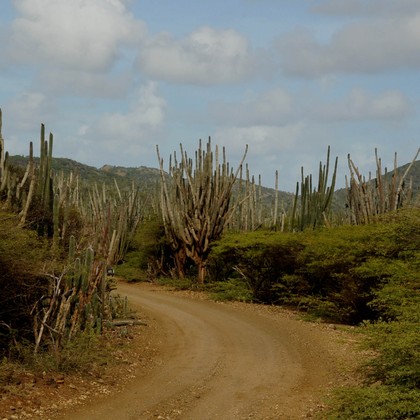
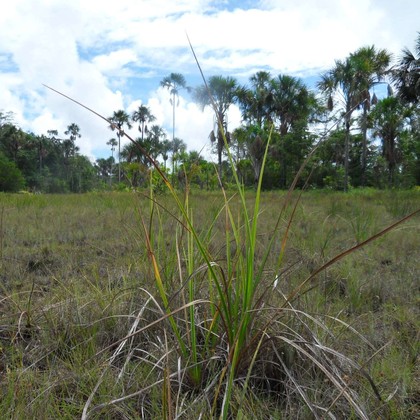
Mature semi-deciduous and evergreen forest, secondary forest, savanna with trees and scrub, from sea level to at least 1,250 m. It forages mainly from the mid-storey to the canopy, running along branches and gliding from tree to tree. It eats lizards, adult and larval insects of many families, nestlings, frogs, snakes and sometimes small mammals, seeds or fruit. The clutch is two or three eggs; in Cuba breeding runs from April to October, in the Bahamas it includes at least April and May.
Where the bird is most at home, classified by the vegetation types of the Caribbean.


Range and movements
In Cuba three subspecies: Coccyzus merlini merlini on the main island and Cayo Conuco and Cayo Saetía off the north coast, Coccyzus merlini santamariae on a chain of smaller cays off the north coast of central Cuba, and Coccyzus merlini decolor on the Isla de la Juventud. In the Bahamas lives Coccyzus merlini bahamensis, on Andros, New Providence, Eleuthera and Harbour Island. The species does not occur outside this area.
- Resident
- Winter visitor (c. Apr–Sep)
- Passage (Mar–Apr, Oct–Nov)
- dark = core range, pale = thinly spread
How and when to look
In Cuba in almost any forest, including the Zapata Peninsula and the Sierra del Rosario. In the Bahamas, Andros is the best place. The bird often sits still for a long time deep inside a tree; it is usually noticed when it glides from one treetop to the next with its long tail trailing behind.
Conservation status
Not threatened. In Cuba the species is common. The small population in the Bahamas is estimated at 2,500 to 10,000 mature birds and is regarded as more vulnerable than the Cuban one; it is confined to four islands.
Scientific name
Coccyzus merlini | (d'Orbigny, ACVMD, 1839) (GBIF: Saurothera merlini)
D'Orbigny, ACVMD described the species in 1839 as Saurothera merlini; because it was later moved to another genus, the author and year stand in brackets. The genus Coccyzus was introduced in 1816 by Vieillot. Coccyzus is Greek, from kokkuzō 'to cry cuckoo', after the cuckoo's call. merlini honours the Havana-born writer and musician María de las Mercedes Santa Cruz y Montalvo, Countess of Merlin (1788–1852). The specimen the first description was based on came from Cuba.