All species › Cuckoos › Cuckoos › Hispaniolan Lizard Cuckoo
Hispaniolan Lizard Cuckoo | Coccyzus longirostris
Hispaniolahagedissenkoekoek | Cuco lagartero de La Española
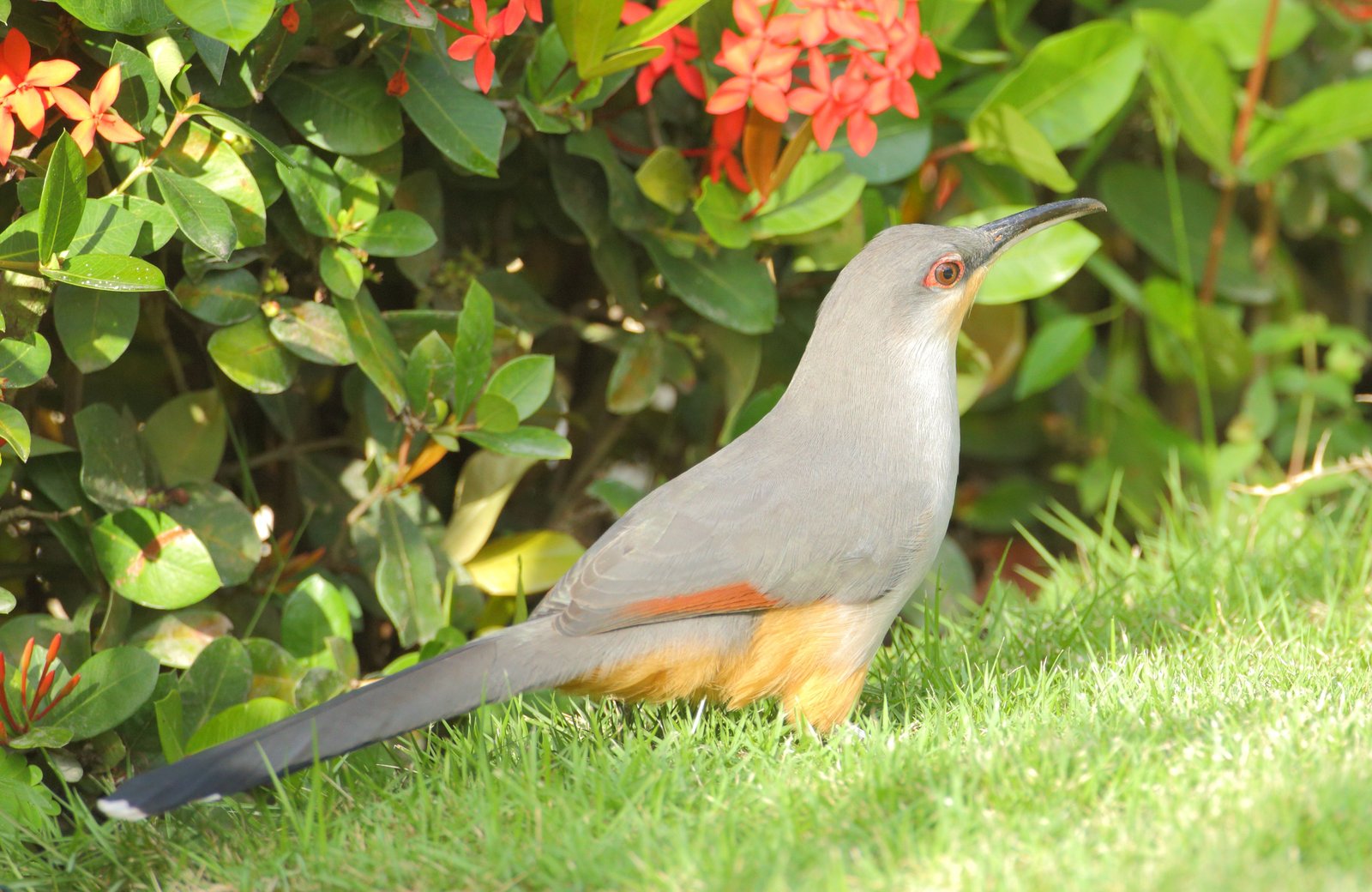
The Hispaniolan Lizard Cuckoo is a long-tailed cuckoo with a long, straight bill found only on Hispaniola and a few offshore islands. It is the commonest large cuckoo on the island and occurs from dry lowland forest up into the mountains, as well as in plantations and gardens. As in all lizard cuckoos, lizards make up a large part of its food.
Voice
The main call is a rattling, grating series that descends in pitch. Also a harsh tchk, a click and a tick cwuh-h-h.
Recording: Ross Gallardy — CC BY-NC-SA 4.0 · converted to mono · xeno-canto
Identification
41–46 cm, about half of it tail. The bill is long and straight, with a black upper mandible and a paler lower mandible; bare red skin surrounds the eye. The upperparts are entirely grey. The wings are chestnut with a rufous patch. The throat is rufous, the breast pale grey and the belly rufous again. The tail is black, with white tips to the undersides of the feathers. The sexes are alike. Juveniles are browner grey above, have a whitish throat and a narrower brown tail with buff tips. Birds from Gonâve are paler and also have a whitish throat.
Confusion species
Bay-breasted Cuckoo Coccyzus rufigularis is heavier, with a shorter, decurved bill with a yellow lower mandible and a dark chestnut throat and breast without a grey breast band. Mangrove Cuckoo Coccyzus minor is much smaller, with a black mask, a curved bill with a yellow lower mandible and buff underparts. Yellow-billed Cuckoo Coccyzus americanus is also much smaller and white below.
Habitat
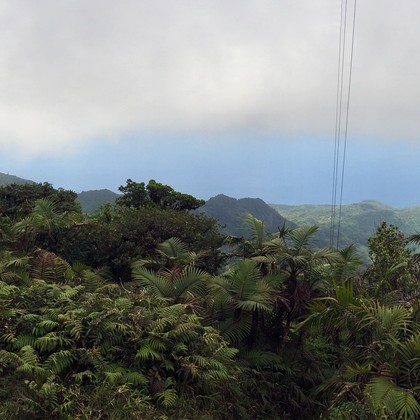
Tropical deciduous and evergreen forest, more open woodland, thickets, mountain slopes with bushes, plantations and gardens, from sea level to about 2,200 m. It eats lizards, small snakes and many kinds of adult and larval insects, which it seeks by clambering through branches and vines. The core breeding season is March to June. The nest is a flat platform of twigs; the clutch is two or three eggs.
Where the bird is most at home, classified by the vegetation types of the Caribbean.




Range and movements
Only on Hispaniola, in both Haiti and the Dominican Republic. The nominate form Coccyzus longirostris longirostris lives on the main island and on Tortuga (Île de la Tortue) and Saona; Coccyzus longirostris petersi is found only on Gonâve Island off the west coast of Haiti. The species does not occur outside Hispaniola and these islands.
- Resident
- dark = core range, pale = thinly spread
How and when to look
In almost any forest in the Dominican Republic, from the dry lowlands of the south-west to the Sierra de Bahoruco and the Cordillera Central; also in plantations and wooded gardens. The rattling call is the quickest lead. Around Puerto Escondido it lives alongside the much scarcer Bay-breasted Cuckoo; the rufous throat with the pale grey breast below it and the straight bill make the difference.
Conservation status
Not threatened. The species is widespread and also occurs in secondary and human-modified landscapes. The population size is not known and numbers appear to be decreasing.
Scientific name
Coccyzus longirostris | (Hermann, 1783) (GBIF: Saurothera longirostris)
Hermann described the species in 1783 as Cuculus longirostris; because it was later moved to another genus, the author and year stand in brackets. The genus Coccyzus was introduced in 1816 by Vieillot. Coccyzus is Greek, from kokkuzō 'to cry cuckoo', after the cuckoo's call. longirostris is Latin, from longus 'long' and rostrum 'bill', after the long bill. The specimen the first description was based on came from Hispaniola.