All species › Cuckoos › Cuckoos › Puerto Rican Lizard Cuckoo
Puerto Rican Lizard Cuckoo | Coccyzus vieilloti
Puerto Ricaanse hagedissenkoekoek | Cuco lagartero puertorriqueño
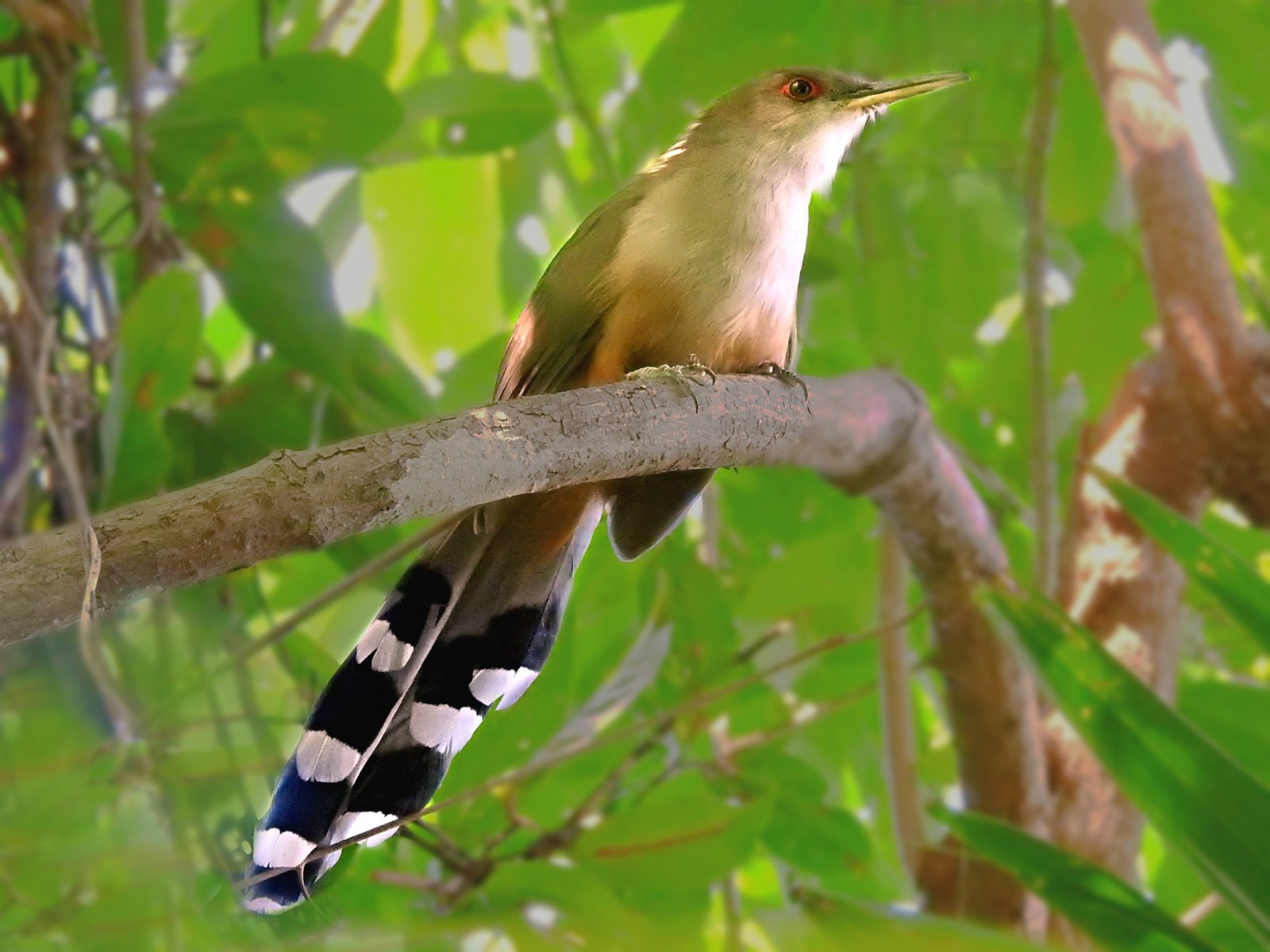
The Puerto Rican Lizard Cuckoo is a large, long-tailed cuckoo found only in Puerto Rico. On the island it is called pájaro bobo mayor, to distinguish it from the smaller Mangrove Cuckoo, the pájaro bobo menor; it also goes by names such as pájaro de lluvia, after the folk belief that its call forecasts rain. Its food consists largely of lizards, especially anoles.
Voice
A harsh, emphatic series of ka-ka-ka-ka notes, gradually becoming faster and louder. The bird is heard more often than seen, and its call is a familiar sound in the island's forests.
Recording: Ross Gallardy — CC BY-NC-SA 4.0 · converted to mono · xeno-canto
Identification
40–48 cm, about half of it tail. The bill is long and slightly decurved, with a black upper mandible and a yellow lower mandible with a black tip; bare red skin surrounds the eye. The upperparts are plain grey-brown, the throat and breast grey, the belly and undertail coverts tawny. The tail is grey-brown above; below it is grey-brown darkening to black towards the large white tips. The sexes are alike. Juveniles have a cinnamon wash on the breast, less black under the tail and an orange-red eye-ring.
Confusion species
Mangrove Cuckoo Coccyzus minor is much smaller, with a black mask through the eye, buff throat and breast and no red skin around the eye. Yellow-billed Cuckoo Coccyzus americanus is also much smaller, white below and has a rufous patch in the primaries. No other lizard cuckoo occurs in Puerto Rico.
Habitat
Semi-open woodland, dense montane forest, dry coastal forest and swamp forest, as well as shade-coffee plantations and the wooded limestone hills of the north of the island; commonest between sea level and 900 m. It sits motionless for long periods and hunts by stealth, clambering along branches or walking on the ground, in the middle and upper layers of the forest but also in the understorey. It eats mainly anoles, also adult and larval insects, eggs and sometimes frogs. The nest is a loose stick platform in a tree or large bush; the clutch is two or three eggs.
Where the bird is most at home, classified by the vegetation types of the Caribbean.





Range and movements
Only in Puerto Rico, throughout the main island, from the dry south to the moist uplands of the east and the limestone country of the north. The species does not occur outside Puerto Rico; the related lizard cuckoos live on Hispaniola, Jamaica, Cuba and the Bahamas.
- Resident
- dark = core range, pale = thinly spread
How and when to look
Good places are the dry forest of Guánica, the Guajataca and Vega forests in the limestone region, and the area around the El Portal visitor centre in El Yunque. The call quickly reveals its presence, but the bird itself can stay hidden for a long time; a motionless bird is often noticed only when it flicks its long tail or glides across an opening.
Conservation status
Not threatened. The species is widespread in Puerto Rico and its numbers are considered stable. Because it also lives in secondary forest and shade coffee, it benefits from the recovery of forest that has taken place on the island since the middle of the twentieth century.
Scientific name
Coccyzus vieilloti | (Bonaparte, 1850) (GBIF: Saurothera vieilloti)
Bonaparte described the species in 1850 as Saurothera vieilloti; because it was later moved to another genus, the author and year stand in brackets. The genus Coccyzus was introduced in 1816 by Vieillot. Coccyzus is Greek, from kokkuzō 'to cry cuckoo', after the cuckoo's call. vieilloti honours the French ornithologist Louis Pierre Vieillot (1748–1830). The specimen the first description was based on came from Antilles (not specified).