All species › Passerines › Tyrant flycatchers › Great Kiskadee
Great Kiskadee | Pitangus sulphuratus
Grote kiskadie | Bienteveo común
The Great Kiskadee is among the most frequently heard and seen birds on Trinidad, in gardens, along roads and near water. Its name imitates the call, as does the Spanish bienteveo. It is a versatile flycatcher that catches insects in flight but also plunges like a kingfisher for small fish and tadpoles and takes lizards, fruit and scraps.
Voice
A loud, three-syllable kis-ka-dee or bien-te-veo, heard throughout the day. Also a harsh kreee and, between pairs, a noisy duet of repeated calls with raised crest and fluttering wings.
Recording: JAYRSON ARAUJO DE OLIVEIRA — CC BY-NC-SA 4.0 · converted to mono · xeno-canto
Identification
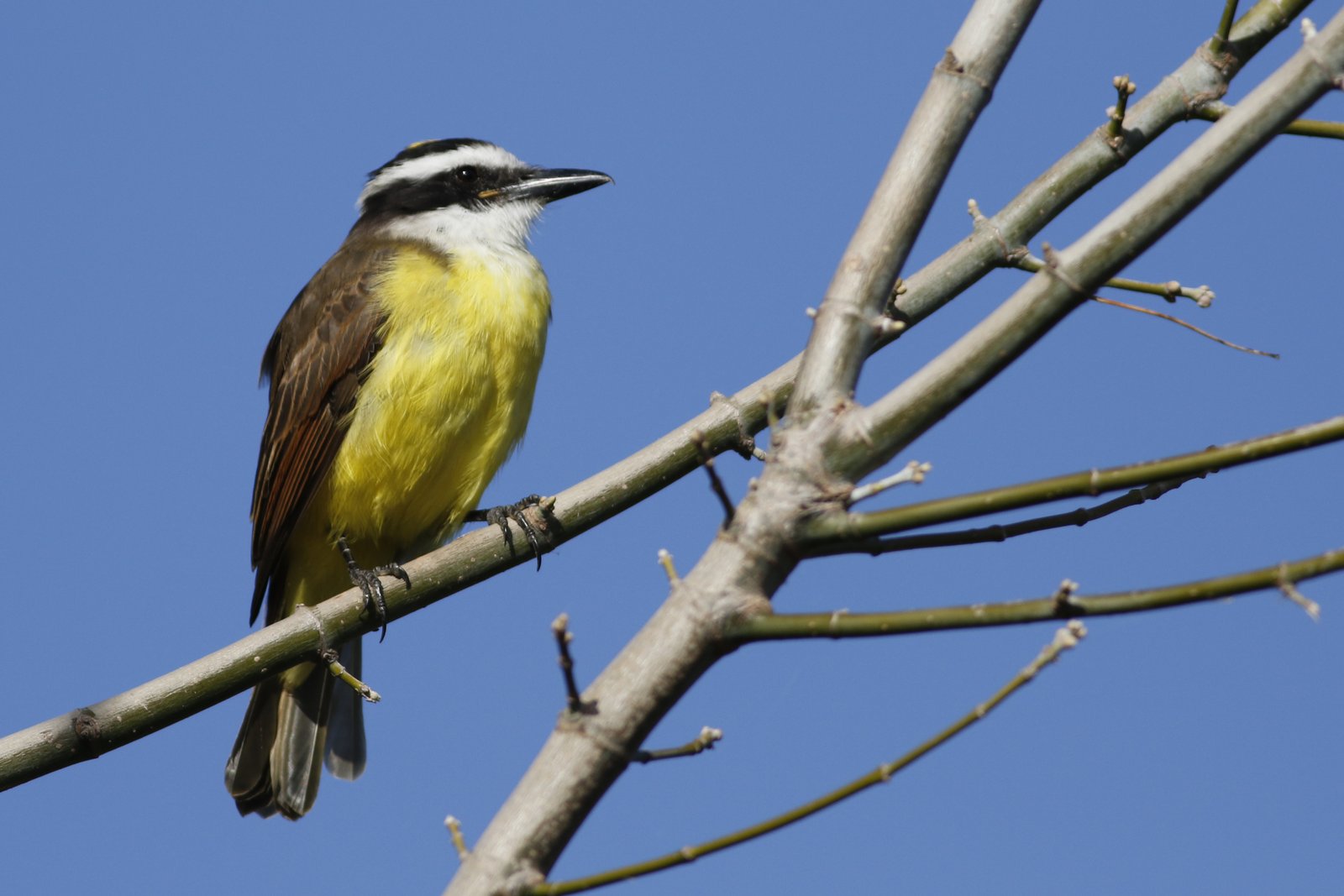
22–25 cm, robust, with a large head and a heavy, straight black bill. The head is black with a broad white supercilium that meets on the nape, and a concealed yellow crown patch. The throat is white, the rest of the underparts bright yellow. The back is brown, and the wings and tail have prominent rufous edges that also show in flight. The sexes are alike; juveniles lack the crown patch and have even more rufous in wing and tail.
Confusion species
Boat-billed Flycatcher Megarynchus pitangua is very similar but has an even broader, arched bill, an olive-brown back and wings without rufous edges, and different calls. Tropical Kingbird Tyrannus melancholicus has a grey head without a white supercilium and a notched tail. Smaller flycatchers with a similar head pattern are clearly smaller and short-billed.
Habitat
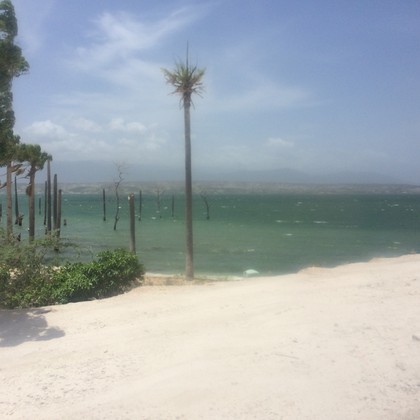
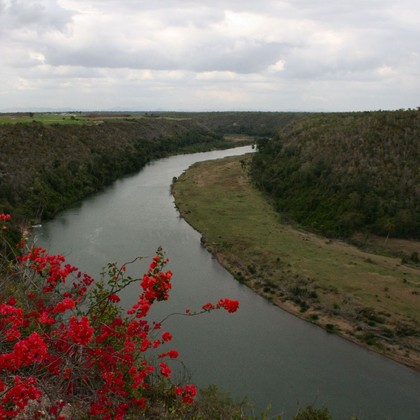
Almost any semi-open country with trees: gardens, parks, yards, plantations, pasture with trees, forest edge and the banks of rivers, ponds and mangroves. It hunts from a perch, often over water. The nest is a large, untidy ball of grass and other material with a side entrance, high in a tree, palm or on a pole.
Where the bird is most at home, classified by the vegetation types of the Caribbean.





Range and movements
A common resident on Trinidad. Also present on Tobago; according to one source it was introduced there by people around 1970. A few isolated records from Barbados and Curaçao. Outside the region from southern Texas through Mexico and Central America to Argentina; introduced to Bermuda.
- Resident
- dark = core range, pale = thinly spread
How and when to look
On Trinidad the call can be heard in almost every garden, including in Port of Spain; at ponds and ditches the bird can be watched diving into the water like a kingfisher. Any kiskadee-like bird without rufous in the wings deserves a second look for Boat-billed Flycatcher.
Conservation status
Not threatened. The species has a very large range and adapts well to built-up and agricultural land.
Scientific name
Pitangus sulphuratus | (Linnaeus, 1766)
Linnaeus described the species in 1766 as [Lanius] sulphuratus; because it was later moved to another genus, the author and year stand in brackets. The genus Pitangus was introduced in 1827 by Swainson. Pitangus derives from Pitanguá guaçú, the Tupí name for a large flycatcher, perhaps the Great Kiskadee. sulphuratus is Latin for 'sulphur-coloured', from sulphur 'sulphur', after the bright yellow underparts. The specimen the first description was based on came from Cayenne, French Guiana.