All species › Passerines › Tyrant flycatchers › Streaked Flycatcher
Streaked Flycatcher | Myiodynastes maculatus
Gestreepte tiran | Papamoscas rayado
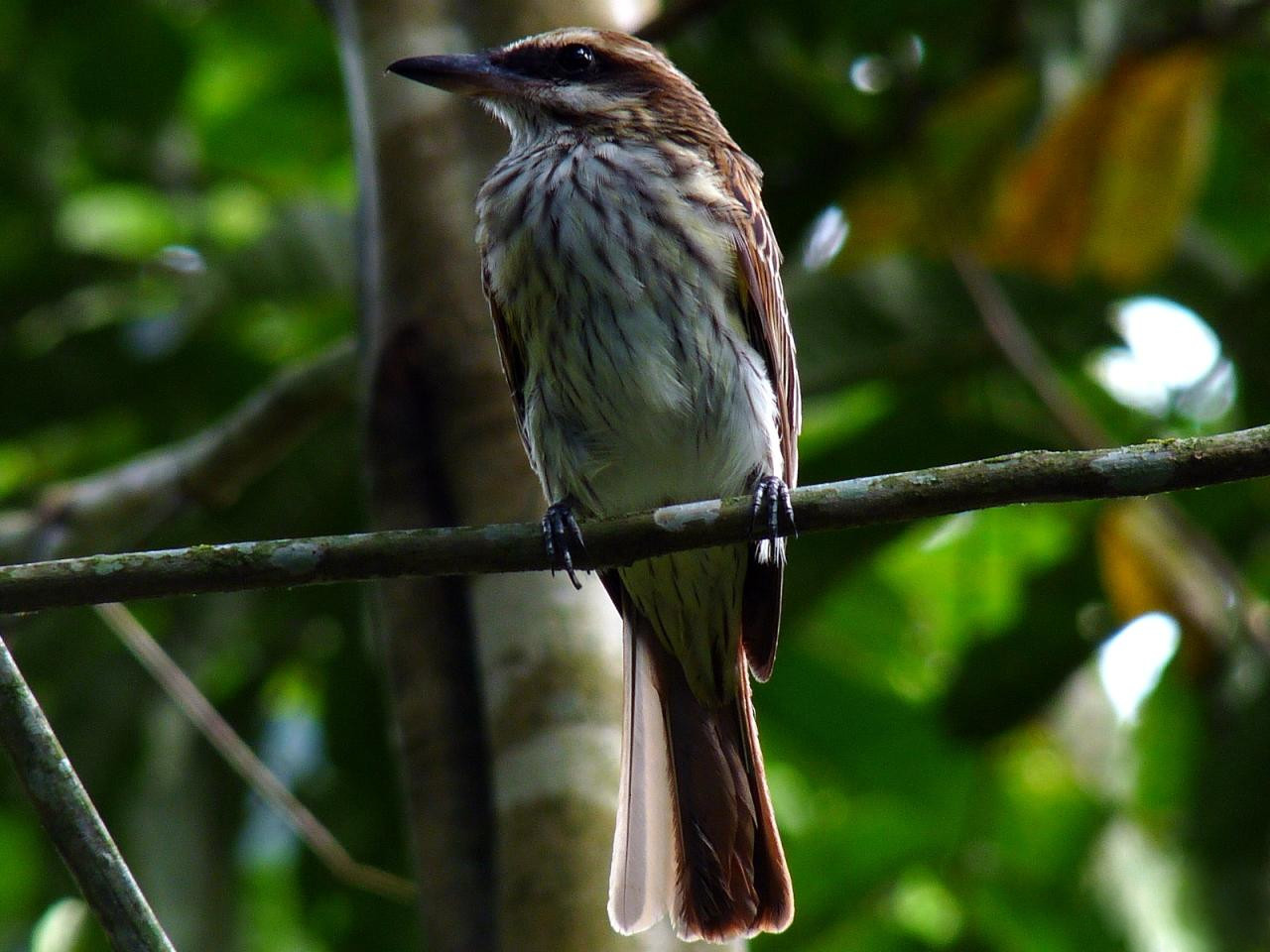
The Streaked Flycatcher is a large, heavily streaked flycatcher of forest edge and canopy. On Trinidad and Tobago the subspecies tobagensis is resident. Despite its streaked pattern it often sits high in the foliage and is mostly noticed by its call.
Voice
A sharp, nasal, somewhat woodpecker-like penk!, often repeated. The dawn song, given at twilight from a high perch, is a melodious, repeated phrase such as cheer-o-wee-wee, or a rising note followed by a short musical chatter.
Recording: Juan Freile — CC BY-NC-SA 4.0 · shortened to the first 60 s, mono · xeno-canto
Identification
20–23 cm, with a large head and a heavy bill whose lower mandible is pale at the base. The upperparts are brown with dark streaks, the rump and tail rufous. A broad blackish-brown stripe from lores to ear coverts forms a mask, with a whitish supercilium above and a dark malar stripe below. The underparts are white to pale yellow, densely and sharply streaked dark on throat, breast and flanks. A yellow crown patch is usually concealed. The sexes are alike; juveniles have more rufous edging above.
Confusion species
Variegated Flycatcher Empidonomus varius, a rare visitor to Trinidad, is smaller and has a short, slender bill, a dark cap and fainter streaking. Piratic Flycatcher Legatus leucophaius is much smaller, short-billed and lacks the rufous tail. Boat-billed Flycatcher Megarynchus pitangua and Great Kiskadee Pitangus sulphuratus have unstreaked yellow bellies.
Habitat
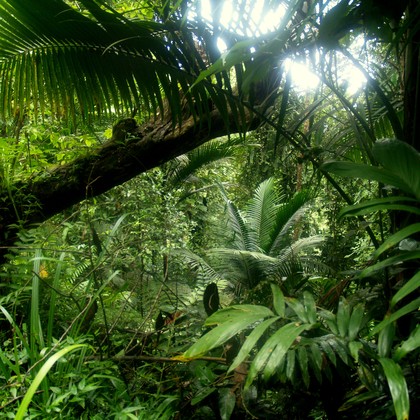
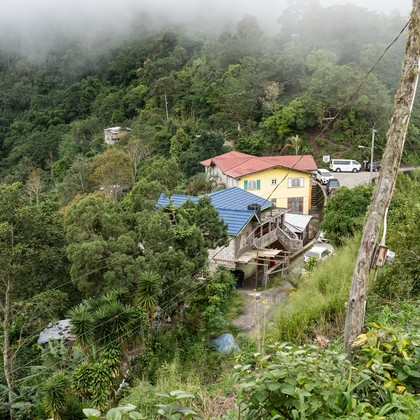
Edges and canopy of moist and dry deciduous forest, secondary forest, cocoa and coffee plantations with shade trees, mangroves and open country with tall trees. It hunts large insects from a perch and also eats much fruit. It nests in a tree cavity or other sheltered niche.
Where the bird is most at home, classified by the vegetation types of the Caribbean.




Range and movements
Resident on Trinidad and Tobago, fairly common on both islands. A few vagrants have been recorded on Bonaire, Aruba and Curaçao. Isolated reports from Hispaniola are unconfirmed and probably erroneous. Outside the region from Mexico through Central America to Argentina; the southernmost birds move to northern South America in the austral winter.
- Resident
- Summer visitor (c. Oct–Mar)
- Winter visitor (c. Apr–Sep)
- Passage (Mar–Apr, Oct–Nov)
- dark = core range, pale = thinly spread
How and when to look
On Trinidad mainly along forest edges in the Northern Range and around cocoa estates; on Tobago in the forest of the Main Ridge and in gardens with large trees. The nasal call is the best clue.
Conservation status
Not threatened. The species has a large range and also thrives in secondary forest and plantations.
Scientific name
Myiodynastes maculatus | (Müller, 1776)
Müller described the species in 1776 as Muscicapa maculata; because it was later moved to another genus, the author and year stand in brackets. The genus Myiodynastes was introduced in 1857 by Bonaparte. Myiodynastes is Greek, from muia 'fly' and dunastēs 'ruler': 'fly-ruler'. maculatus is Latin for 'spotted', after the heavily streaked breast and back. The specimen the first description was based on came from Cayenne, French Guiana.