All species › Waders, gulls and terns › Gulls and terns › Franklin's Gull
Franklin's Gull | Leucophaeus pipixcan
Franklins meeuw | Gaviota de Franklin
Franklin's Gull breeds in the marshes of the North American prairies and migrates through the interior to the Pacific coast of South America, mainly Peru and Chile. The Caribbean lies east of this route, and the species is a rare vagrant here. It is the only gull with two complete moults a year, so adults almost always show fresh wings.
Voice
Calls little away from the breeding grounds. Calls are softer and less harsh than those of Laughing Gull: a nasal kuk and a high wee-ah.
Recording: Dante Buzzetti — CC BY-NC-SA 4.0 · converted to mono · xeno-canto
Identification
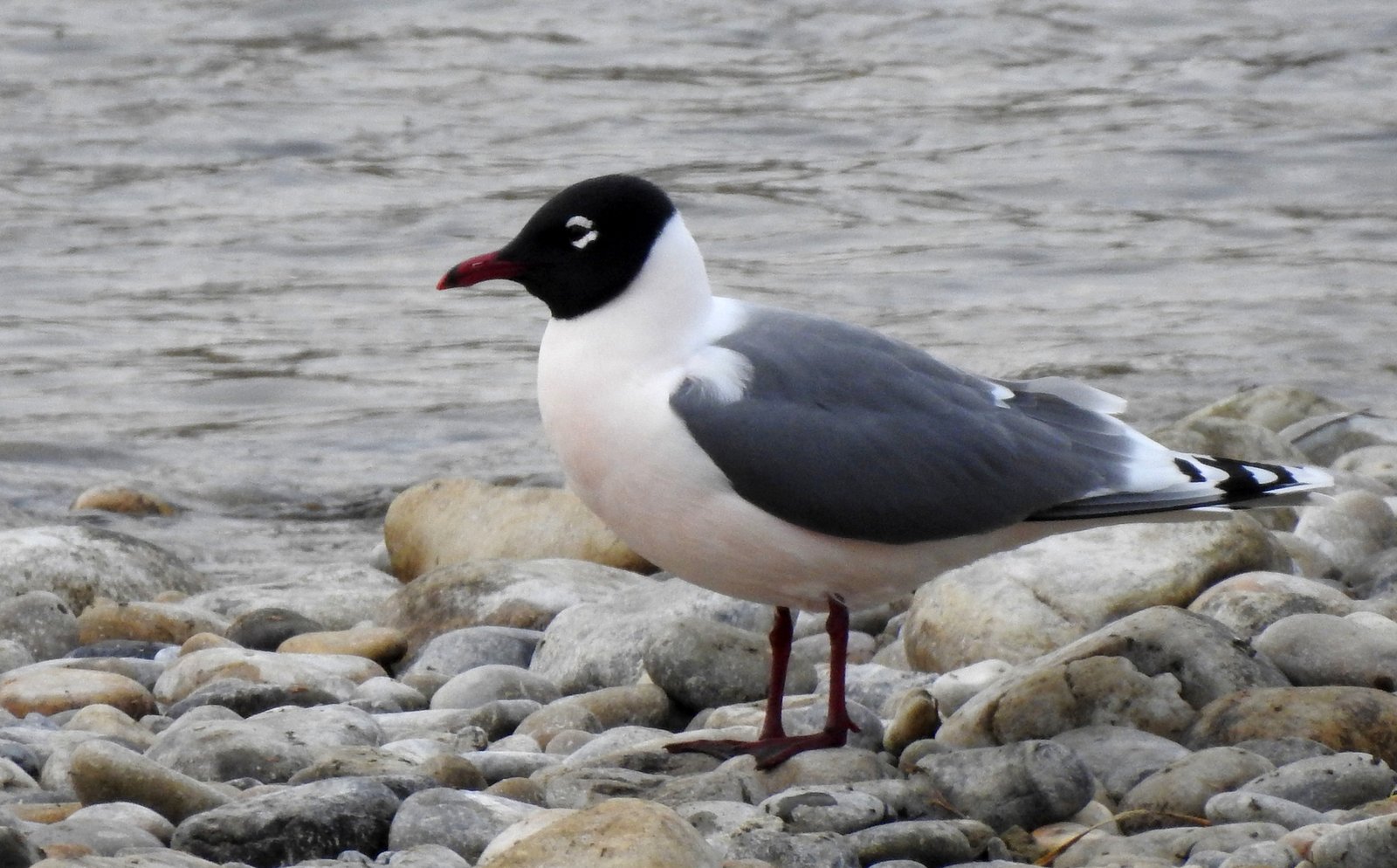
32–36 cm, compact, with a round head and a fairly short bill. Adults have a dark slate-grey mantle and a white band between the grey of the wing and the black wing tip, which itself has broad white tips. In breeding plumage the head is black with broad white eye crescents, the bill red and the breast often pink-tinged; in winter a dark half-hood remains over the rear of the head, with white eye crescents. First-year birds have a grey mantle, brownish wings, a dark half-hood, white underparts and a black tail band that leaves the outer tail feathers white.
Confusion species
Laughing Gull Leucophaeus atricilla is larger, with a longer, drooping bill, narrower eye crescents, black wing tips without a white band and, in winter, only a grey wash on the head; first-year Laughing Gulls have a grey-brown breast and a complete tail band. Bonaparte's Gull Chroicocephalus philadelphia is smaller and paler grey, with a white leading edge to the primaries.
Habitat
Coastal waters, lagoons, salt pans, mudflats and harbours, usually with Laughing Gulls.
Where the bird is most at home, classified by the vegetation types of the Caribbean.



Range and movements
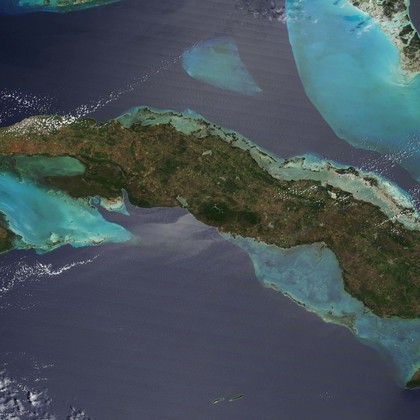
Scattered records, including from Trinidad and Tobago, Barbados, Guadeloupe, Puerto Rico, Cuba, the Cayman Islands, the Bahamas and the ABC Islands, including Aruba. Beyond the region it breeds on the prairies of Canada and the United States and winters along the Pacific coast of South America, from Ecuador to Chile.
How and when to look
Careful scanning of Laughing Gull flocks in harbours and salt pans gives the best chance. In winter plumage the white eye crescents and the dark half-hood are the first features to catch the eye.
Conservation status
Not threatened globally. In the Caribbean a rare vagrant with no established population.
Scientific name
Leucophaeus pipixcan | (Wagler, 1831)
Wagler described the species in 1831 as Larus Pipixcan; because it was later moved to another genus, the author and year stand in brackets. The genus Leucophaeus was introduced in 1855 by Bruch. Leucophaeus is Ancient Greek, from leukos 'white' and phaios 'dusky'. pipixcan is a Nahuatl name for a kind of gull. The specimen the first description was based on came from Mexico.