All species › Cuckoos › Cuckoos › Dark-billed Cuckoo
Dark-billed Cuckoo | Coccyzus melacoryphus
Kleine mangrovekoekoek | Cuclillo piquioscuro
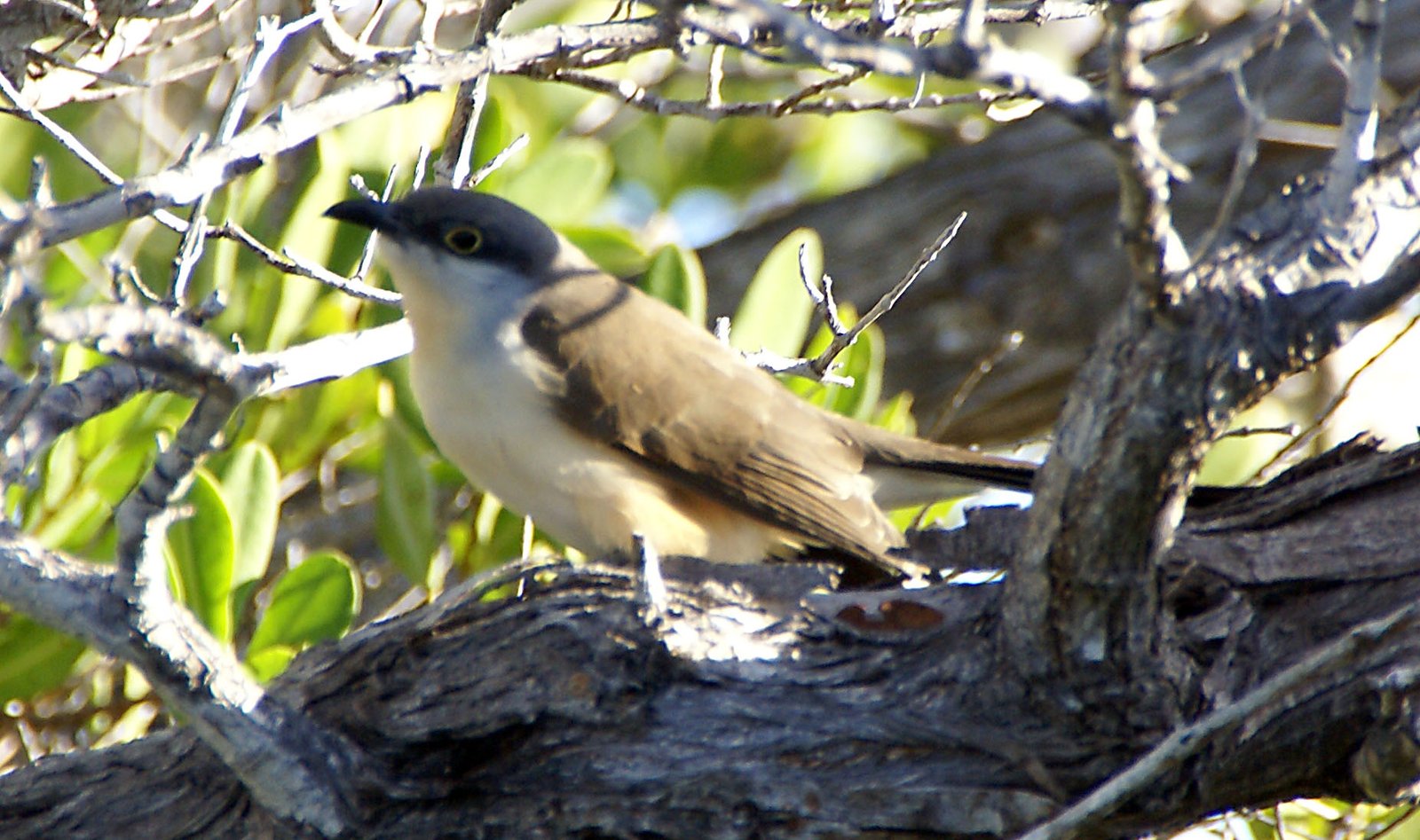
The Dark-billed Cuckoo is a slender cuckoo from South America, with a grey crown, a black eye mask and warm ochre underparts. Many of the birds that breed in the south of the continent move north in the austral winter. In the Caribbean it is a rare visitor, mainly to Trinidad, and it does not breed there; the birds seen on the island come from the South American mainland.
Voice
Rarely heard in the region. The call is a series of six to eight resonant, buzzy notes reminiscent of a kazoo; also a ventriloquial ga-ga-ga-go-go and a descending series of guttural notes.
Recording: Franco Vushurovich — CC BY-NC-SA 4.0 · converted to mono · xeno-canto
Identification
25–28 cm, about half of it tail. The crown is grey and contrasts with the grey-brown upperparts. A broad black mask runs from the bill through the eye to the ear coverts; below it is a paler, greyish cheek. Throat, breast and belly are warm buff to ochre. The bill is entirely black and slightly curved; around the eye is a narrow yellow to olive ring. The tail is brown above and black below with narrow white tips to the feathers. The sexes are alike; young birds are duller, with a brown crown, a less distinct mask and sometimes some rufous in the wing.
Confusion species
Mangrove Cuckoo Coccyzus minor is very similar, with the same black mask and ochre underparts, but is slightly larger, has a yellow lower mandible, a less grey crown and large white spots on the underside of the tail. Yellow-billed Cuckoo Coccyzus americanus has no mask, pure white underparts, a yellow lower mandible and rufous in the primaries. Black-billed Cuckoo Coccyzus erythropthalmus also has a dark bill, but white underparts, no mask and, in adults, a red eye-ring.
Habitat
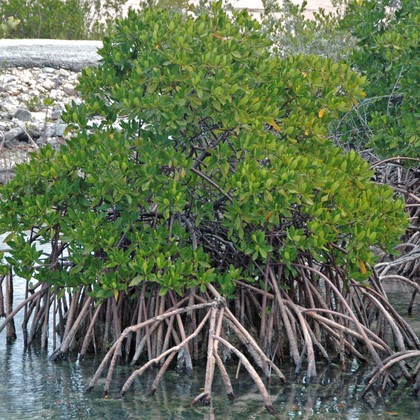
Within its range tropical deciduous forest, gallery forest, mature secondary forest, scrub and mangroves, mainly in the lowlands below about 950 m, occasionally much higher. It keeps hidden in dense foliage, searching slowly and unobtrusively among the branches for caterpillars and other large insects, and often sits motionless for long periods. On the breeding grounds it builds a flat platform of twigs in a tree or bush, on which two to five greenish-blue eggs are laid; unlike many Old World cuckoos the parents incubate them themselves.
Where the bird is most at home, classified by the vegetation types of the Caribbean.


Range and movements
In the region a rare visitor to Trinidad, where it does not breed. Also recorded as a vagrant on Grenada, and there are reported sightings from San Andrés. It is not known as a regular visitor to the other islands. Outside the region over almost all of mainland South America except Chile, and on the Galápagos Islands; birds from the south move north between about March and October, into the Amazon basin and Venezuela. Also recorded as a vagrant in Panama, Florida and Texas.
- Resident
- dark = core range, pale = thinly spread
How and when to look
A sighting in the region is a matter of luck; the chance is greatest in Trinidad in the months when southern birds move north. Any masked cuckoo with an all-black bill deserves careful comparison with Mangrove Cuckoo, paying attention to the colour of the lower mandible, the crown and the size of the white tail spots; a photograph of the underside of the tail helps with identification.
Conservation status
Globally not threatened; the species has a very large range in South America. In the Caribbean a rare visitor without a settled population. Records in the region are worth documenting.
Scientific name
Coccyzus melacoryphus | Vieillot, 1817
Vieillot described the species in 1817 and placed it straight away in the genus where it still stands. The genus Coccyzus was introduced in 1816 by Vieillot. Coccyzus is Greek, from kokkuzō 'to cry cuckoo', after the cuckoo's call. melacoryphus is Greek, from melas 'black' and koruphē 'crown', after the dark crown. The specimen the first description was based on came from Paraguay.