All species › Parrots › Parrots › Cuban Parakeet
Cuban Parakeet | Psittacara euops
Cubaanse parkiet | Catey
The Cuban Parakeet is the smallest Psittacara and the only native parakeet of Cuba. It once occurred throughout the island and on Isla de la Juventud, but forest clearance and trapping for the cage-bird trade have pushed it back to a number of scattered areas. In Cuba it is called catey.
Voice
A metallic, grating kree-kree in flight, also used as an alarm call, and a long-drawn, rasping kkkeeerrrr from feeding flocks. During courtship short, soft keirp-keirp-keirp series.
Recording: GABRIEL LEITE — CC BY-NC-SA 4.0 · converted to mono · xeno-canto
Identification
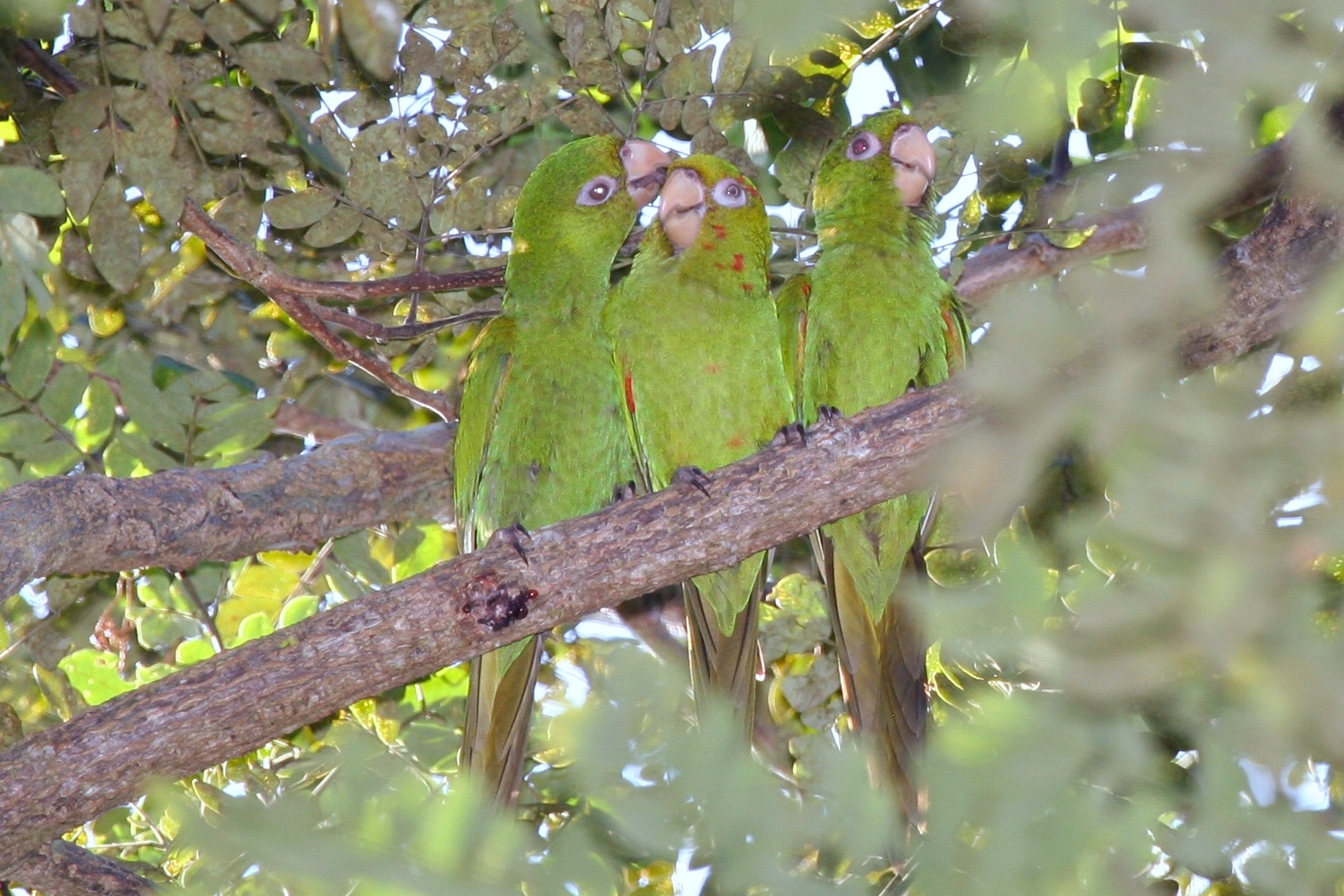
24–27 cm, slim, with a long pointed tail. Yellowish green, paler below. Single red feathers are scattered over the head, neck and breast, usually fewer in females than in males. The edge of the wing is red and the underwing coverts are red, which shows well in flight; flight feathers and tail are pale green to olive below. Bare pinkish to reddish-white skin surrounds the eye, the iris is pale yellow and the bill pale pinkish horn. Juveniles have little or no red on head and breast.
Confusion species
Cuban Amazon Amazona leucocephala is larger and stockier, with a short square tail, a white forehead and a red throat. Escaped parakeets of other species lack the combination of red flecks on head and neck and red underwing; the otherwise similar Hispaniolan Parakeet Psittacara chloropterus is larger and does not occur in Cuba.
Habitat
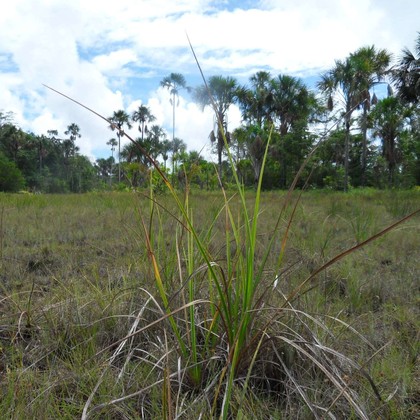
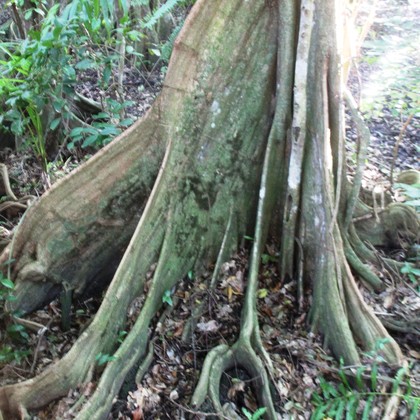
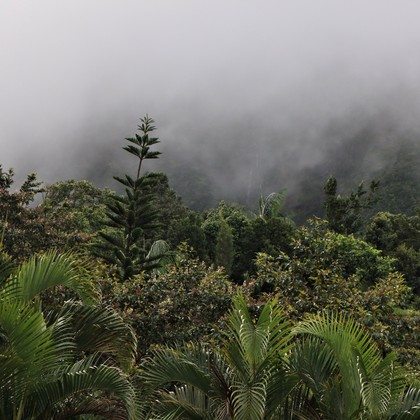
Palm savanna with scattered trees, semi-evergreen and evergreen forest in the lowlands and mountains, swamp forest, limestone forest and forest edge, up to about 1100 m. It eats seeds, fruit, flower buds, pollen and nectar of dozens of plant species. It lives in flocks of up to about 50 birds. It breeds from February to September, nearly always in holes excavated by woodpeckers in dead royal palms, sometimes in crevices in limestone cliffs.
Where the bird is most at home, classified by the vegetation types of the Caribbean.



Range and movements
Only in Cuba. Now mainly in the Zapata swamp, the western Escambray mountains, parts of Villa Clara, Sancti Spíritus, Ciego de Ávila and Camagüey, the Cauto basin and the mountains of Guantánamo. It disappeared from Isla de la Juventud around 1900. The species does not occur outside Cuba.
- Resident
- dark = core range, pale = thinly spread
How and when to look
On the Zapata Peninsula and in the Escambray mountains around Topes de Collantes. Early in the morning and late in the afternoon flocks fly noisily between roost and feeding trees; in palm savanna they can be watched at nest holes in dead palm trunks.
Conservation status
Considered Vulnerable by the IUCN; the population is declining. The main threats are the loss of forest and of dead palms with nest holes, and the illegal taking of nestlings for the cage-bird trade; severe hurricanes can destroy nest trees and food sources. Cuban specialists argue for a higher threat category.
Scientific name
Psittacara euops | (Wagler, 1832) (GBIF: Aratinga euops)
Wagler described the species in 1832 as Sittace euops; because it was later moved to another genus, the author and year stand in brackets. The genus Psittacara was introduced in 1825 by Vigors. Psittacara joins Greek psittakos 'parrot', Latin psittacus, with the genus name Ara, the macaws. euops is Greek, from eu 'fine' and ōps 'face', probably after the red flecks on the head and neck. The specimen the first description was based on came from Cuba.