All species › Parrots › Parrots › Brown-throated Parakeet
Brown-throated Parakeet | Eupsittula pertinax
Maïsparkiet | Perico carisucio
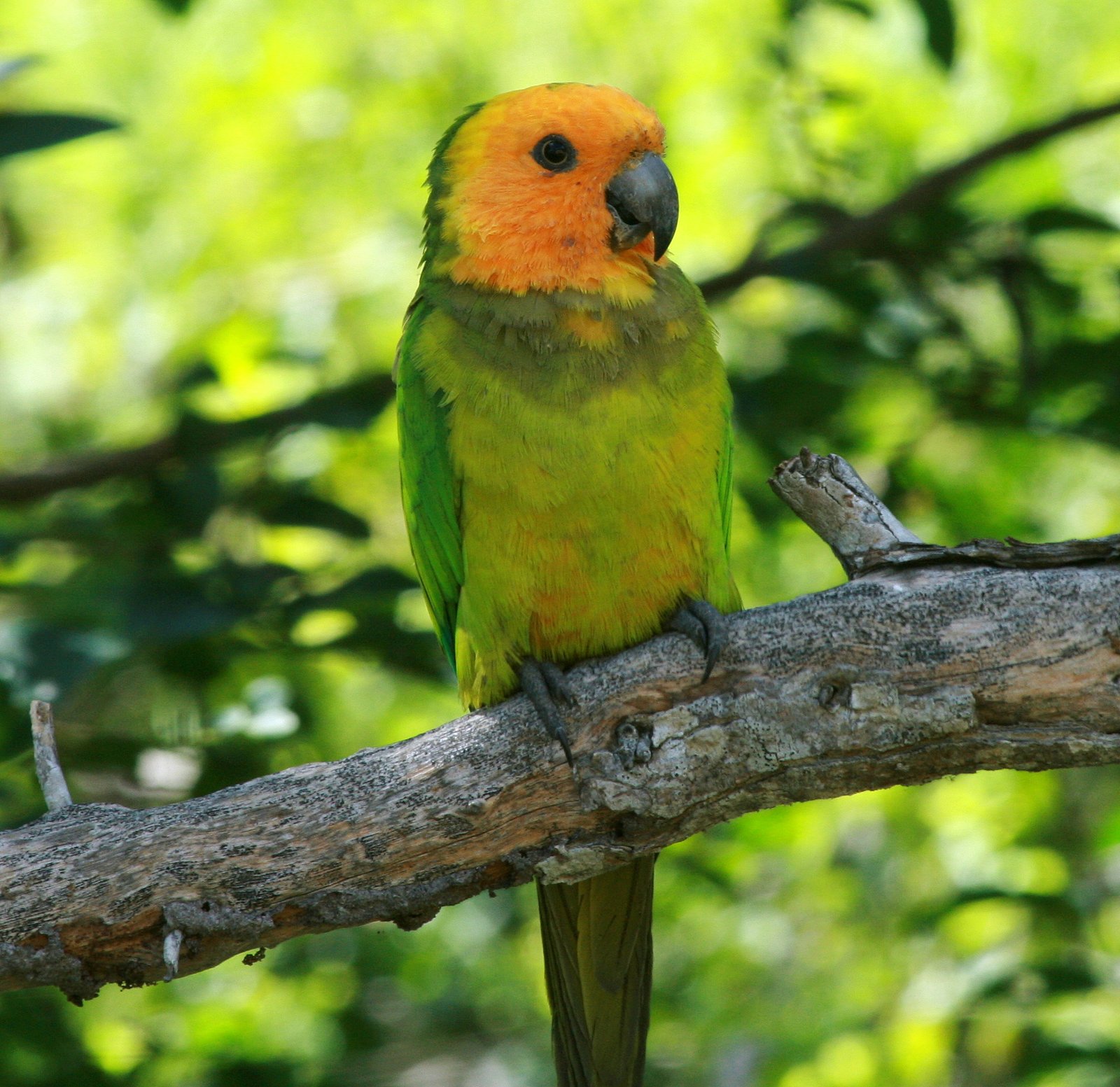
The Brown-throated Parakeet is the native parakeet of Aruba, Curaçao and Bonaire, where it is called prikichi in Papiamentu. Each of the three islands has its own subspecies. It was introduced to St Thomas from Curaçao in the nineteenth century and has since spread over part of the Virgin Islands.
Voice
A raw, rasping scraart scraart, rapidly repeated, and shorter two-syllable calls; flocks chatter in the treetops and keep in contact in flight. The calls of the island birds are more varied than those of mainland birds.
Recording: JAYRSON ARAUJO DE OLIVEIRA — CC BY-NC-SA 4.0 · converted to mono · xeno-canto
Identification
23–28 cm, with a long pointed tail. Green above, with an olive-brown throat and breast and a green belly with an orange central patch. Head colour varies by island. On Curaçao (subspecies pertinax) forehead, face and chin are yellow to orange-yellow; on Bonaire (xanthogenia) most of the head is yellow; on Aruba (arubensis) the face is browner, with yellow only around the eye. The flight feathers are edged blue. The bill is greyish horn. The sexes are alike; young birds have less yellow on the head.
Confusion species
On the ABC Islands this is the only native parakeet. Blue-crowned Parakeet Thectocercus acuticaudatus, an alien on Curaçao, is larger, with a blue head and red on the undertail. Chestnut-fronted Macaw Ara severus is larger, with a chestnut forehead and a bare white face. Yellow-shouldered Amazon Amazona barbadensis on Bonaire is much larger and stockier, with a short tail.
Habitat
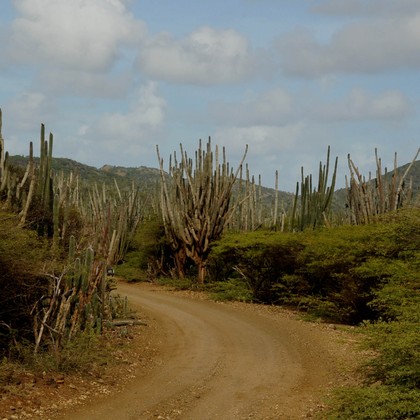
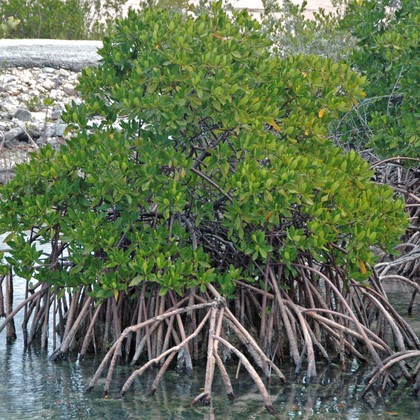
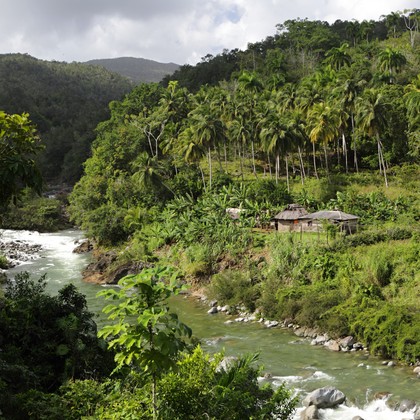
Thorn scrub and cactus scrub, dry woodland on limestone, mangroves, country estates, gardens and residential areas. It eats seeds, fruit, flowers and cactus fruit, and visits fruit trees in gardens. It nests mainly in cavities dug into arboreal termite nests of the genus Nasutitermes, and also in tree holes and rock faces.
Where the bird is most at home, classified by the vegetation types of the Caribbean.


Range and movements
Aruba, Curaçao and Bonaire (also feeding on Klein Curaçao and Klein Bonaire): common resident. Virgin Islands: introduced to St Thomas, where it has occurred since the 1860s, and now also on St John, Tortola, Jost Van Dyke and Virgin Gorda; a small population on Culebra (Puerto Rico). There are a few records from Trinidad, of uncertain origin. Outside the region from Panama and Costa Rica through northern Colombia and Venezuela, Isla Margarita and the Guianas to northern Brazil.
- Resident
- dark = core range, pale = thinly spread
How and when to look
On the ABC Islands almost anywhere with trees and scrub, including Willemstad, Oranjestad and Kralendijk. On St Thomas along the trail at Magens Bay. The subspecies are told by island and head colour; a termite nest with a hole in its side may hold a nest.
Conservation status
Not threatened. Common on the ABC Islands, though chicks are taken from nests to be kept as pets. An introduced species on the Virgin Islands.
Scientific name
Eupsittula pertinax | (Linnaeus, 1758) (GBIF: Aratinga pertinax)
Linnaeus described the species in 1758 as Psittacus pertinax; because it was later moved to another genus, the author and year stand in brackets. The genus Eupsittula was introduced in 1853 by Bonaparte. Eupsittula combines Greek eu 'good, true' with Modern Latin psittacula 'little parrot': 'true parakeet'. pertinax is Latin for 'tenacious, persistent'. The specimen the first description was based on came from Curaçao.