All species › Passerines › Ovenbirds and woodcreepers › Cocoa Woodcreeper
Cocoa Woodcreeper | Xiphorhynchus susurrans
Cocoamuisspecht | Trepatroncos cacao
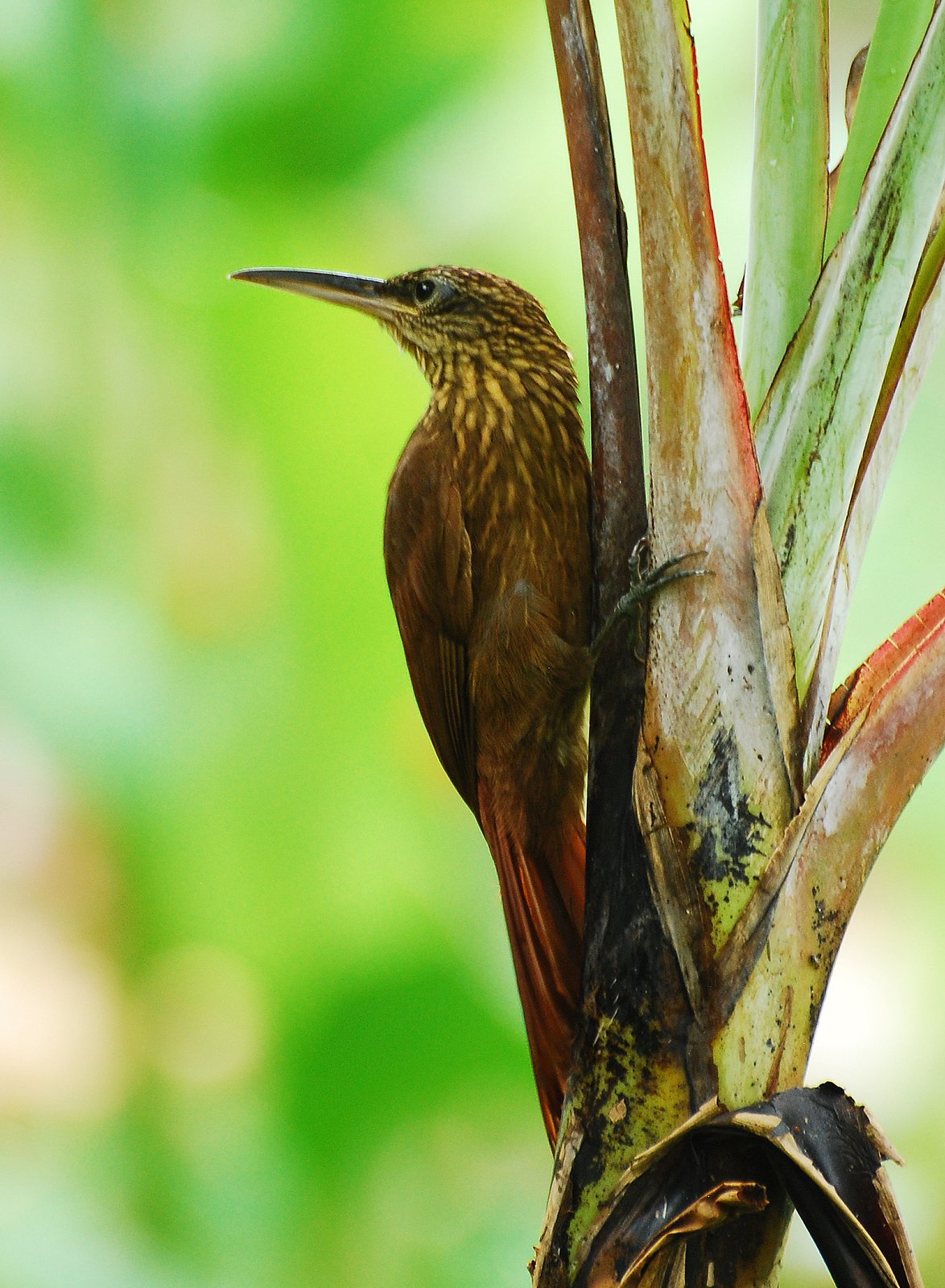
The Cocoa Woodcreeper is the largest and commonest woodcreeper on Trinidad and Tobago. Its name refers to the shaded cocoa plantations where it is frequent. It is mostly noticed by voice: a loud, laughing whistled series often comes from a bird hidden on the far side of a trunk.
Voice
A loud series of 7 to 20 clear, upward-inflected whistles that speeds up and slows again, like a laughing chew-chew-chee-chee-chee…; also a rolling, laughing long call and short calls such as cheer and pyewl. Heard most at dawn and dusk.
Recording: Johan Chaves — CC BY-NC-SA 4.0 · converted to mono · xeno-canto
Identification
21–24 cm, with a long, fairly heavy, slightly curved dark bill with a paler lower mandible, and a long stiff tail. Crown and nape are dark brown with small ochre teardrop spots. The face is dark with pale streaks. The throat is pale buff to buffy-white with fine black scaling. The back is olive-brown with narrow pale streaks; the lower back, wings and tail are chestnut. The breast is reddish-brown with pale, black-edged teardrop spots that fade towards the belly. Juveniles are darker, with a shorter, blacker bill. The sexes are alike.
Confusion species
Plain-brown Woodcreeper Dendrocincla fuliginosa is smaller and plain brown, without spots, and has a straight bill. Straight-billed Woodcreeper Dendroplex picus is smaller, with a straight pale bill and pale streaks rather than spots, and lives mainly in mangroves and open country on Trinidad. Streak-headed Woodcreeper Lepidocolaptes souleyetii of Trinidad is smaller and slimmer, with a thin, strongly curved pale bill and a finely streaked crown.
Habitat
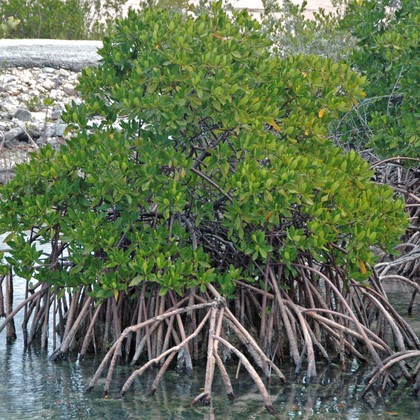
Humid evergreen forest, gallery forest, drier deciduous woodland, forest edge, old secondary forest and cocoa and coffee plantations with shade trees; on Trinidad also in mangroves. It forages alone or in mixed flocks of insectivores, sometimes at army-ant swarms, gleaning arthropods from bark crevices, dead leaves, epiphytes and moss. It nests in natural tree cavities lined with bark flakes; only the female incubates and tends the young.
Where the bird is most at home, classified by the vegetation types of the Caribbean.




Range and movements
In the Caribbean on Trinidad and Tobago, common on both islands in almost any wooded area, from the coast into the mountains. Outside the region from Guatemala through Central America to Panama and in northern Colombia and Venezuela.
- Resident
- dark = core range, pale = thinly spread
How and when to look
On both islands in almost any forest, for example in the Arima Valley on Trinidad and along the Main Ridge on Tobago. A bird given away by its loud whistling is often seen only when it flies to another trunk.
Conservation status
Not threatened. The species is common and tolerates forest edge, secondary forest and shaded plantations well.
Scientific name
Xiphorhynchus susurrans | (Jardine, 1847)
Jardine described the species in 1847 as Dendrocolaptes susurrans; because it was later moved to another genus, the author and year stand in brackets. The genus Xiphorhynchus was introduced in 1827 by Swainson. Xiphorhynchus is Greek, from xiphos 'sword' and rhunkhos 'bill', after the long, straight bill. susurrans is Latin for 'whispering', from susurrare; an odd name for this noisy bird. The specimen the first description was based on came from Tobago.