All species › Passerines › Ovenbirds and woodcreepers › Plain-brown Woodcreeper
Plain-brown Woodcreeper | Dendrocincla fuliginosa
Grijswangmuisspecht | Trepatroncos pardo
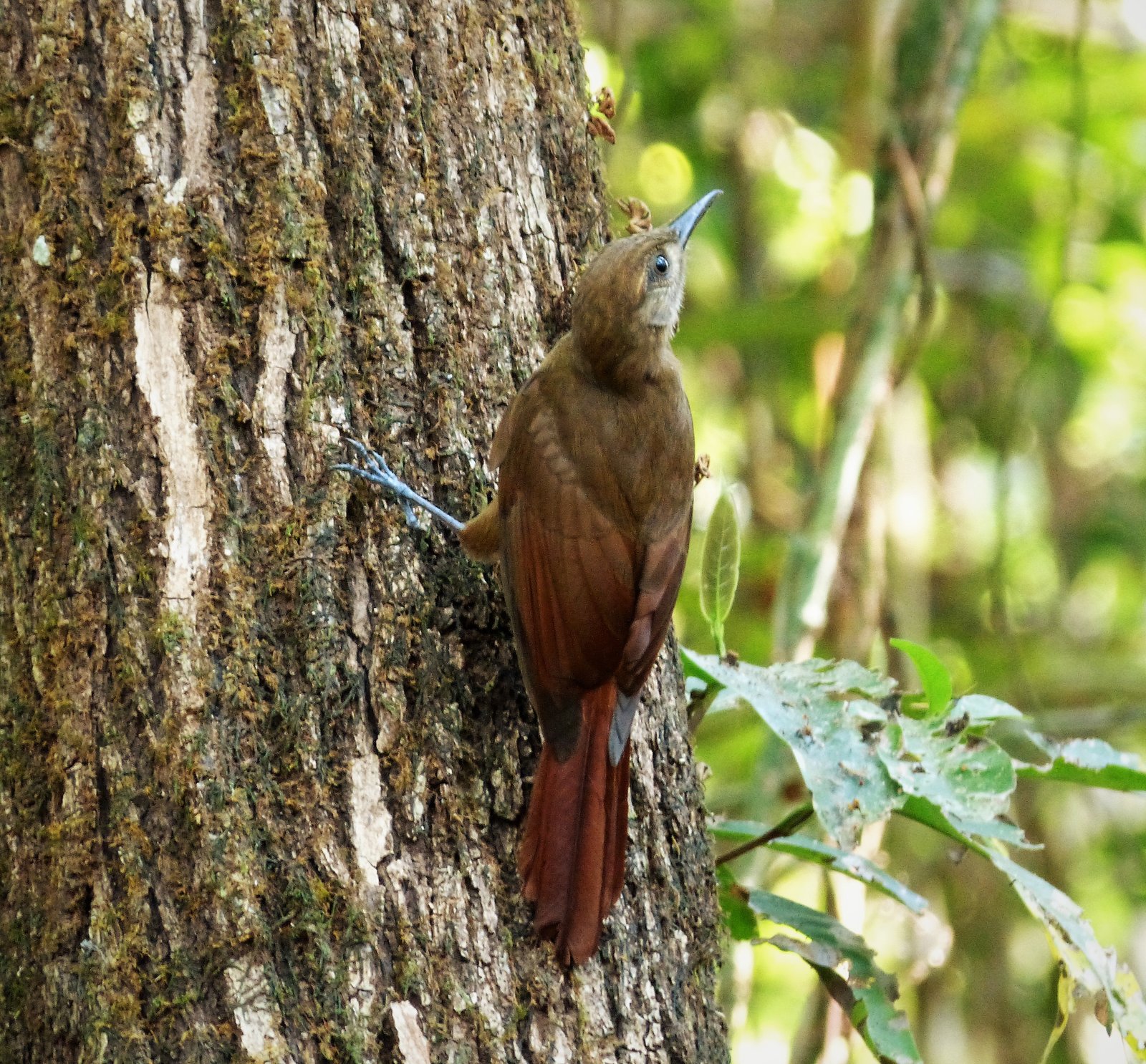
The Plain-brown Woodcreeper is a medium-sized, plain brown woodcreeper without streaks or spots. It is known as a follower of army-ant swarms: on a trunk just above the column of ants it waits for insects fleeing the ants. In the Caribbean it lives on Trinidad and Tobago.
Voice
A long whinnying or rattling series that may end in a sputter, and various sharp, squeaky calls such as peeyk and stieek.
Recording: Jaime Suárez — CC BY-NC-SA 4.0 · shortened to the first 60 s, mono · xeno-canto
Identification
19–22 cm, with a straight, medium-length dark bill, a slightly peaked crown and a long stiff tail. The upperparts are plain olive-brown, the wings and tail warm rufous. The face is greyish, with a narrow pale supercilium, a faint pale stripe below the eye and a dark malar stripe. The underparts are plain brown, without streaks or spots. The sexes are alike.
Confusion species
Cocoa Woodcreeper Xiphorhynchus susurrans is larger, with a longer, slightly curved bill and pale spots and streaks on the head, throat and breast. Straight-billed Woodcreeper Dendroplex picus has a straight pale bill and a heavily streaked head and back. On Tobago, Olivaceous Woodcreeper Sittasomus griseicapillus is much smaller and slimmer, with an olive-grey head and underparts and a short thin bill.
Habitat
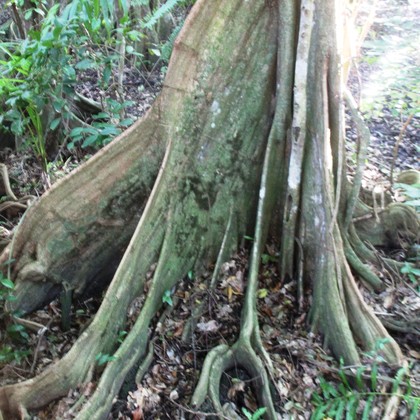
Humid evergreen forest, older secondary forest and swamp forest, from the lowlands into the hills and mountains. It searches trunks and branches for arthropods, alone or in pairs; at army-ant swarms it clings to vertical trunks 4–10 m up and drops onto flushed prey. The nest is a cup of dead leaves and plant fibres in a tree cavity.
Where the bird is most at home, classified by the vegetation types of the Caribbean.



Range and movements
In the Caribbean on Trinidad and Tobago, common in forest on both islands. Outside the region from Honduras through Central America into South America, east of the Andes to central Brazil.
- Resident
- dark = core range, pale = thinly spread
How and when to look
Where army ants are crossing the forest floor, as in the Northern Range on Trinidad and the Main Ridge forest on Tobago, several birds often cling low on the trunks. Even away from ant swarms the bird can be approached closely and stays motionless on a trunk for long periods.
Conservation status
Not threatened. The species has a very large range, but is sensitive to forest fragmentation, especially where army ants disappear.
Scientific name
Dendrocincla fuliginosa | (Vieillot, 1818)
Vieillot described the species in 1818 as Dendrocopus fuliginosus; because it was later moved to another genus, the author and year stand in brackets. The genus Dendrocincla was introduced in 1840 by Gray. Dendrocincla is Greek, from dendron 'tree' and kinklos, an unidentified bird mentioned by Aristotle and later linked with wagtails. fuliginosa is Latin for 'sooty', after the plain dark brown plumage. The specimen the first description was based on came from Cayenne, French Guiana.