All species › Woodpeckers and allies › Woodpeckers › Golden-olive Woodpecker
Golden-olive Woodpecker | Colaptes rubiginosus
Olijfrugspecht | Carpintero olivo
The Golden-olive Woodpecker is a medium-sized, green and yellow woodpecker found from Mexico to Argentina, which in the region lives in Trinidad and Tobago. Each island has its own subspecies: Colaptes rubiginosus trinitatis in Trinidad and the larger, more bronzy Colaptes rubiginosus tobagensis in Tobago.
Voice
The song is a long, rising rattling trill. Also a sharp keek and a liquid dyeet. It drums in short rolls.
Recording: Paul Molina Abril — CC BY-NC-SA 4.0 · converted to mono · xeno-canto
Identification
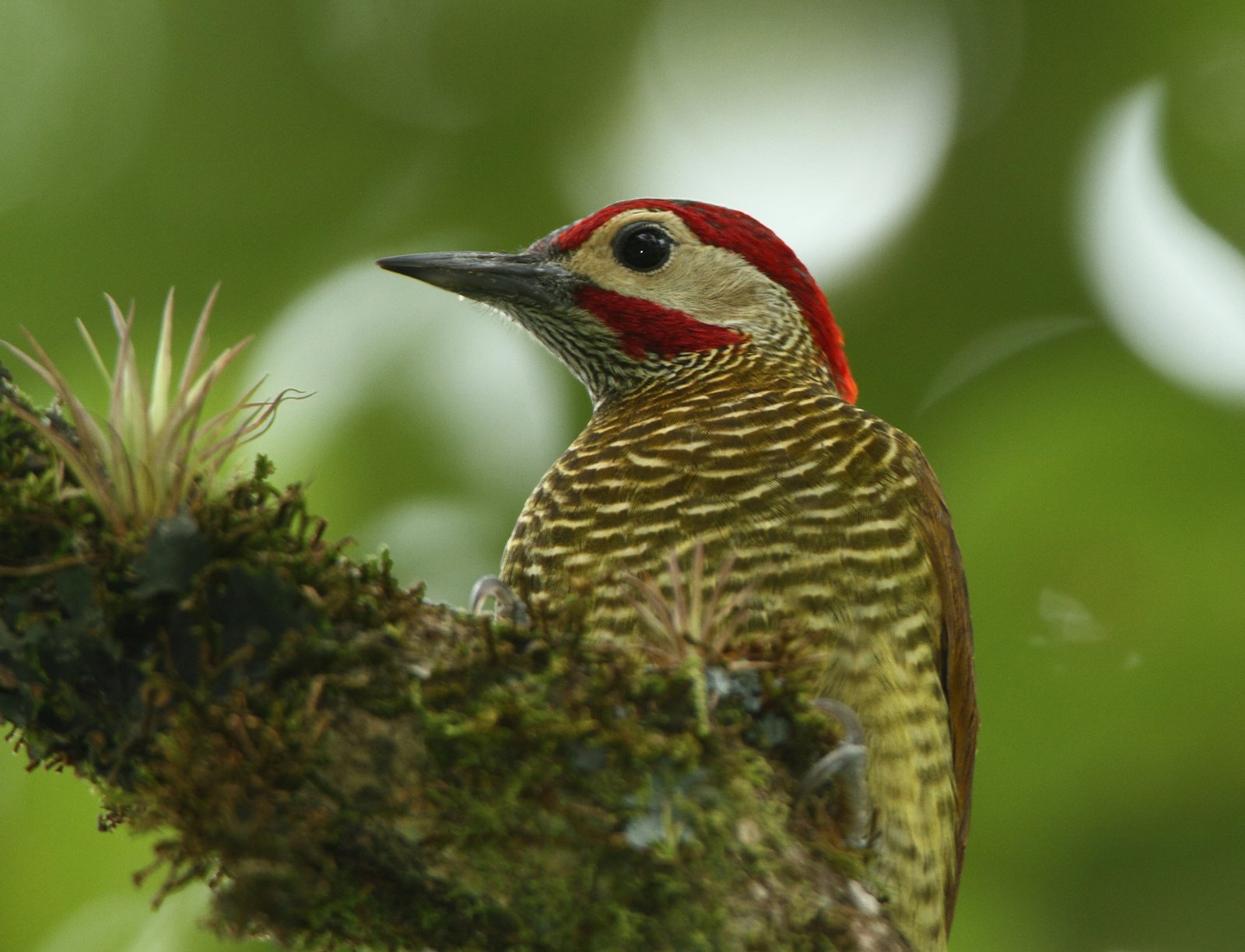
18–23 cm. The upperparts are golden-olive with a bronze wash, more strongly bronze with reddish tones in Tobago. Forehead and crown are slate grey, edged red at the sides, and the nape is red. The cheeks are pale grey to whitish, the throat dark. The underparts are pale yellow with dense olive barring. The male has a broad red moustache; the female has red only on the nape and a streaked moustache. Tobago birds have a heavier bill.
Confusion species
Red-crowned Woodpecker Melanerpes rubricapillus in Tobago has a black-and-white barred back, a pale, unbarred head and breast and a red crown. Chestnut Woodpecker Celeus elegans in Trinidad is larger and chestnut-brown. Trinidad's large black woodpeckers are told at once by size and colour.
Habitat
Moist and semi-evergreen forest, montane forest and forest edges, also secondary forest and plantations with shade trees; in Tobago also drier forest. It searches trunks and branches in the middle and upper storeys for ants, beetle larvae and other insects, and also eats berries. It excavates a nest hole in a dead tree or branch, 1–18 m up; both parents incubate.
Where the bird is most at home, classified by the vegetation types of the Caribbean.





Range and movements
In the region in Trinidad and Tobago, where it is a fairly common resident on both islands. Outside the region from Mexico through Central America and the Andes to north-western Argentina, and in northern South America east to the Guianas.
- Resident
- dark = core range, pale = thinly spread
How and when to look
In Trinidad mainly in the forest of the Northern Range, in Tobago in the Main Ridge forest. The rattling song and the quiet tapping of foraging birds show where it is; the green plumage is inconspicuous among the leaves.
Conservation status
Not threatened. The species has a very large range and adapts to many forest types and semi-open landscapes.
Scientific name
Colaptes rubiginosus | (Swainson, 1820)
Swainson described the species in 1820 as Picus rubiginosus; because it was later moved to another genus, the author and year stand in brackets. The genus Colaptes was introduced in 1825 by Vigors. Colaptes is Greek kolaptēs 'chiseller', from kolaptō 'to peck, to chisel', after the hacking into wood. rubiginosus is Latin for 'rusty', from rubigo 'rust', after the rusty tones of the plumage. The specimen the first description was based on came from Caracas, Venezuela.