All species › Passerines › Swallows and martins › Brown-chested Martin
Brown-chested Martin | Progne tapera
Bruinborstzwaluw | Golondrina parda
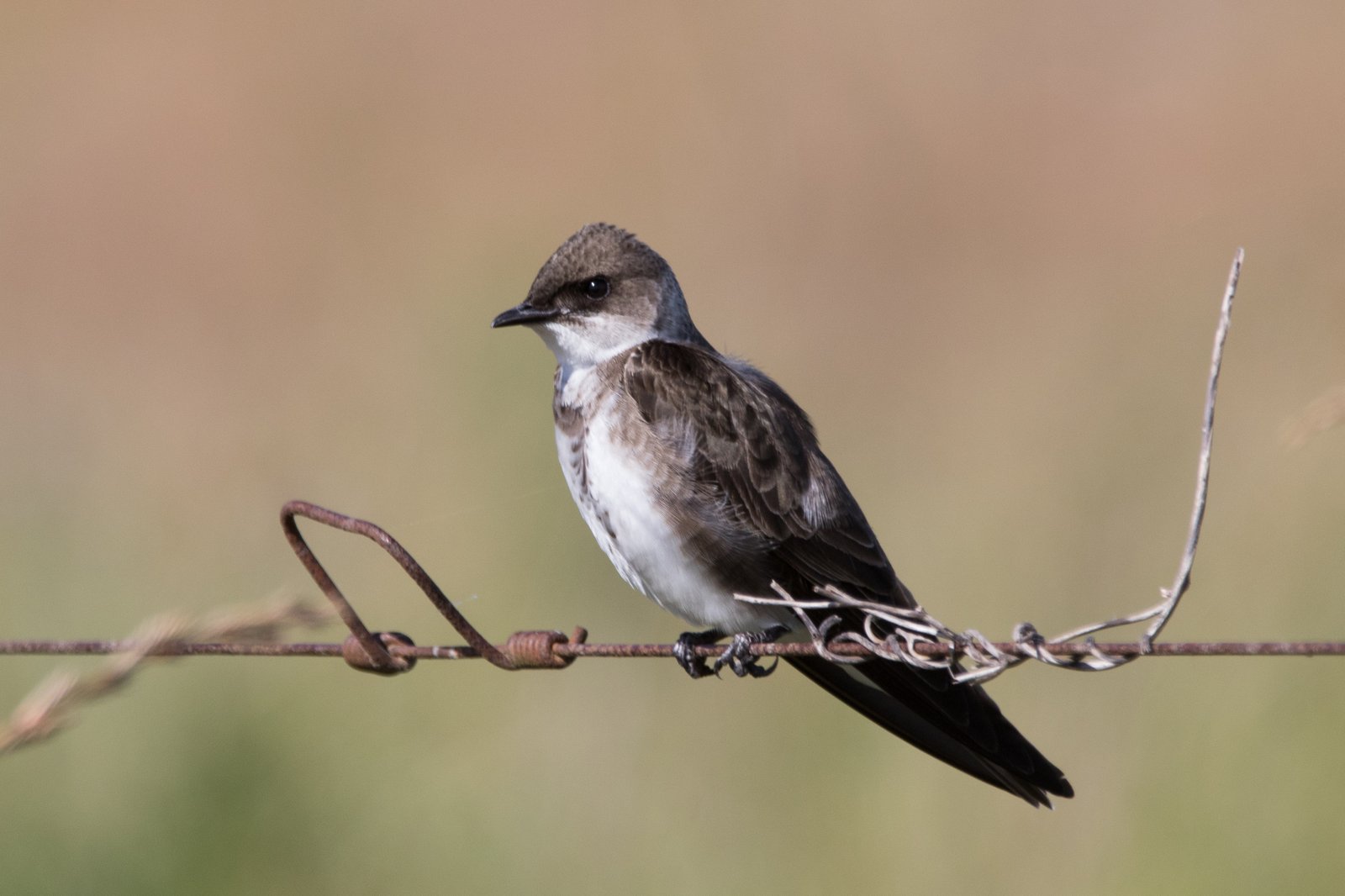
The Brown-chested Martin is a large brown swallow of South America that appears in the Caribbean only as a rare visitor. Birds reaching the region are probably mostly of the southern form Progne tapera fusca, which after breeding in southern South America moves to the north of the continent in the austral winter. It looks like an outsized Sand Martin but is a martin in build and flight.
Voice
A dry, buzzy djzeut and a more musical dureet. The song is a series of liquid, rolling, descending trills with gurgling notes.
Recording: JAYRSON ARAUJO DE OLIVEIRA — CC BY-NC-SA 4.0 · converted to mono · xeno-canto
Identification
16–18 cm, with broad wings and a slightly forked tail. The upperparts are grey-brown to sandy brown without gloss; wings and tail are a little darker. The throat and underparts are white, with a brown breast band. In the southern form the breast band is more sharply defined and a line of dark spots runs from the centre of the breast to the belly. The sexes are alike; juveniles have a less forked tail and a grey-brown wash on the sides of the throat.
Confusion species
Sand Martin Riparia riparia also has a brown breast band but is much smaller, with narrower wings and a quicker, fluttering flight. Southern Rough-winged Swallow Stelgidopteryx ruficollis is smaller, lacks the breast band and has an ochre throat. Females and juveniles of Grey-breasted Martin Progne chalybea and Caribbean Martin Progne dominicensis are darker above and have a diffuse grey-brown breast without a defined band and without a white throat.
Habitat
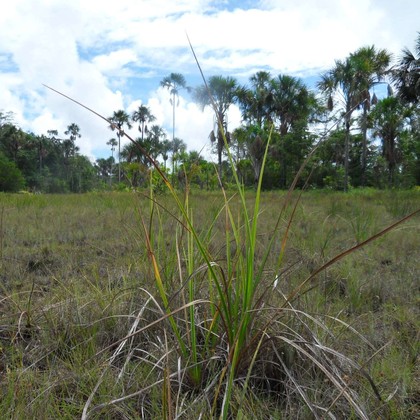
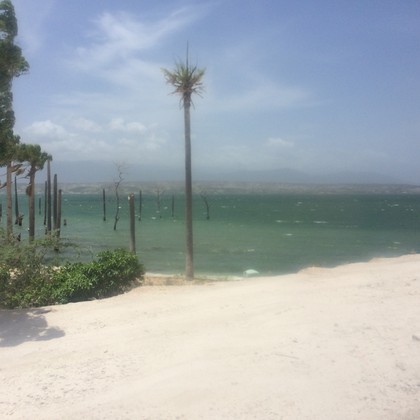
Open country with scattered trees, savanna, pastures and open water, often near rivers and lakes. It hunts flying insects, often in flocks. In South America it breeds alone or in loose colonies in cavities in banks, termite nests, trees and buildings; the clutch is usually four eggs.
Where the bird is most at home, classified by the vegetation types of the Caribbean.

Range and movements
A rare visitor or vagrant to Aruba, with fewer records from Curaçao, Bonaire and San Andrés, mainly in the austral winter. Single records from Barbados and Guadeloupe are regarded as vagrants. Outside the region in Panama and throughout South America except Chile; southern birds move north in flocks to the north of the continent in the austral winter.
- Resident
- dark = core range, pale = thinly spread
How and when to look
On Aruba and Curaçao during the austral winter it is worth checking swallow flocks over open ground and near pools. A large brown swallow with a white throat and a clear breast band is almost certainly this species; its size is best judged alongside other swallows.
Conservation status
Least Concern. A common and widespread species in South America; in the Caribbean only a few birds a year, or fewer, are involved.
Scientific name
Progne tapera | (Linnaeus, 1766)
Linnaeus described the species in 1766 as Hirundo Tapera; because it was later moved to another genus, the author and year stand in brackets. The genus Progne was introduced in 1826 by Boie. Progne (also Procne) is the daughter of King Pandion of Athens in Greek myth, who was turned into a swallow; in Latin also a word for 'swallow'. tapera comes from the Tupí name Taperá, 'home-living (bird)', for a kind of swallow, via Marcgrave (1648). The specimen the first description was based on came from America (later restricted to Pernambuco, Brazil).