All species › Passerines › Swallows and martins › Grey-breasted Martin
Grey-breasted Martin | Progne chalybea
Grijsborstpurperzwaluw | Golondrina acerada
The Grey-breasted Martin is the martin present year-round on Trinidad and Tobago, where it is common in towns, villages and open country. Caribbean Martin occurs there mainly in the breeding season, and Purple Martin only on passage. Away from Trinidad and Tobago the species is rare or a vagrant in the region.
Voice
A gurgling chew-chew and a series of twittering and grating notes, especially around the nest site and early in the morning. The call resembles that of Caribbean Martin.
Recording: Jacob Wijpkema — CC BY-NC-SA 4.0 · shortened to the first 60 s, mono · xeno-canto
Identification
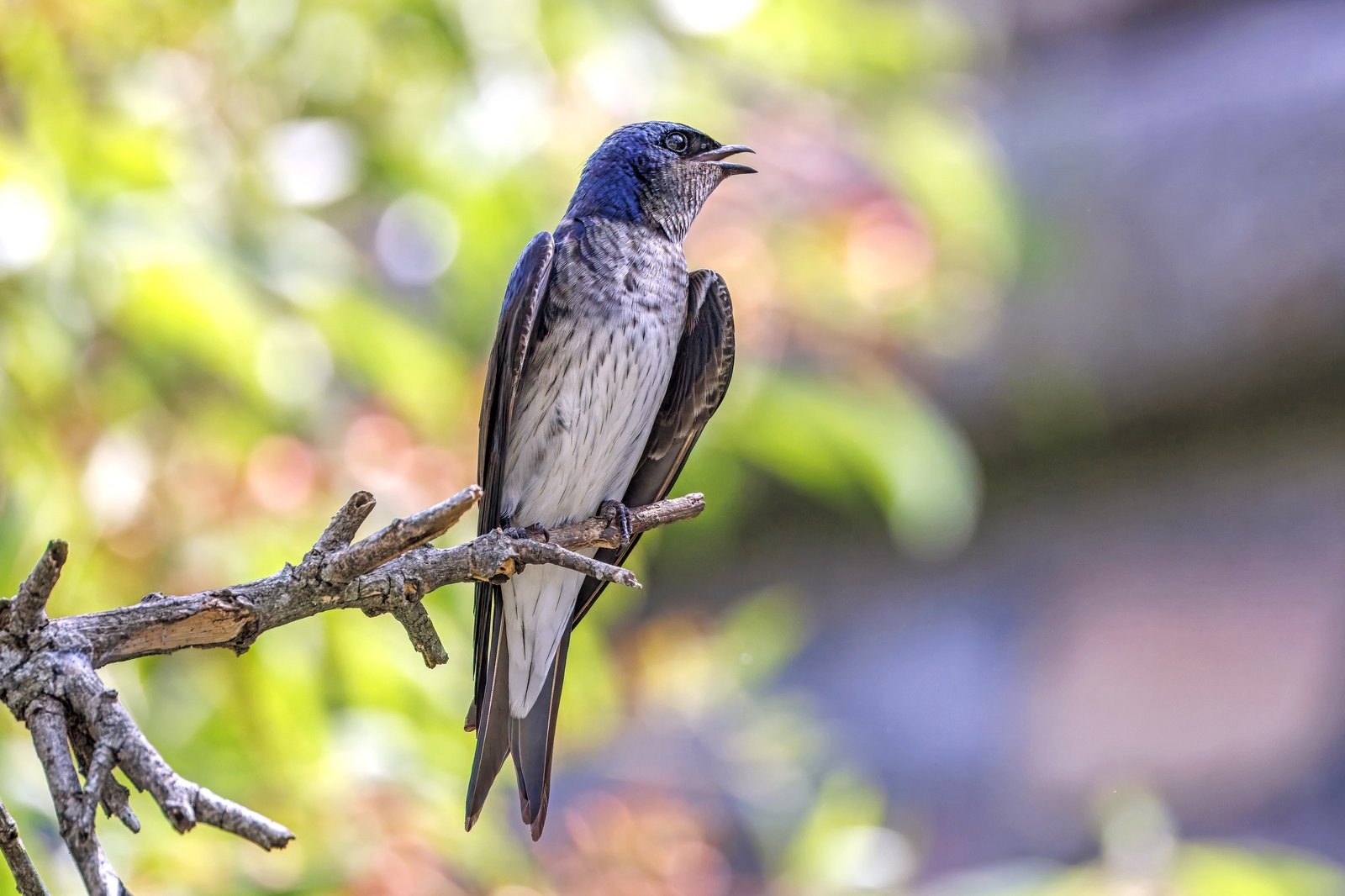
16–18 cm, a large swallow with broad wings and a forked tail. The male is glossy steel-blue to blue-black above; the throat, breast and flanks are grey-brown and merge gradually into the white belly and undertail coverts. The female is duller, with less gloss above and a paler, greyer throat and breast. Juveniles are dull brown above. Flight alternates flapping and gliding; often in flocks.
Confusion species
Male Caribbean Martin Progne dominicensis is entirely blue-black on the head, throat and breast, with a sharply defined white belly; the female closely resembles Grey-breasted Martin but has a darker brown breast that contrasts more sharply with the white belly. Purple Martin Progne subis, a passage migrant, is larger; the male is wholly blue-black, the female has a greyish collar, a pale forehead and often dark streaks below. Brown-chested Martin Progne tapera is brown above without gloss, with a white throat and a brown breast band.
Habitat
Open country with scattered trees, pastures, riverbanks, coasts and especially built-up areas, where birds perch on wires and roofs. It hunts flying insects, often higher than the smaller swallows. It nests in cavities: in and under the roofs of buildings, in old woodpecker holes and in banks. The clutch is usually two to four eggs.
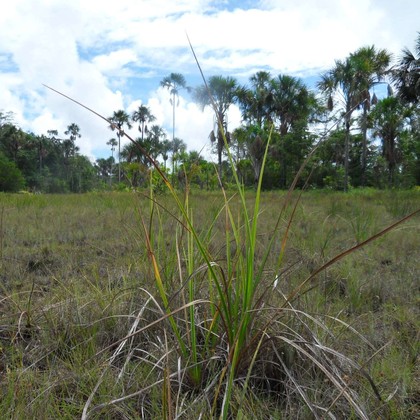
Where the bird is most at home, classified by the vegetation types of the Caribbean.




Range and movements
Resident on Trinidad and Tobago, with some movement after the breeding season. Reports from elsewhere in the region, including the ABC Islands and San Andrés, are few and not always certain, as female Caribbean Martins look very similar. Outside the region from Mexico to Argentina; the southernmost birds move to northern South America in the austral winter.
- Resident
- dark = core range, pale = thinly spread
How and when to look
In Port of Spain and other towns on Trinidad flocks sit on wires and roofs and are most active at nest sites in the morning. In the breeding season, when Caribbean Martins are also present, the colour of the throat and breast of the males is the first feature to check.
Conservation status
Least Concern. A common species with a very large range that uses buildings as nest sites.
Scientific name
Progne chalybea | (Gmelin, 1789)
Gmelin described the species in 1789 as Hirundo chalybea; because it was later moved to another genus, the author and year stand in brackets. The genus Progne was introduced in 1826 by Boie. Progne (also Procne) is the daughter of King Pandion of Athens in Greek myth, who was turned into a swallow; in Latin also a word for 'swallow'. chalybea is Latin for 'steel-coloured', from Greek khalups 'steel', after the steel-blue gloss of the upperparts. The specimen the first description was based on came from Cayenne, French Guiana.