All species › Passerines › Gnatcatchers › Blue-grey Gnatcatcher
Blue-grey Gnatcatcher | Polioptila caerulea
Blauwgrijze muggenvanger | Perlita azulgris
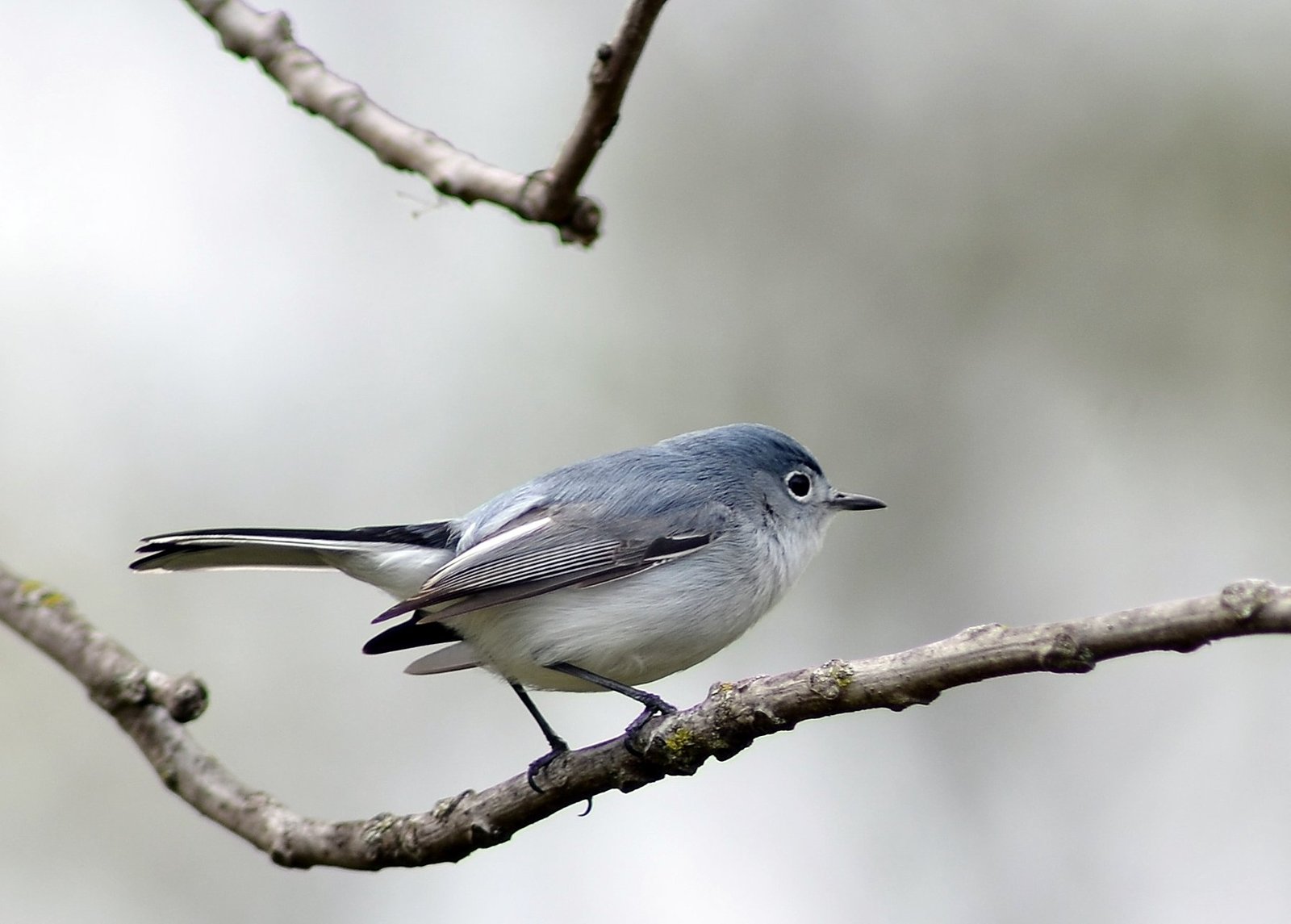
The Blue-grey Gnatcatcher is a small, active bird with a long, flicking tail. A subspecies of its own, caesiogaster, breeds in the Bahamas; in winter North American birds join it there and in Cuba and the Cayman Islands. In the north-west of the region it is then one of the commonest small wintering songbirds.
Voice
A thin, whining, nasal speee or chee, often repeated and heard all year. The song is a soft, high series of twitters and short nasal notes, heard in spring in the Bahamas.
Recording: Manuel Grosselet — CC BY-NC-SA 4.0 · converted to mono · xeno-canto
Identification
10–13 cm, slim, with a thin, straight bill and a long tail. Upperparts blue-grey, underparts white with a grey wash. A complete, narrow white eye-ring. The tail is black with white outer feathers and looks almost all white from below. Breeding males have a black line on the forehead that continues over the eye. Females and winter birds are greyer above and lack the line. It constantly flicks and fans its tail.
Confusion species
Cuban Gnatcatcher Polioptila lembeyei has a black crescent behind the eye around the ear coverts, is greyer below and lives only in coastal scrub in Cuba. A perched bird seen from above may recall a warbler, but the long black-and-white tail and plain blue-grey tone are distinctive.
Habitat
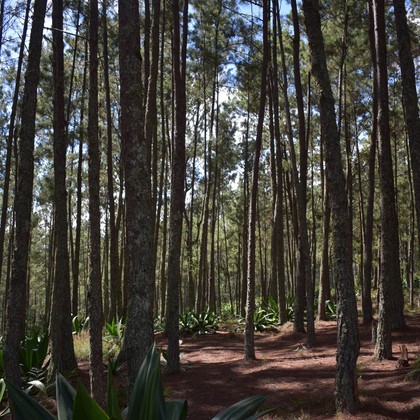
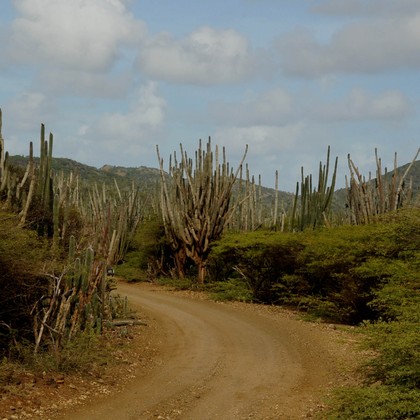
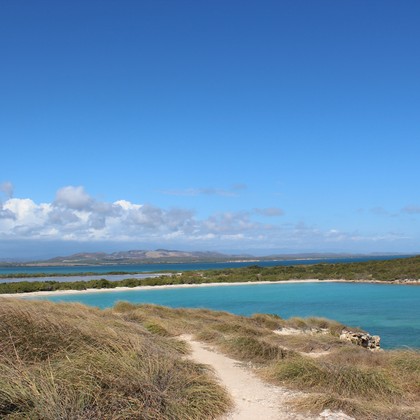
Pine forest, dry forest and coastal woodland, thorn scrub and coastal scrub, mangrove edges and gardens with trees and shrubs. It forages actively in the canopy and bushes for small insects and spiders, picked from leaves or caught in a short flight. The nest is a small, tall cup of plant fibres, spider silk and lichens on a branch.
Where the bird is most at home, classified by the vegetation types of the Caribbean.




Range and movements
Resident and breeding in the Bahamas, joined in winter by migrants from North America; present in the Turks and Caicos Islands. Common winter visitor to Cuba, including the Isle of Youth and the cays, and to the Cayman Islands. Rare to vagrant in Jamaica, Hispaniola, Puerto Rico and the Virgin Islands. Outside the region it breeds from southern Canada and the eastern and south-western United States to Mexico and Guatemala, and winters into Central America.
- Resident
- Summer visitor (c. Oct–Mar)
- Winter visitor (c. Apr–Sep)
- Passage (Mar–Apr, Oct–Nov)
- dark = core range, pale = thinly spread
How and when to look
In winter in Cuba in almost any dry forest and coastal scrub, for example on the Zapata Peninsula and the northern cays, and in the Bahamas in the pine forest. The nasal call and flicking tail give the bird away; in Cuba every gnatcatcher in coastal scrub is worth checking for the crescent of Cuban Gnatcatcher.
Conservation status
Not threatened. The population is large and has expanded its breeding range northwards in North America in recent decades.
Scientific name
Polioptila caerulea | (Linnaeus, 1766)
Linnaeus described the species in 1766 as Motacilla caerulea; because it was later moved to another genus, the author and year stand in brackets. The genus Polioptila was introduced in 1855 by Sclater. Polioptila is Greek, from polios 'grey' and ptilon 'feather': 'grey-feathered'. caerulea is Latin for 'sky-blue', after the blue-grey upperparts. The specimen the first description was based on came from Philadelphia, Pennsylvania, USA.