All species › Passerines › New World warblers › Blackburnian Warbler
Blackburnian Warbler | Setophaga fusca
Sparrenzanger | Reinita gorjinaranja
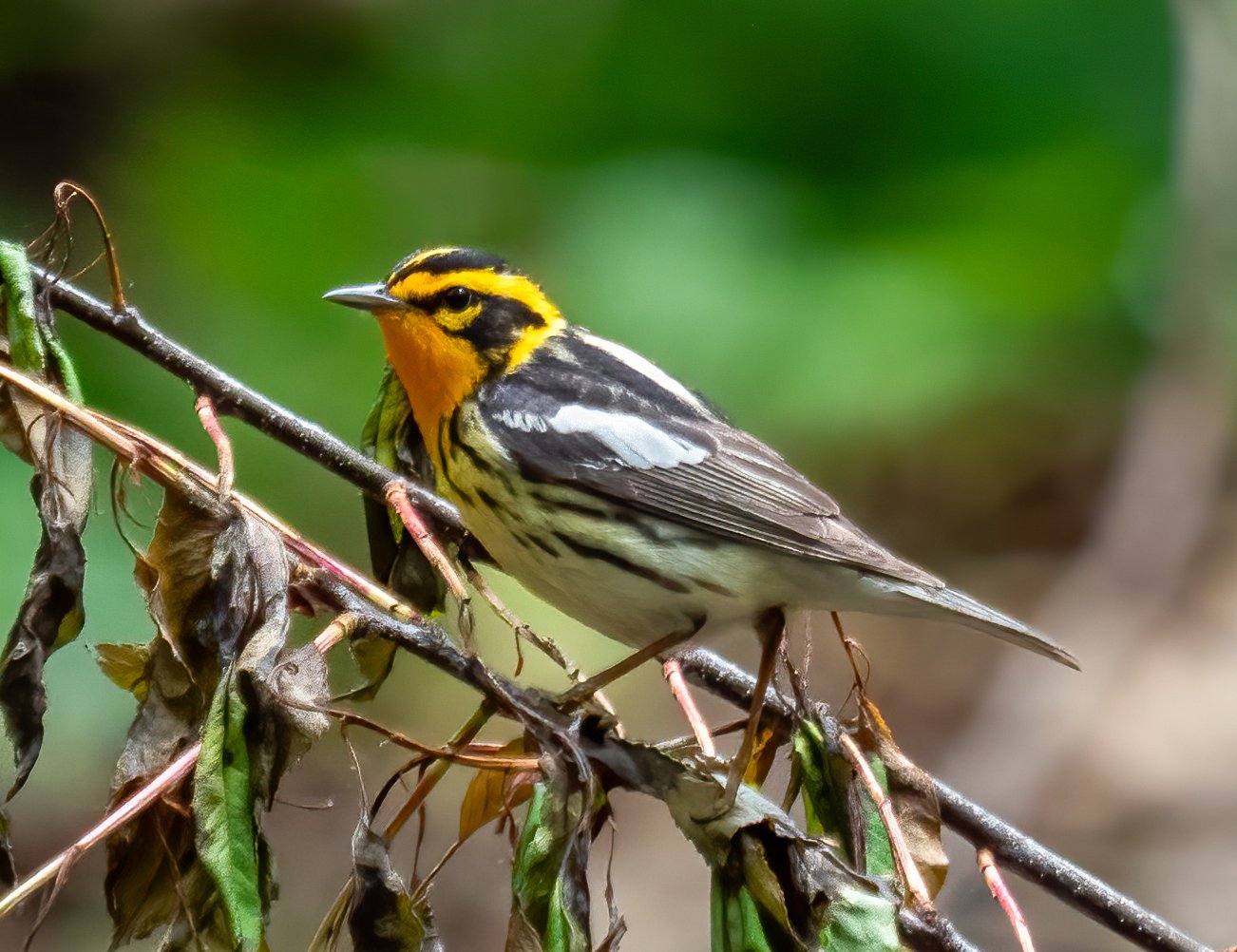
The Blackburnian Warbler is a warbler of the high canopy of conifer forest in north-eastern North America. The breeding male is the only warbler with a bright orange throat. It winters in montane forest in the Andes and migrates largely through Central America; only small numbers pass through the Caribbean, mainly in the west.
Voice
The call is a sharp chip. The song is very high-pitched and ends in a barely audible trill: tsee tsee tsee tsee tsiiiii; it is seldom heard on the islands.
Recording: Bates Estabrooks — CC BY-NC-SA 4.0 · shortened to the first 60 s, mono · xeno-canto
Identification
11–13 cm. The breeding male is black above, with two pale stripes on the back, a large white wing patch and a bright orange throat, supercilium and crown spot around a black triangular cheek patch; the belly is white to yellowish, with black flank streaks. Females and autumn birds are duller: grey-brown above with pale back stripes, two white wing bars, a yellow-orange to pale yellow throat and supercilium surrounding the dark cheek, and streaked flanks. In every plumage the dark triangular cheek framed by pale is distinctive.
Confusion species
Yellow-throated Warbler Setophaga dominica has a lemon-yellow throat, a plain grey unstreaked back and a white neck patch. Female Black-throated Green Warblers Setophaga virens have a green back and a yellow cheek without a dark triangle. Autumn Bay-breasted Warblers Setophaga castanea and Blackpoll Warblers Setophaga striata lack the contrasting face pattern and have greenish backs.
Habitat
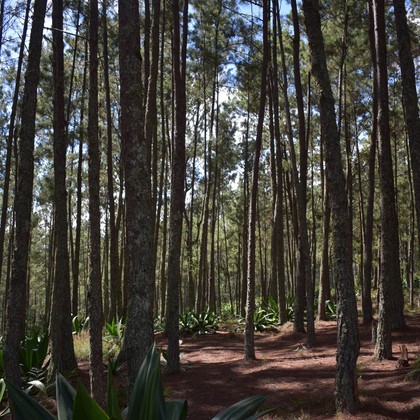
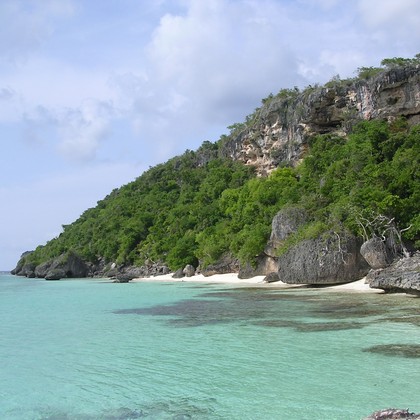
On passage high in the canopy of all kinds of forest, from coastal woodland and pine forest to montane forest, and in tall trees in parks and gardens; often in mixed flocks with other warblers.
Where the bird is most at home, classified by the vegetation types of the Caribbean.



Range and movements
A scarce passage migrant in the Bahamas, Cuba, Jamaica and the Cayman Islands, mainly in autumn; rare on Hispaniola (Haiti and the Dominican Republic), Puerto Rico, the Virgin Islands, the Lesser Antilles and Trinidad and Tobago. A few birds have been recorded in winter. Breeds in Canada, the north-eastern United States and the Appalachians; winters mainly in the Andes from Colombia and Venezuela to Peru and Bolivia, in smaller numbers in southern Central America.
- Resident
- Summer visitor (c. Oct–Mar)
- Winter visitor (c. Apr–Sep)
- Passage (Mar–Apr, Oct–Nov)
- dark = core range, pale = thinly spread
How and when to look
The best chance is in September and October on Cuba and the Bahamas, in the crowns of tall trees with mixed flocks of migrant warblers. Even an autumn bird stands out by its pale face with the dark cheek triangle.
Conservation status
Not threatened. The population is stable. On the breeding grounds the species is sensitive to the logging of old conifer forest, and on the wintering grounds to the loss of montane forest in the Andes.
Scientific name
Setophaga fusca | (Müller, 1776)
Müller described the species in 1776 as Motacilla fusca; because it was later moved to another genus, the author and year stand in brackets. The genus Setophaga was introduced in 1827 by Swainson. Setophaga is Greek, from sēs, sētos 'moth' and -phagos '-eating': 'moth-eater'. fusca is Latin for 'dusky, dark', after the dark plumage of the female and young bird. The specimen the first description was based on came from French Guiana.