All species › Passerines › Waxbills › Black-rumped Waxbill
Black-rumped Waxbill | Estrilda troglodytes
Zwartstaartastrild | Estrilda culinegra
The Black-rumped Waxbill is native to the savanna belt of sub-Saharan Africa, from Senegal to Ethiopia. In the Caribbean it is established on Guadeloupe and Martinique; on Puerto Rico and the Virgin Islands, where it was reported earlier, recent records are few.
Voice
A sharp chip or tset contact call, also in flight. The song is a short series of nasal notes.
Recording: Romuald Mikusek — CC BY-NC-SA 4.0 · converted to mono · xeno-canto
Identification
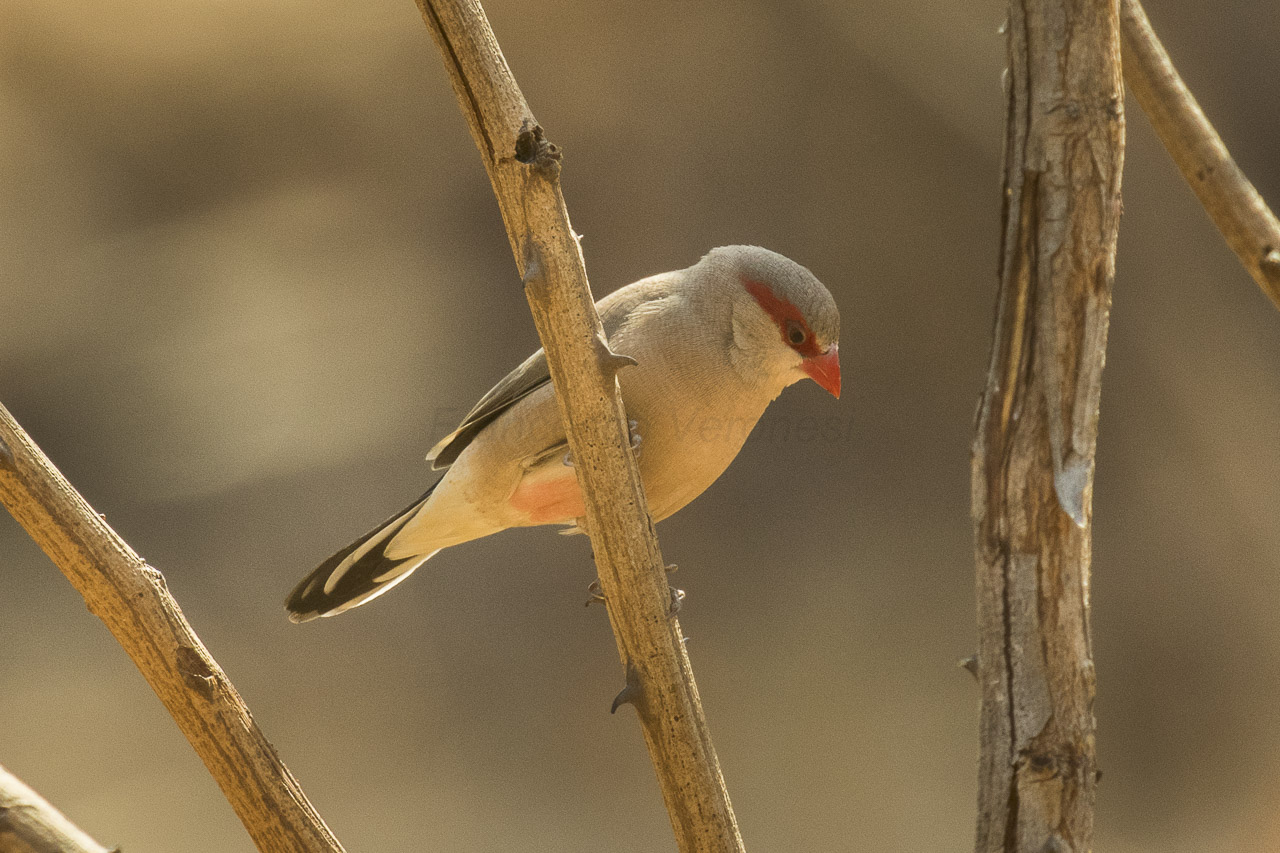
9–10 cm, small and slim, with a fairly long, black tail. The bill is red and a narrow red stripe runs through the eye. The upperparts are pale grey-brown and almost unbarred; the underparts are pale greyish with a pink wash, strongest on the belly. Rump and uppertail coverts are black, the undertail coverts white. The sexes are similar; the female has less pink on the belly. Juveniles are duller, with a faint eye-stripe and a dark bill.
Confusion species
Common Waxbill Estrilda astrild is larger and longer-tailed, clearly finely barred, with a brown rump, black undertail coverts and a red belly streak. Orange-cheeked Waxbill Estrilda melpoda has an orange cheek without an eye-stripe and a red rump. Female Red Avadavat Amandava amandava has a red rump and white spots on the wing.
Habitat
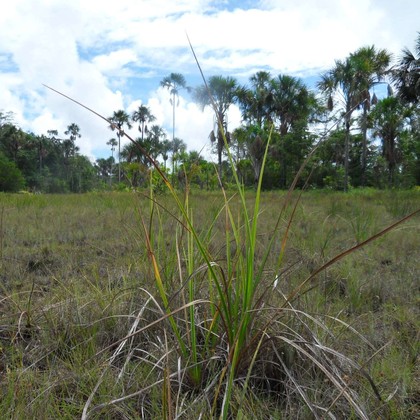
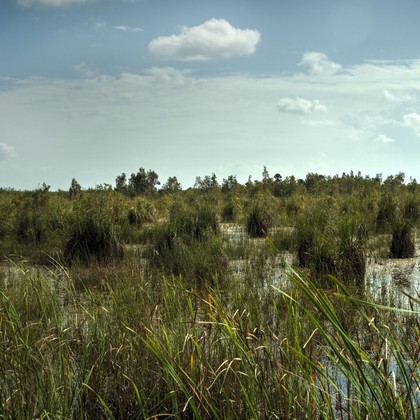
Tall grass and rank vegetation in dry to damp open country: pastures, roadsides, fallow land, the edges of fields and cane fields, scrub with grassy clearings and the grassy banks of ditches. It forages in small flocks on grass seeds, restlessly flicking its tail from side to side. The nest is a ball of grass with a side entrance, low in dense vegetation.
Where the bird is most at home, classified by the vegetation types of the Caribbean.



Range and movements
Introduced and established on Guadeloupe and Martinique. Formerly reported locally on Puerto Rico, where it is now rarely seen; probably extirpated from the US Virgin Islands. Native from Senegal and Gambia east to Ethiopia, northern Uganda and north-western Kenya. Also introduced to Hawaii, the Iberian Peninsula and Japan.
- Resident
- dark = core range, pale = thinly spread
How and when to look
Guadeloupe offers the best chances, in grassy areas and along roadsides in the lowlands. When a bird flicks its tail sideways, the black rump and tail and the white undertail are visible, separating it from Common Waxbill.
Conservation status
Not threatened globally. In the Caribbean a locally established alien.
Scientific name
Estrilda troglodytes | (Lichtenstein, 1823)
Lichtenstein described the species in 1823 as F[ringilla] Troglodytes; because it was later moved to another genus, the author and year stand in brackets. The genus Estrilda was introduced in 1827 by Swainson. Estrilda was formed from astrild, the epithet Linnaeus gave the common waxbill; the origin of that word is uncertain — perhaps a German or Dutch avicultural term for a waxbill, perhaps a misprint for Estrilda. troglodytes is Greek trōglodytēs 'cave-dweller', from trōglē 'hole' and dyein 'to enter'. The specimen the first description was based on came from Senegambia.