All species › Cuckoos › Cuckoos › Chestnut-bellied Cuckoo
Chestnut-bellied Cuckoo | Coccyzus pluvialis
Jamaicaanse regenkoekoek | Cuco de lluvia jamaicano
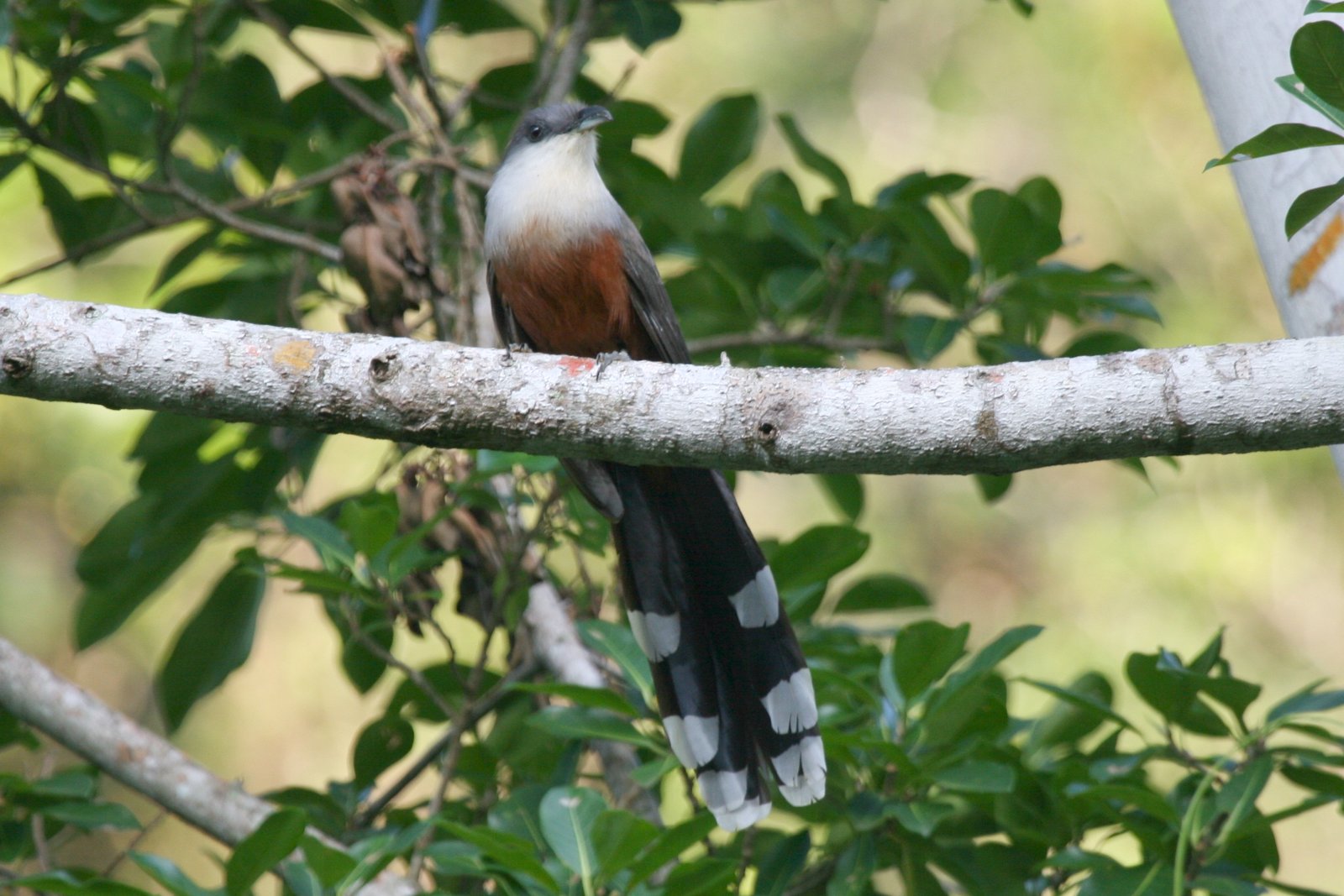
The Chestnut-bellied Cuckoo is a large, long-tailed cuckoo found only in Jamaica. On the island it is known as Old Man Bird, Hunter and Rain Bird, among other names; the last refers to the folk belief that its call foretells rain. Together with Bay-breasted Cuckoo it was formerly placed in its own genus Hyetornis; today both are included in Coccyzus.
Voice
A hoarse quak-quak-ak-ak-ak-ak, starting slowly and accelerating towards the end. The call of Jamaican Lizard Cuckoo is similar, but lower and fast from the start, a rattling cak-cak-cak-ka-ka-ka.
Recording: Bobby Wilcox — CC BY-NC-SA 4.0 · converted to mono · xeno-canto
Identification
48–56 cm, about half of it tail; this makes it the largest cuckoo in Jamaica. The upperparts are dull brown, the face and breast light grey with a paler throat, the belly dark rufous. The blackish bill is heavy and clearly decurved. The long, graduated tail is black with a purple gloss and large white tips, visible especially from below. The sexes are alike. Juveniles have a dark brown tail without gloss but with white tips.
Confusion species
Jamaican Lizard Cuckoo Coccyzus vetula is smaller and slimmer, with a long, straight bill with a paler lower mandible, red bare skin around the eye, rufous primaries and a whitish throat; the rest of the underparts are rufous too, but paler. Mangrove Cuckoo Coccyzus minor and Yellow-billed Cuckoo Coccyzus americanus are much smaller; the former has a black mask and buff underparts, the latter is white below.
Habitat
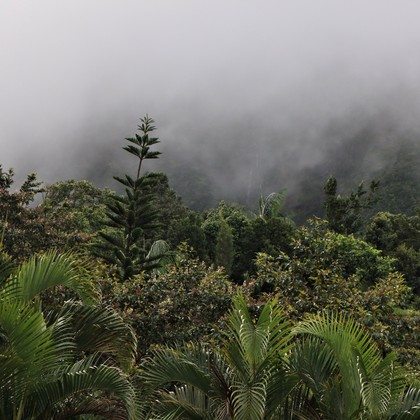
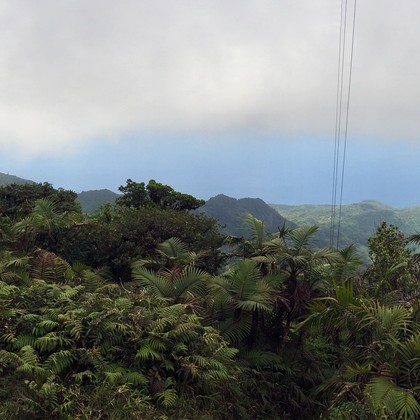
Evergreen forest, secondary forest, thickets and brush and semi-open woodland, from sea level to above 1,500 m; in the mountains also in scrub along forest edges. It hops along branches and through vines and eats adult insects, caterpillars, lizards, nestlings and eggs. The nest is a shallow twig platform in a tree, up to about 10 m above the ground. Breeding is usually from March to June, sometimes from February; the clutch is two to four eggs.
Where the bird is most at home, classified by the vegetation types of the Caribbean.


Range and movements
Only in Jamaica, spread over most of the island wherever forest or dense vegetation remains, from the lowlands up into the Blue Mountains. The species does not occur outside Jamaica.
- Resident
- dark = core range, pale = thinly spread
How and when to look
Wooded hills and mountain slopes, such as the Blue Mountains, the John Crow Mountains and Cockpit Country, offer the best chance; the species also occurs in rough, overgrown farmland. It is often heard first. A large cuckoo hopping through the branches like a squirrel and showing a long black tail with big white spots as it flies across is, in Jamaica, one of the two large endemic cuckoos; the grey breast, dark belly and curved bill point to this species.
Conservation status
Not threatened. The range is small, but the species is widespread in Jamaica and the population is thought to be stable, although its size is not known. It also occurs in secondary forest and thickets and is therefore less vulnerable to forest loss than species tied to old forest.
Scientific name
Coccyzus pluvialis | (Gmelin, 1788) (GBIF: Hyetornis pluvialis)
Gmelin described the species in 1788 as Cuculus pluvialis; because it was later moved to another genus, the author and year stand in brackets. The genus Coccyzus was introduced in 1816 by Vieillot. Coccyzus is Greek, from kokkuzō 'to cry cuckoo', after the cuckoo's call. pluvialis is Latin for 'relating to rain', after old names such as 'Rainbird' and 'Oiseau de pluie' for this Jamaican cuckoo. The specimen the first description was based on came from Jamaica.