All species › Passerines › New World warblers › Bahama Yellowthroat
Bahama Yellowthroat | Geothlypis rostrata
Bahamamaskerzanger | Mascarita de las Bahamas
The Bahama Yellowthroat is a large, heavy-billed yellowthroat found only on a few islands of the northern Bahamas. It resembles the Common Yellowthroat, which also occurs there in winter, but lives in drier terrain and moves more slowly and deliberately through the undergrowth.
Voice
The song resembles that of Common Yellowthroat, a loud wichety-wichety-wichit, but is somewhat lower and slower. There is also a quiet 'whisper song' with trills and spluttering notes. The usual call is a sharp tuck.
Recording: Jim Holmes — CC BY-NC-SA 4.0 · converted to mono · xeno-canto
Identification
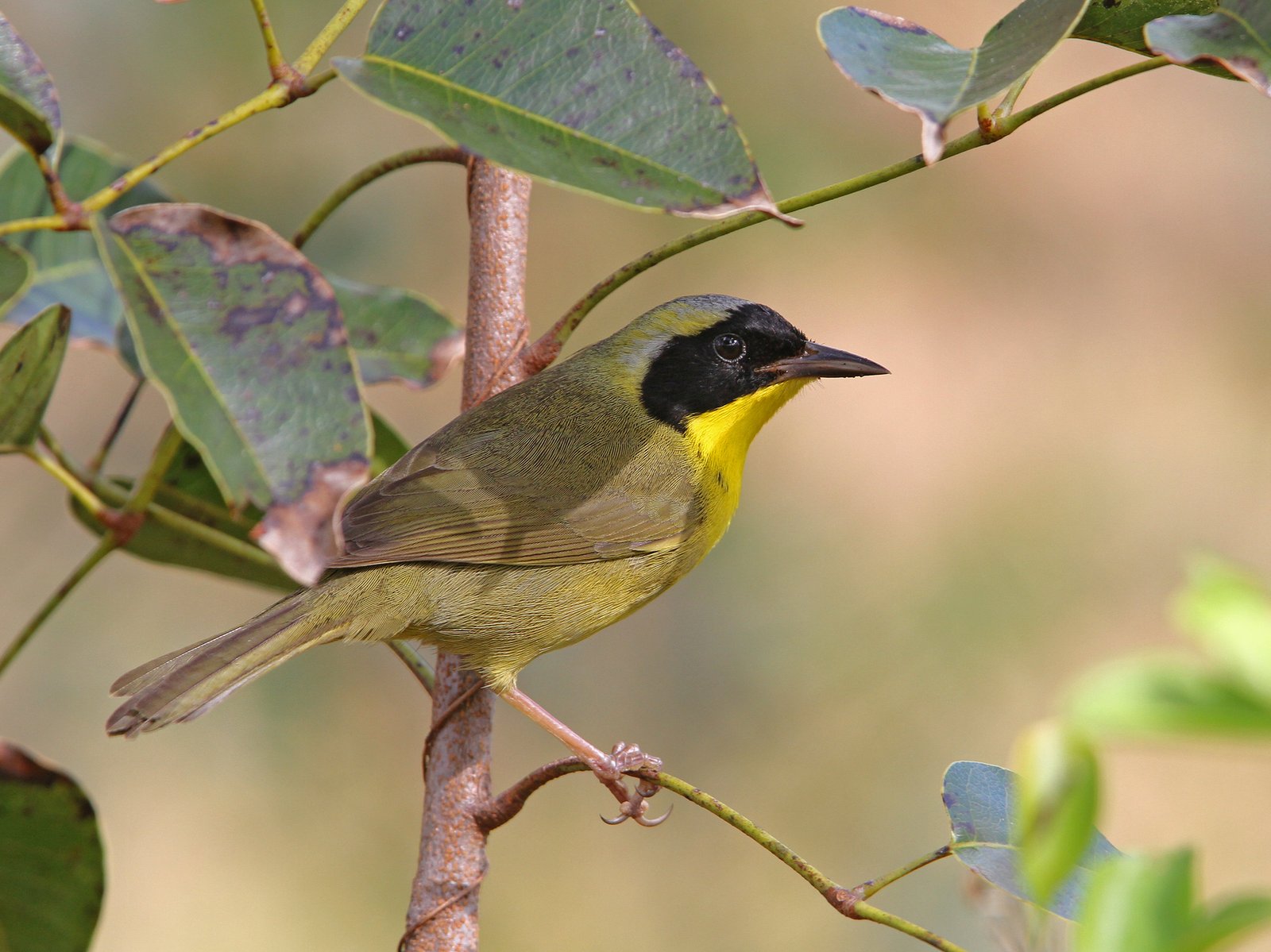
15 cm, clearly larger than Common Yellowthroat, with a thick black bill and dusky pink legs. The male has a broad black mask from forehead to neck side, bordered above by a grey-white band that merges into a grey hindcrown and nape. Upperparts are yellowish olive-green, throat and breast yellow and the rest of the underparts slightly paler yellow with olive flanks. The female lacks a mask and has a brownish crown, a thin grey-white supercilium and greyish ear-coverts; her underparts are also largely yellow.
Confusion species
Common Yellowthroat Geothlypis trichas, present on the same islands in winter, is smaller and finer-billed, with a whitish belly; the male has a narrower, whiter band above the mask and no grey hindcrown. It favours wetter, low vegetation. Females are more alike; they are separated by bill, size and the more evenly yellow underparts of Bahama Yellowthroat.
Habitat
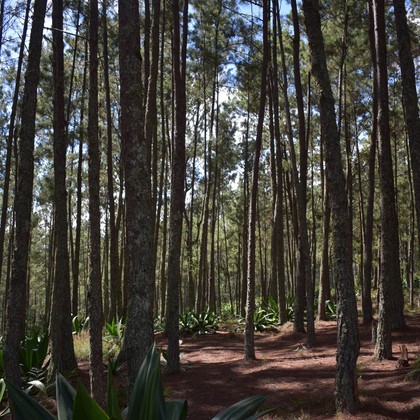
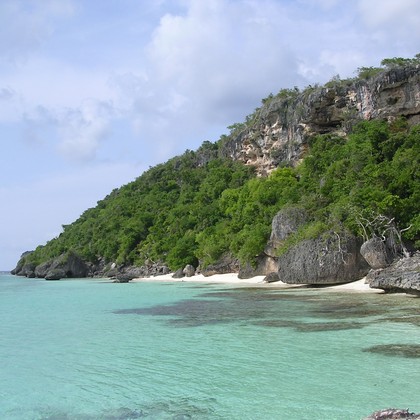
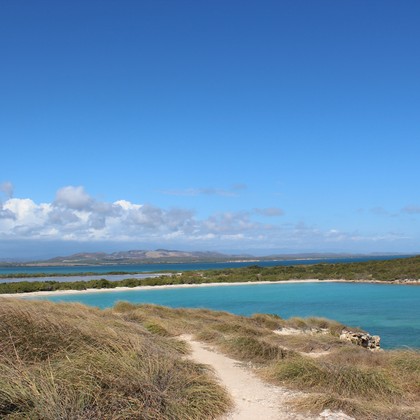
Mainly the understorey of open pine forest with bracken and low thatch palms, also dense shrubbery along forest edges, coastal woodland, dry broadleaf coppice and overgrown ground. Marshes and wet areas are avoided. It searches for insects and other invertebrates low in the vegetation and on the ground.
Where the bird is most at home, classified by the vegetation types of the Caribbean.

Range and movements
Only in the northern Bahamas: Grand Bahama, Abaco and Little Abaco, Andros, New Providence, Eleuthera and Cat Island, with different subspecies on different island groups. It does not occur in the southern Bahamas or beyond.
- Resident
- dark = core range, pale = thinly spread
How and when to look
In the pine forests of Abaco, Grand Bahama and Andros, early in the morning when males sing from a low shrub or palm frond. The slow movements and heavy bill help to separate it from Common Yellowthroats, which in winter keep mainly to wet vegetation.
Conservation status
Not threatened, but numbers are thought to be decreasing. The species has a small range and is vulnerable to the logging and burning of pine forest, development and hurricanes, which have damaged large parts of the forest on Abaco and Grand Bahama.
Scientific name
Geothlypis rostrata | Bryant, 1867
Bryant described the species in 1867 and placed it straight away in the genus where it still stands. The genus Geothlypis was introduced in 1847 by Cabanis. Geothlypis is Greek, from gē 'ground' and thlupis, an unidentified small bird: 'ground warbler', after its life low in dense cover. rostrata is Latin for 'billed, large-billed' (from rostrum 'bill'), after the heavier bill than in related yellowthroats. The specimen the first description was based on came from Nassau, New Providence, Bahamas.