All species › Pigeons and doves › Pigeons and doves › African Collared Dove
African Collared Dove | Streptopelia roseogrisea
Izabeltortel | Tórtola rosigrís
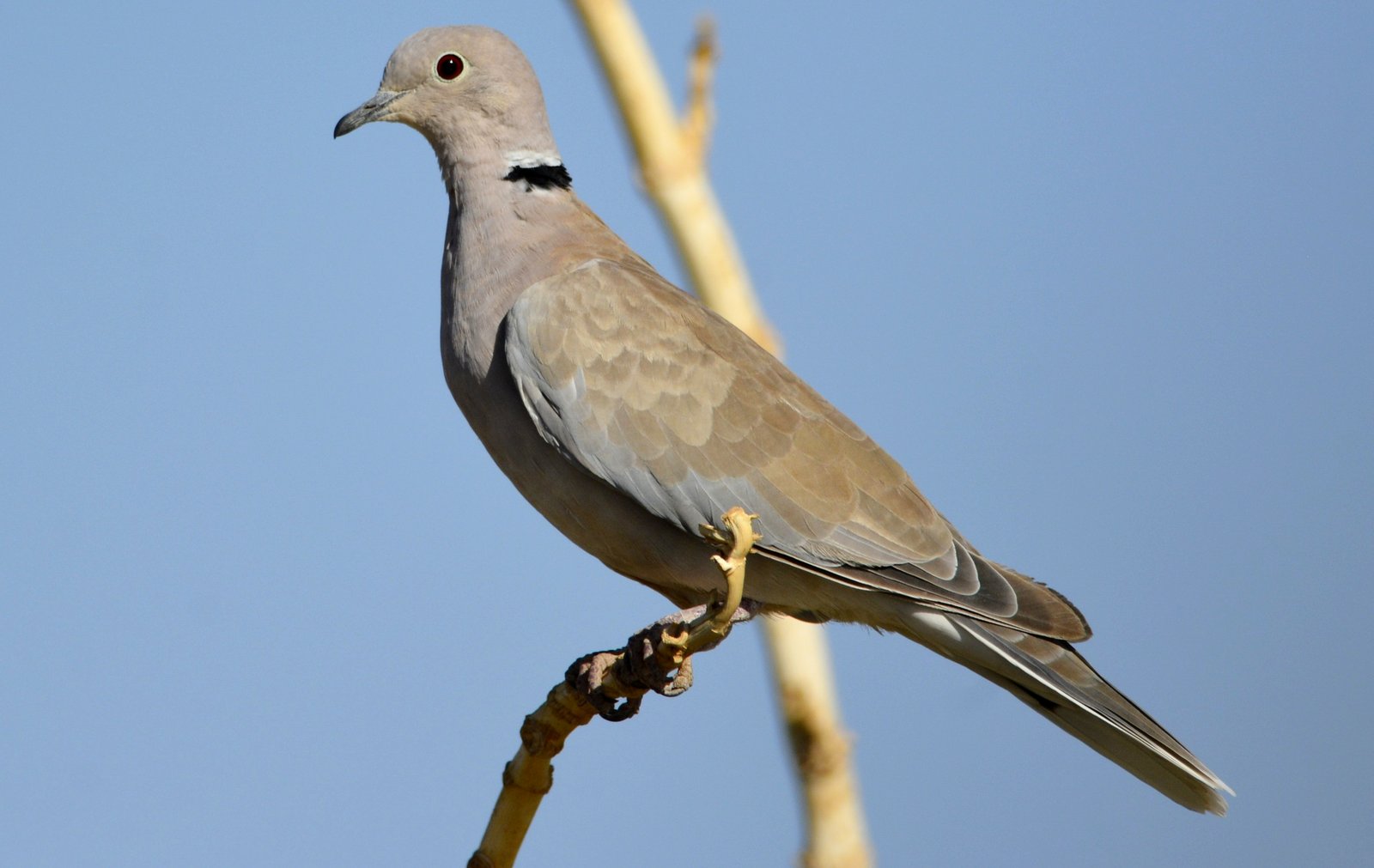
The African Collared Dove is a small, pale dove with a black neck ring, the wild ancestor of the Barbary Dove, the domestic dove kept in cages and aviaries for centuries. It is not native to the Caribbean. Puerto Rico holds a feral population in the dry coastal lowlands of the south and south-west; in Puerto Rican Spanish it is called paloma collarina africana. Birds in the field often cannot be assigned with certainty to the wild form, the domestic Barbary Dove or hybrids.
Voice
A soft, rolling coo in two parts, a short note followed by a long, trilled one: coo-krrrrooo. Also a soft, cackling laugh, typical of the domestic Barbary Dove as well. Eurasian Collared Dove calls in three clearly separated syllables.
Recording: Zsombor Károlyi — CC BY-NC-SA 4.0 · converted to mono · xeno-canto
Identification
25–28 cm, smaller and more slender than Eurasian Collared Dove. The plumage is pale grey-brown with a creamy tone, head and neck pale pink, belly and undertail coverts white. On the nape a narrow black collar, edged white above. The primaries are grey-brown and contrast only slightly with the rest of the wing. From below, the tail is black at the base and white beyond. The iris is red, the legs pink to red. The sexes are alike. Domestic Barbary Doves are often paler still, up to wholly cream or white, and may have paler legs and bill.
Confusion species
Eurasian Collared Dove Streptopelia decaocto is larger, darker and greyer, with grey undertail coverts, clearly dark primaries and a three-part call. In the field the distinction is often possible only on call and the colour of the undertail coverts. Zenaida Dove Zenaida aurita and Common Ground Dove Columbina passerina lack the collar.
Habitat
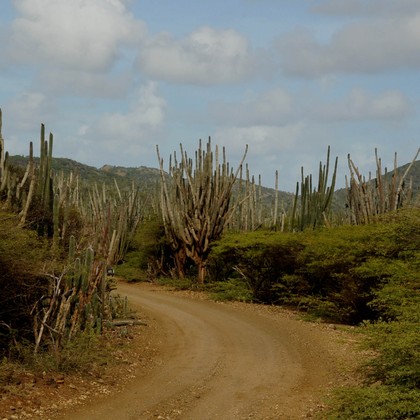
Villages and towns, gardens and yards in dry lowlands, and adjoining dry scrub and dry forest. In Puerto Rico almost confined to the subtropical dry and moist zones of the southern and south-western coastal plain, usually close to houses. It eats seeds and grain on the ground. According to the Puerto Rico Breeding Bird Atlas it breeds from January to July, peaking in May; the nest is a flimsy stick platform in a tree or shrub.
Where the bird is most at home, classified by the vegetation types of the Caribbean.



Range and movements
Feral in southern and south-western Puerto Rico, including the municipality of Cabo Rojo. Birds have also been reported repeatedly from Barbados, Cuba, the Dominican Republic and Grenada, with single records from several other islands; these are often escaped Barbary Doves, and whether established populations exist outside Puerto Rico is unclear. Native to the Sahel, the northern Horn of Africa and the south-western Arabian Peninsula.
- Resident
- dark = core range, pale = thinly spread
How and when to look
In Puerto Rico in villages and residential areas in the south-west, where it occurs among Eurasian Collared Doves. The call is the best way to separate the two; the white undertail is also visible on birds perched on a wire.
Conservation status
Not threatened globally. In the Caribbean an alien. Little is known about numbers and trends in Puerto Rico, and confusion with Eurasian Collared Dove and with domestic Barbary Doves means its distribution in the region is incompletely described.
Scientific name
Streptopelia roseogrisea | (Sundevall, 1857)
Sundevall described the species in 1857 as Columbam roseogriseam; because it was later moved to another genus, the author and year stand in brackets. The genus Streptopelia was introduced in 1855 by Bonaparte. Streptopelia is Greek, from streptos 'collar, twisted chain' and peleia 'dove', after the dark neck collar of these doves. roseogrisea is Latin, from roseus 'rose-red' and griseus 'grey', after the pinkish-grey plumage. The specimen the first description was based on came from Nubia.