All species › Waders, gulls and terns › Gulls and terns › Sabine's Gull
Sabine's Gull | Xema sabini
Vorkstaartmeeuw | Gaviota de Sabine
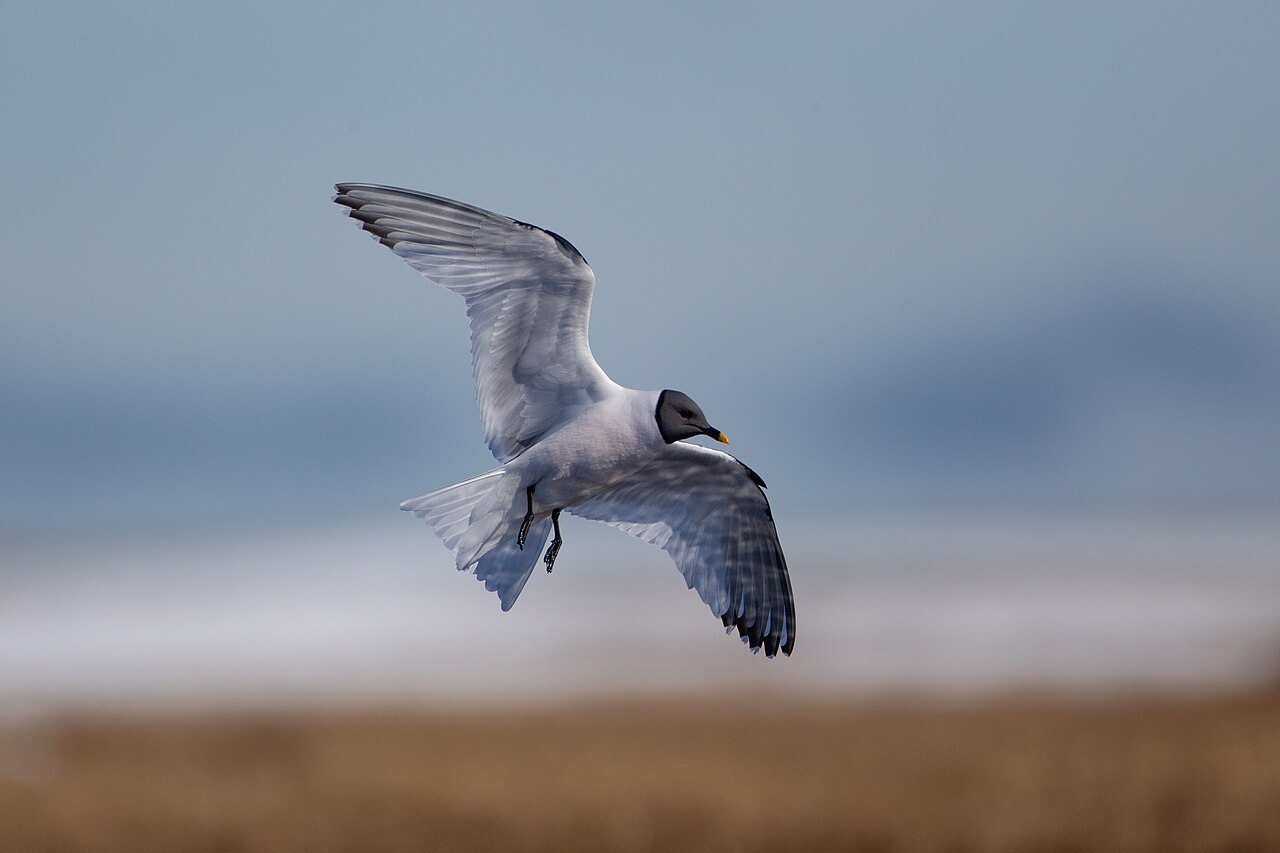
A small, tern-like gull of the open ocean, brought within reach of the coast only by a sustained north-westerly blow. The black, white and grey triptych on the upperwing is recognisable at long range, even through a telescope full of mist and rain.
Click a thumbnail to switch the photo above.
Voice
Usually silent at sea. At the colony and in small parties it gives a harsh, tern-like ki-k-k-kree, higher and more grating than a Kittiwake. Off western European coasts the call is effectively irrelevant, since birds pass at range and into the wind.
Recording: Stein Ø. Nilsen — CC BY-NC-SA 4.0 · Wikimedia Commons
Identification
Summer adults have a slate-grey hood closed off below by a thin black collar, and a black bill with a yellow tip. The back and forewing are grey, the outer primaries black and the inner primaries and secondaries white, so the upperwing carries three sharply bounded triangles. The tail is white and clearly forked. Most birds passing western Europe are juveniles, with the same wing pattern but with brown-scalloped back and coverts, a black terminal tail band, and a grey-brown boa running from the crown down the side of the neck.
Confusion species
Juvenile Kittiwake is the bird that turns up on the same days. Both are small, fast and boldly marked, but the pattern does not match: Kittiwake carries a black W across outstretched wings and a black collar on the nape, while Sabine's shows three clean triangles, black outside, white in the middle and grey on the forewing, with no collar. If the tail is visible the case is closed: forked on Sabine's, at most shallowly notched on Kittiwake and with a black terminal band running into the corners.
Habitat
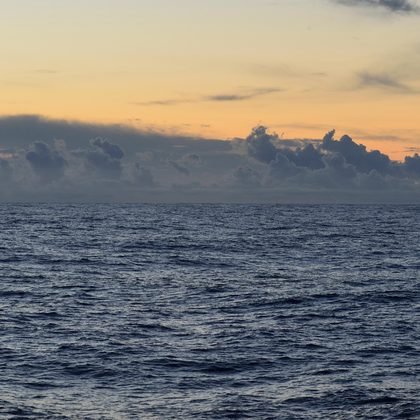
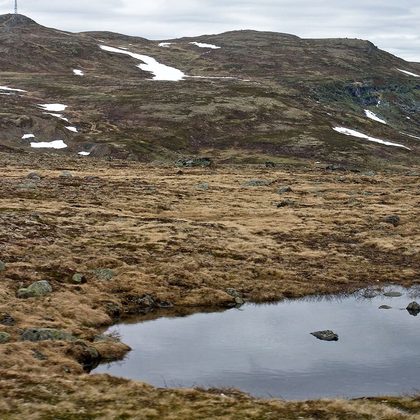
Outside the breeding season a true pelagic seabird, working the open ocean over upwelling zones and reaching sight of land only in heavy weather. Breeds on low-lying, wet high-arctic tundra dense with pools and ponds, often in small loose colonies among Arctic Terns, picking insects, larvae and small fish from the surface.
Where the bird is most at home, classified with EUNIS — the European standard for habitats.
Range and movements
Breeds in high-arctic North America, Greenland, Svalbard and Siberia; Svalbard is the nearest breeding ground to Europe. Birds passing the North Sea come from the eastern North American Arctic and Greenland and stage in the Bay of Biscay before continuing to the waters off south-western Africa. Numbers seen from land are small everywhere, with the Atlantic coasts of the British Isles and Iberia doing better than the North Sea. Iberian records concentrate off Asturias and Galicia, mainly on autumn passage; in the Canaries it is considered accidental.
- Resident
- Breeding (summer)
- Winter
- Passage
- dark = core range, pale = thinly spread
How and when to look
Seawatching is the only approach. On a September or October day with force seven or more from the north-west, go to Westkapelle, the Brouwersdam or Camperduin, sit out of the wind and work the surf line and the band beyond it. Expect a juvenile rather than an adult, so look for the triangles and not for the grey hood.
Conservation status
Not globally threatened and, as far as is known, increasing rather than declining. In the Siberian part of the range birds suffer from hunting and egg collecting. The longer-term uncertainty is climate: both the wet tundra it nests on and the upwelling systems it winters over are sensitive to change.
Scientific name
Xema sabini | (Sabine, 1819)
Sabine described the species in 1819 as Larus sabini; because it was later moved to another genus, the author and year stand in brackets. The genus Xema was introduced in 1819 by Leach. Xema appears to be an invented name without meaning; William Leach introduced it in 1819 without explanation. sabini honours the British polar explorer Edward Sabine (1788–1883), who collected the first specimens on islets off the west coast of Greenland; his brother Joseph described the species from that material. The specimen the first description was based on came from the Sabine Islands, Greenland.