All species › Gamebirds › Pheasants and partridges › Rock Ptarmigan
Rock Ptarmigan | Lagopus muta
Alpensneeuwhoen | Lagópodo alpino
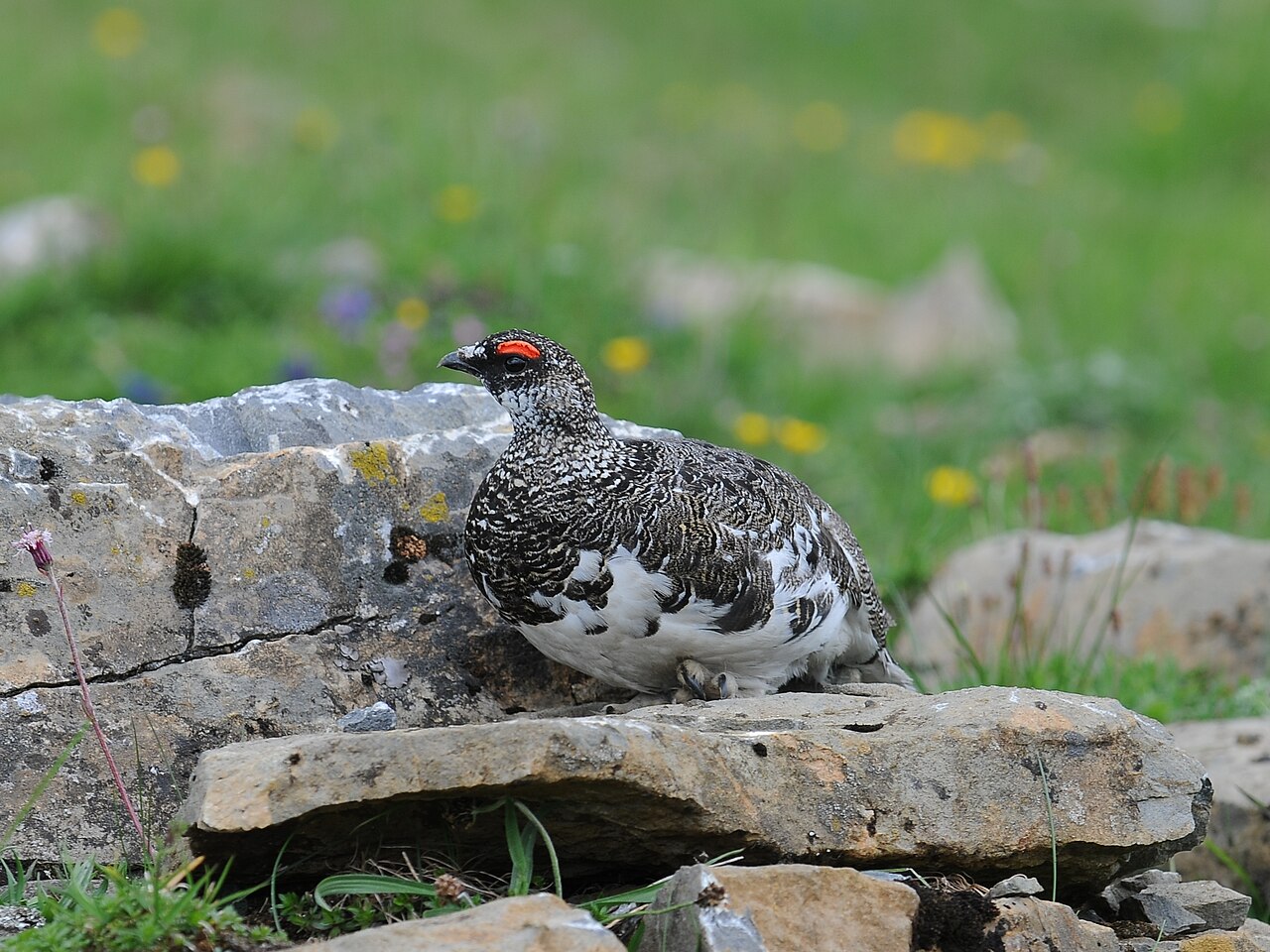
A grouse that changes its plumage three times a year and stays above the tree line all year round. On the bare boulder fields of the Alps a birdwatcher can walk straight past one: the bird does not stir until you are ten metres away, and then it slips off on foot between the blocks.
Click a thumbnail to switch the photo above.
Voice
Dry and creaking, closer to a noise than a song. The cock gives a rasping arr-arr-ka-ka-ka, like a stick drawn across a comb, usually from a boulder or during a short display flight in which he planes down on stiff wings. Flushed birds give a short kerr-kerr. On a still morning the rattle carries several hundred metres across the stones and finds the bird long before the eye does.
Recording: Lawrence Shove / British Library — CC BY-SA 4.0 · Wikimedia Commons
Identification
A small, round grouse with a notably fine, short bill and fully feathered feet. Winter birds are white with a black tail that shows only in flight; the cock adds a black loral stripe running from the bill base through the eye and a red comb above it. Summer plumage is grey-brown with dense dark vermiculation, the belly and wings staying white, and autumn plumage is a colder, plainer ash-grey. The primaries are white all year. A cock in summer plumage is at its most striking in early June in the Alps.
Confusion species
The comparison that matters is with Willow Grouse, absent from the map area outside Scandinavia but sharing the same fells with Rock Ptarmigan there. In white winter plumage only the cock Rock Ptarmigan carries the black loral stripe; hens lack it, so its absence proves nothing. In summer Rock Ptarmigan is cold grey with fine vermiculation while Willow Grouse is warm rufous with coarser barring, the cock showing a chestnut head and neck against a still-white body. In autumn Rock Ptarmigan is uniform ash-grey and Willow Grouse warmer brown and more broadly barred. The bill settles it: small and slight on Rock Ptarmigan, clearly deeper and heavier on Willow Grouse. Red Grouse is the easy one in this group, being the only bird here that never turns white and stays red-brown all year. On the British Isles Rock Ptarmigan and Red Grouse overlap in altitude on the shoulders of the hills, Red Grouse coming up out of the heather and Ptarmigan coming down off the plateau.
Habitat
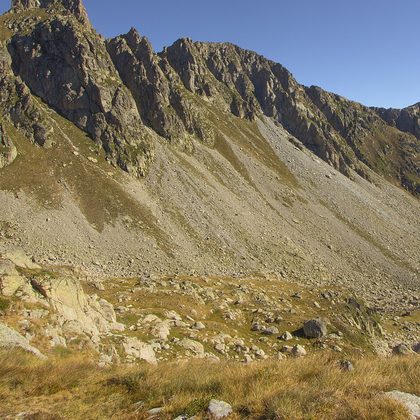
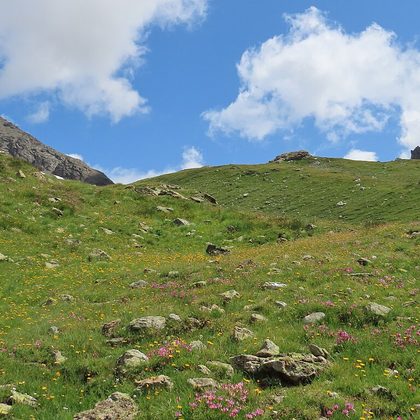
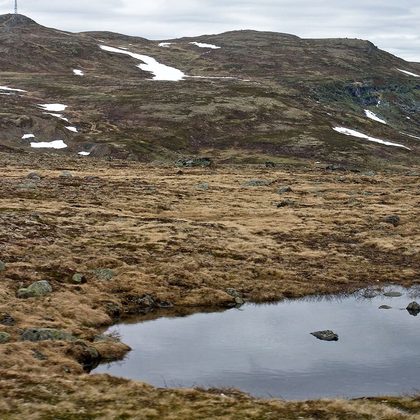
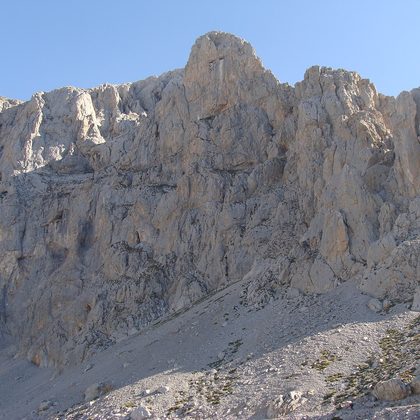
The alpine zone above the tree line: screes, boulder fields, short alpine turf with dwarf shrubs, and the edges of snowfields. In the Alps and Pyrenees from about 1800 metres to above 3000 metres; in Scandinavia and Iceland much lower, on stony tundra and bare mountain ridges. It forages on foot on buds, leaves and berries of dwarf willow, bog bilberry and crowberry; in winter it digs itself into snow holes.
Where the bird is most at home, classified with EUNIS — the European standard for habitats.

Range and movements
Iceland, the Scandinavian mountains and the far north-east of Europe, the British Isles and, isolated in the south, the Alps and the Pyrenees. On the British Isles only in the Highlands (subspecies millaisi), with the Cairngorms, Lochnagar, Drumochter and the Torridon and Wester Ross tops as the core. In the Pyrenees the subspecies pyrenaica, from the Mesa de los Tres Reyes to the Maladeta and on through the eastern Pyrenees, with 400 to 700 pairs in the Aragonese part: the southern edge of the range. The species does not leave its mountain; it is absent from the lowlands.
- Resident
- Breeding (summer)
- Passage
- dark = core range, pale = thinly spread
How and when to look
In June or July take a cable car up and follow a ridge or boulder field at around 2,200 to 2,600 metres, early on a calm morning — in the Alps, in the Pyrenees around Ordesa or Aigüestortes, or lower down on the Cairn Gorm plateau. Listen for the croak first, then glass the stones for something the wrong colour; fresh droppings on a flat slab tell you birds are working the ground. Stay on the path, keep off ski runs and cornice edges in winter, and keep dogs on a lead, as the chicks crouch in the sward.
Conservation status
Not globally threatened, but in the southern mountain ranges numbers are declining. Ski resorts fragment its habitat, birds fly to their deaths against cables and lift installations, and ski touring and snowshoeing disturb them in precisely the months when they are hardest pressed. On top of this, the zone with long-lasting snow cover is shrinking, so that a white bird more and more often stands on brown ground.
Scientific name
Lagopus muta | (Montin, 1781)
Montin described the species in 1781 as Tetrao mutus; because it was later moved to another genus, the author and year stand in brackets. The genus Lagopus was introduced in 1760 by Brisson. Lagopus is Greek, from lagos 'hare' and pous 'foot', that is 'hare-footed', for the feet feathered down to the toes. muta is Latin for 'mute, silent'; the feminine form agrees with the feminine Lagopus and replaced the long-used spelling mutus. The specimen the first description was based on came from Sweden.