All species › Gamebirds › Pheasants and partridges › Red Grouse
Red Grouse | Lagopus scotica
Schots sneeuwhoen | Lagópodo escocés
The red-brown grouse of the hills of the British Isles, and the only ptarmigan that keeps one plumage all year. It has its own entry in this guide because, as the subspecies scotica of the Willow Grouse, it has both a distinct field appearance and a story of its own: it is tightly bound up with the management of the ground it lives on.

Click a thumbnail to switch the photo above.
Voice
A hard staccato bark that carries across the moor as a warning: go-back, go-back, go-back-back-back, tailing off into a chuckling uk-uk-uk as the bird drops back into the heather. Displaying cocks also call from a short, steeply climbing song flight. Best heard at first light in March and April; for the rest of the year what you usually hear is the alarm bark of a bird you have walked too close to.
Recording: Lawrence Shove / British Library — CC BY-SA 4.0 · Wikimedia Commons
Identification
A heavy, rounded grouse with a stout bill and white-feathered legs. Red-brown throughout the year, the cock warm chestnut with a swollen scarlet comb, the hen duller and more closely barred black, which lets her disappear against bare peat. The body is dark and plain, the tail black and the underwing white; those white underwings and white feet are the clearest marks in flight. Flight is low and fast, short whirring bursts alternating with long glides that follow the contour of the hill.
Confusion species
Within the genus this is the straightforward bird, being the only one that never turns white. Rock Ptarmigan, which sits higher on the same Scottish hills, is white with a black tail in winter and adds a black loral stripe on the cock, cold grey with fine vermiculation in summer, and uniform ash-grey in autumn. Willow Grouse of Scandinavia is also wholly white in winter but never shows a loral stripe, warm rufous with coarse barring in summer, and warm brown in autumn. Bill shape separates those two from each other: heavy on Willow Grouse, slight on Rock Ptarmigan. On the moor itself the trap is a hen Black Grouse, which is greyer, forked-tailed and shows a white wingbar.
Habitat
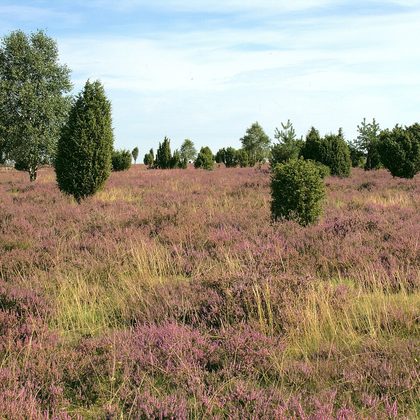
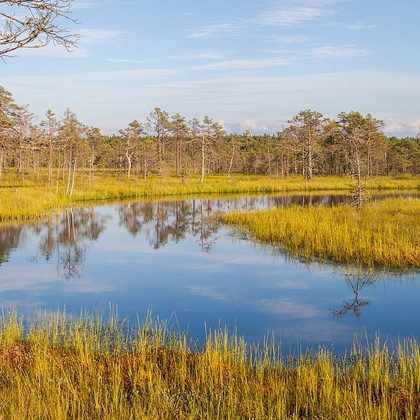
Heather moorland on acid ground, blanket bog with heather and cotton grass, and the rough acid grassland running off the edges of it. The diet is young heather shoots for most of the year, with cowberry, cotton grass and, for the chicks, insects. The best ground is a mosaic of heather of different ages: young shoots for food, old tussocks for cover.
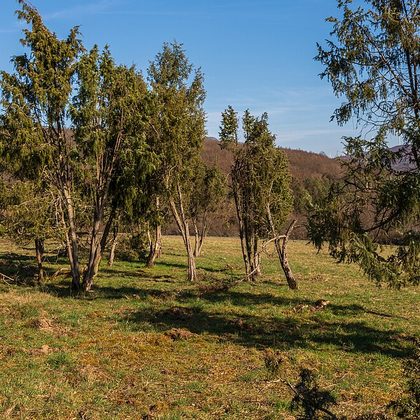
Where the bird is most at home, classified with EUNIS — the European standard for habitats.
Range and movements
The British Isles only, from Devon and Wales through the Peak District and the Pennines to the Highlands and the Outer Hebrides, with the highest densities on the managed moors of northern England and eastern Scotland. On the island of Ireland numbers have fallen a long way. There is no continental population, and there are no vagrants.
- Resident
- Breeding (summer)
- Passage
- dark = core range, pale = thinly spread
How and when to look
In March or April drive a high moorland road in the Cairngorms early in the day, over the A939 or the roads around Lochindorb, and stop at every calling bird. At that season the cocks like to stand on a stone or a peat bank beside the road and let a car come close. Later in the year the barking tails off. From 12 August many access points to the moor carry a notice that shooting is taking place that day; on such days it is better to keep off the ground.
Conservation status
Not a threatened bird, with a population of the order of a few hundred thousand pairs, but the management around it is one of the sharpest conservation arguments on the island of Great Britain. Rotational heather burning, heavy predator control and medicated grit keep densities high enough for driven shooting, while the same management is charged with drying out peat, releasing carbon and going hand in hand with the illegal killing of Hen Harriers. Scotland therefore introduced licensing for shooting this bird in 2024, and from September 2026 for heather burning as well; in England the same debate continues without a licensing system.
Scientific name
Lagopus scotica | (Latham, 1787) (GBIF: Lagopus lagopus)
Latham described the species in 1787 as Tetrao scoticus; because it was later moved to another genus, the author and year stand in brackets. The genus Lagopus was introduced in 1760 by Brisson. Lagopus is Greek, from lagos 'hare' and pous 'foot', that is 'hare-footed', for the feet feathered down to the toes. scotica means 'of Scotland', after the area where the bird occurs. The specimen the first description was based on came from Scotland.