All species › Passerines › Grasshopper warblers › River Warbler
River Warbler | Locustella fluviatilis
Krekelzanger | Buscarla fluvial
The largest and darkest of the reeling warblers, and the only one that delivers its song from an open twig instead of buried in cover. Its world is eastern: the willow and alder fringes of rivers in central and eastern Europe and the Baltic region, where from mid-May it reels through half the night like an old treadle sewing machine. In north-west Europe it is a bird of one late-spring evening — almost always a singing male, found by ear, and rarely staying more than a few days; in Iberia it is a rarity.
Voice
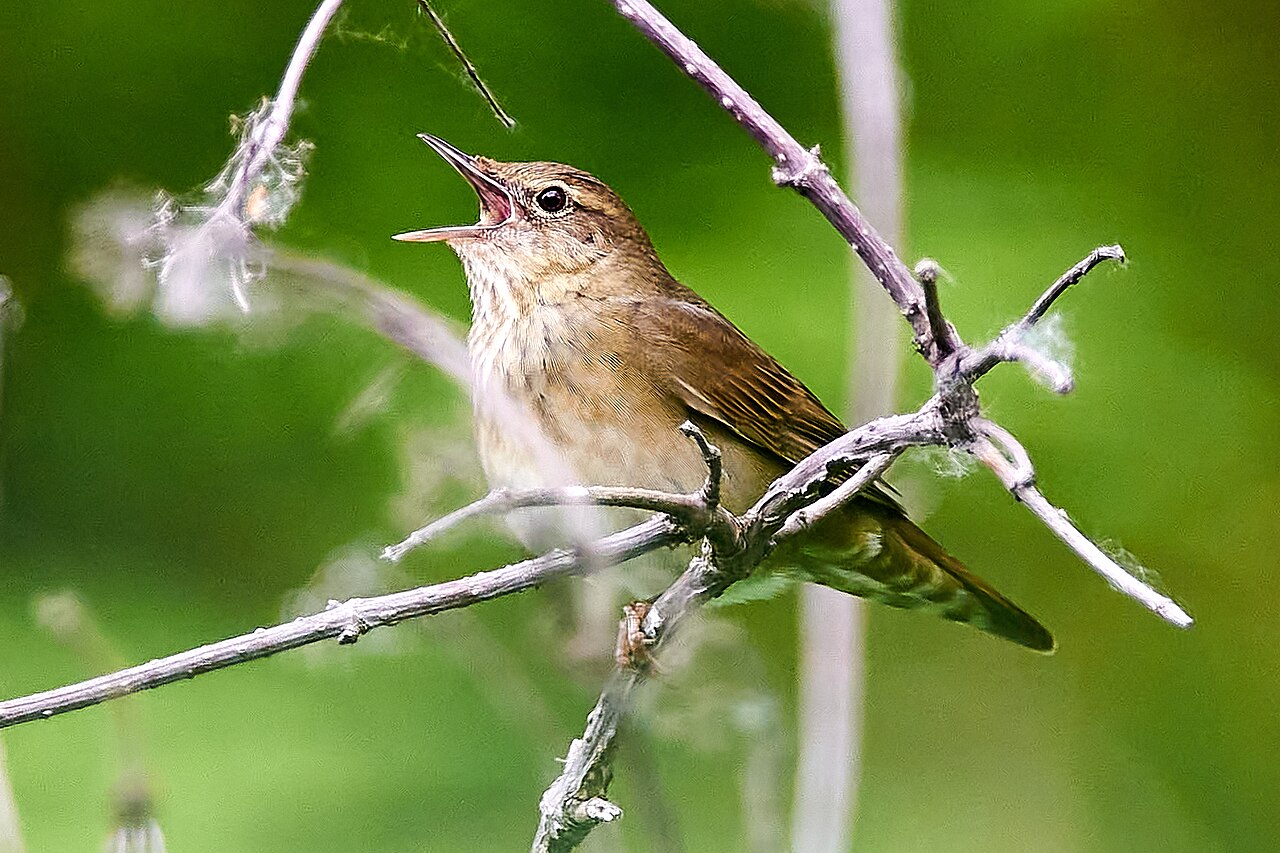
This is where it is settled, and the currency is tempo. River Warbler delivers separate, hard pulses — zzree-zzree-zzree-zzree or dzee-dzee-dzee-dzee — at roughly five to eight a second, slow enough to hear individually and even to beat out with a finger. The effect is hard, dry and jointed, an old treadle sewing machine or a steam locomotive getting under way, and it stays on one low pitch. Grasshopper Warbler reels so much faster that nothing can be counted: its pulses fuse into one unbroken, high, thin srrrrrrrr. Savi's is faster still but much lower and fuller, an even purring motor. Set them in a row: River slow, low and jointed; Savi's fast, low and smooth; Grasshopper fast, high and dry. A bout usually opens with a few hesitant separate ticks that accelerate into the reel, and runs from half a minute to several minutes. It sings from about an hour after sunset deep into the night and again before first light, from mid-May into July — and unlike its two relatives it often does so from an open side branch halfway up an alder or willow, bill wide open and throat quivering, staying put for minutes on end. The call is a hard, short chik and a rasping zrrr, neither of them distinctive.
Recording: Robert Petersen — CC BY-SA 4.0 · xeno-canto
Identification
A fairly large, solid warbler of fourteen to sixteen centimetres, uniform olive-brown to coffee-brown above with no streaking whatever. The clinching feature is on the breast: chin, throat and upper breast carry a cloud of diffuse grey-brown streaks and smudges on an off-white to greyish-buff ground — not the crisp lines of a Sedge Warbler but a dirty-looking wash that fades out towards the flanks. The undertail coverts are strikingly long with broad off-white tips. The tail is long, broad and graduated, the supercilium narrow and vague, the legs flesh to pale pink. It has the longest primary projection of any reeling warbler, which fits a bird that winters in southern Africa.
Confusion species
Grasshopper Warbler is clearly smaller and greener-olive, with fine dark streaks on crown and mantle and streaked undertail coverts — but a clean, unmarked breast. River Warbler is the exact reverse: plain above, smudged below. Savi's Warbler is warm red-brown, unstreaked above and below, with plain undertail coverts lacking pale tips, and it sings a low, even purr. Tempo separates all three: River Warbler is the only one whose pulses you can count. Reed and Blyth's Reed Warblers are smaller and warmer brown and lack both the breast smudging and the long, pale-tipped undertail coverts.
Habitat
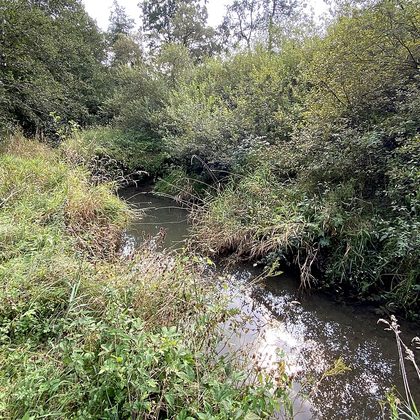
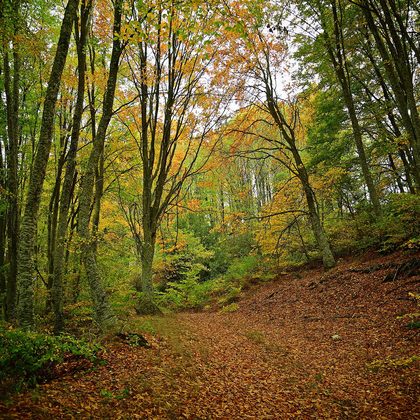
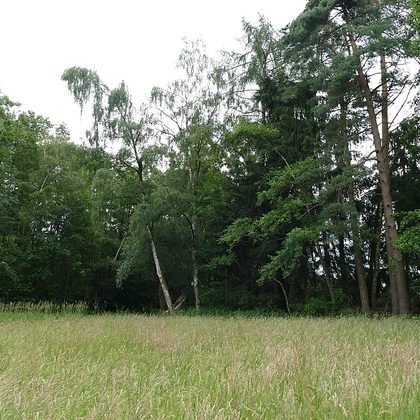
Damp, dense broadleaved woodland and scrub along streams and rivers with a tall, rank herb layer of nettle, meadowsweet and hogweed: alder carr, willow fringes, overgrown floodplain copses, rank stream-valley edges and young plantation. Also neglected parkland and old orchards, provided the ground layer is dense and damp. It needs no open water, only cover right down to the ground; it forages by walking and climbing through the litter and among the stems, taking bugs, flies, small beetles and spiders.
Where the bird is most at home, classified with EUNIS — the European standard for habitats.
Range and movements
From eastern central Europe and the Baltic region east through eastern Europe and the Balkans to western Siberia. The western edge of the breeding range has been creeping outward for more than a century, so that further west in central Europe it is now a regular if scarce breeder, and Scandinavia has been reached. In north-west Europe it is a rare vagrant of late spring and early summer, almost always singing males that usually stay only a short time at the same site. Winters in south-eastern Africa, from Tanzania to Mozambique and Zambia. In Iberia it is an exceptional occurrence, almost always singing males in late spring.
- Breeding (summer)
- Passage
- dark = core range, pale = thinly spread
How and when to look
Late May and the first half of June, in the two hours after sunset, along a rank stream or river bank with alders and willows. Count the pulses: separate ticks you can follow mean River Warbler; a single fused reel means Grasshopper. Do not walk straight at the sound — first scan the open side branches two to four metres up with binoculars, because unlike its relatives this bird will sit there in view for minutes.
Conservation status
Not globally threatened, with a large range and a broadly stable European population. The westward spread throws up new breeding areas most decades. The pinch points are the straightening, embanking and clearing of streams and rivers, the felling of bankside woodland and the flailing of rank riparian strips; where floodplains and stream valleys become rank again and spring water floods over the banks, the species settles.
Scientific name
Locustella fluviatilis | (Wolf, 1810)
Wolf described the species in 1810 as Sylvia fluviatilis; because it was later moved to another genus, the author and year stand in brackets. The genus Locustella was introduced in 1829 by Kaup. Locustella is Latin, a diminutive of locusta 'grasshopper'. fluviatilis is Latin for 'of the river', from fluvius 'river', after the damp riverside woods where it breeds. The specimen the first description was based on came from the Danube, Austria.