All species › Waders, gulls and terns › Sandpipers and snipes › Red Phalarope
Red Phalarope | Phalaropus fulicarius
Rosse franjepoot | Falaropo picogrueso
The Red Phalarope is a wader that spends its entire winter on the open ocean, riding the swell like a cork above plankton-rich fronts. In north-west Europe it is therefore chiefly a seawatching bird, one that can appear on a beach lake or in the surf after an autumn gale.

Click a thumbnail to switch the photo above.
Voice
Usually silent; if you do hear one, it is a short, high, sharp pit or wit, thinner and higher than Red-Necked Phalarope and easily lost in the wind. Feeding parties at sea keep up a soft, high twittering. On the breeding grounds displaying females give a fast, low rattling prrp-prrp. Off the coasts of north-west Europe and Iberia birds nearly always pass in silence, so do not count on sound.
Recording: Avery Bartels — CC BY-NC-SA 4.0 · Wikimedia Commons
Identification
Bulkier and rounder than Red-Necked Phalarope, with a short, thick, blunt bill that is yellow at the base. In the plumages we see, winter and first-winter, the mantle is plain pale grey with no pale lines, and the head is white with a black eye-patch and a dark rear crown. September juveniles are still dark-backed with cream fringes and a pink-buff wash on neck and breast, but moult quickly into that clean grey. Summer females are deep rusty red from throat to tail, with a white face patch, black crown and yellow bill; males are duller. On the water it sits high, rear body raised, and often spins in tight circles to stir up food.
Confusion species
Red-Necked Phalarope is the heart of the problem: smaller and slimmer, with a needle-fine, wholly black bill, and in winter a darker grey mantle with obvious pale lines down the back. Juvenile Red-necked are much darker above with striking buff-yellow mantle stripes. At range on the sea a floating Red Phalarope can suggest a Little Gull or a small auk, but the spinning feeding action and the ticking bill movements are typical. Sanderling is white and grey too, but runs on the beach and does not swim.
Habitat
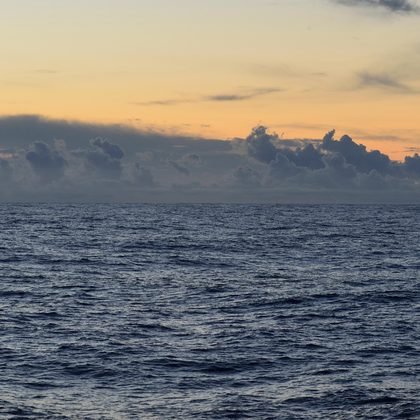
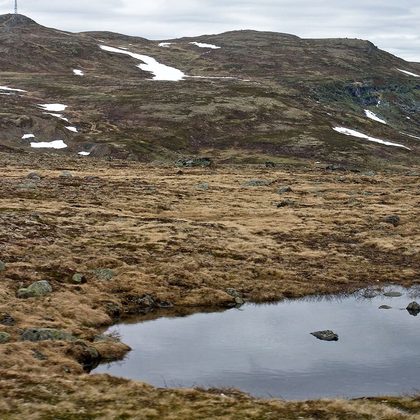
Outside the breeding season wholly pelagic: it winters on the open ocean above upwellings and along plankton-rich current boundaries, picking from the surface film. Only gales bring it inshore or, exceptionally, to an inland pool or harbour, where it may then feed without any shyness at your feet. It breeds on wet coastal tundra with pools and sedge in the high Arctic.
Where the bird is most at home, classified with EUNIS — the European standard for habitats.
Range and movements
Breeds in Iceland, Svalbard, the Eurasian Arctic, Greenland and arctic North America, and winters at sea, including over the upwellings off West Africa and South America. Along the southern North Sea coast it is a scarce but annual autumn migrant recorded from seawatch points, peaking in October and November with most birds after north-westerly gales. Along the Iberian coast it is more regular, especially over the Bay of Biscay and off Galicia, and it passes the Strait of Gibraltar in varying numbers.
- Resident
- Breeding (summer)
- Winter
- Passage
- dark = core range, pale = thinly spread
How and when to look
Seawatching is the best chance: in October or November, after a hard north-westerly to westerly blow, take up position behind a groyne or in a seawatch hide and scan the surface of the water rather than the sky. A Red Phalarope stands out as a small, pale, high-riding bird that vanishes into the troughs and bobs up again, often spinning. In the days after the storm it pays to check adjacent beach lakes, harbours and even inland waters; wind-blown birds sometimes linger for a day or two and then allow point-blank views.
Conservation status
Least Concern, with a large circumpolar world population that is hard to count because it disperses across the open ocean. The European breeders in Iceland and Svalbard form only a small part of it. Its vulnerability lies mainly at sea: changes in plankton production through warming and shifting currents, oil pollution and entanglement in fishing gear affect it directly, while on the breeding grounds earlier snowmelt and predation play a part. Mass mortality after prolonged storms is well documented.
Scientific name
Phalaropus fulicarius | (Linnaeus, 1758)
Linnaeus described the species in 1758 as Tringa fulicaria; because it was later moved to another genus, the author and year stand in brackets. The genus Phalaropus was introduced in 1760 by Brisson. Phalaropus comes through French phalarope from Greek phalaris 'coot' and pous 'foot': like coots, phalaropes have lobed toes. fulicarius derives from Latin fulica 'coot', for those same lobed toes. The specimen the first description was based on came from Hudson Bay.