All species › Birds of prey › Hawks, eagles and kites › Red Kite
Red Kite | Milvus milvus
Rode wouw | Milano real
The Red Kite is a long, narrow-winged raptor with a deeply forked rufous tail that twists constantly like a rudder. Europe holds essentially the entire world population.

Click a thumbnail to switch the photo above.
Voice
A high, mewing series: weeoo-ee-ee-ee, hesitant and wavering in tone, often given over the breeding site. Less loud and penetrating than the Buzzard's mew.
Recording: Pascal Christe — CC BY-SA 4.0 · Wikimedia Commons
Identification
Soaring on slightly raised, kinked wings with a constantly twisting, deeply forked tail. From below, large pale windows at the base of the primaries contrast with black wingtips. The head is pale grey to almost white, body and tail warm rufous. Flight is buoyant and rocking, with few wingbeats.
Confusion species
Black Kite: darker and browner, with a much shallower tail fork that looks nearly straight when spread, and without the striking pale hand windows. Buzzard: more compact, broad rounded wings, short rounded tail. At long range the tail fork remains the decisive feature.
Habitat
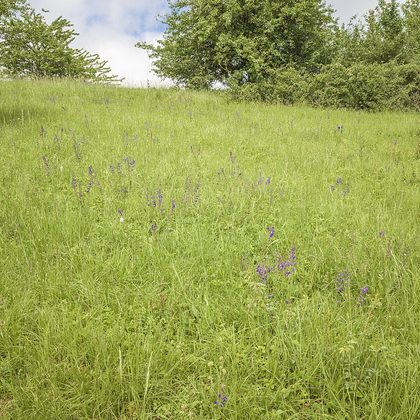
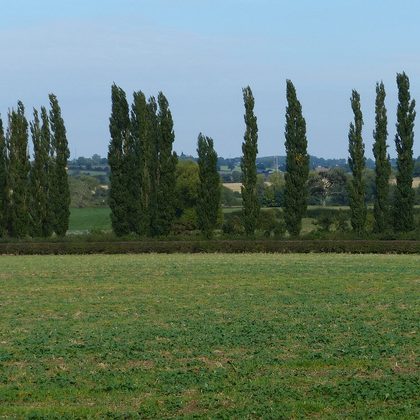
Small-scale farmland with copses, hedgebanks and grazed slopes — a landscape offering both nest trees and open hunting ground. Opportunistic: takes voles and young birds, but lives largely on carrion and readily follows ploughing tractors.
Where the bird is most at home, classified with EUNIS — the European standard for habitats.



Range and movements
Core areas lie in central and western Europe, Iberia and Wales; on the island of Great Britain the species recovered after reintroduction. Iberia also holds a very large wintering population.
- Resident
- Breeding (summer)
- Winter
- Passage
- dark = core range, pale = thinly spread
How and when to look
Migration in March and October over ice-pushed ridges, hill country and watchpoints. Also check freshly ploughed fields and meadows being mown: Red Kites home in on them and circle low.
Conservation status
Not threatened (IUCN: Least Concern) after a clear recovery; the species was previously listed as Near Threatened. Poisoning — both illegal and indirect via rodenticides — remains the main cause of death, alongside collisions with wind turbines and power lines.
Scientific name
Milvus milvus | (Linnaeus, 1758)
Linnaeus described the species in 1758 as Falco milvus; because it was later moved to another genus, the author and year stand in brackets. The genus Milvus was introduced in 1799 by De Lacépède. Milvus is the Latin word for the red kite. The specific name repeats the genus name: milvus was the Roman name for precisely this bird. The specimen the first description was based on came from Sweden.