All species › Passerines › Wagtails and pipits › Olive-Backed Pipit
Olive-Backed Pipit | Anthus hodgsoni
Siberische boompieper | Bisbita de Hodgson
A Tree Pipit out of the Siberian taiga: greener, cleaner and more sharply marked than Tree Pipit. It breeds from the Urals to the Japanese islands and winters in southern and south-east Asia, but every autumn a share of the young birds heads the wrong way, and in October and November a handful appear along the North Sea coasts, in the British Isles and in Scandinavia. Numbers have gradually increased over the last thirty years, and a few now stay on into the winter.

Voice
The call is thin, high and penetrating: a drawn-out tseez or teez, reedy, with a slightly rising end. It resembles a Tree Pipit's call but is higher, thinner, held longer, and lacks the hoarse, buzzing, almost electric quality; where Tree Pipit rasps, this one is smooth and whistled. Hidden birds often call from cover before they flush, and a good share of island records begin that way. The song — practically never heard in the guide area — is a loud, clear, accelerating phrase recalling Tree Pipit but purer and more musical, given from a treetop or in a short song flight above the taiga.
Recording: Jochem Verweij — CC BY-SA 4.0 · xeno-canto
Identification
The size of a Tree Pipit or slightly smaller at 14–15 cm, but more compact and far more contrasty. The upperparts strike you first: warm olive-green and virtually unstreaked across mantle and rump — at most a shadow of streaking — where every other small pipit in the region is clearly streaked there. Against that the underparts read like white paper: clean white with a yellow wash over the upper breast and heavy jet-black streaks running from the malar stripe well down the flanks. The face is the second character, and on its own is enough: a long, broad supercilium, warm orange-buff in front of the eye and abruptly bright white behind it, and at the rear edge of the ear-coverts a small, sharply defined black spot with a white or buff dot beside or above it — the ear spot, obvious in a decent photograph. The bill is fine with a pink base, the legs are pink, the hindclaw short and curved. It walks in a short-legged, dumpy way, pumping the tail conspicuously, and when disturbed goes up into a tree like a Tree Pipit, often sitting motionless along a thick branch.
Confusion species
Tree Pipit is the only serious candidate; three characters separate the two. The back: clearly streaked and buff-olive on Tree Pipit, near-plain and green here. The face: vague on Tree Pipit, crisp and two-toned here, with that black-and-white spot at the rear of the ear-coverts. The underparts: yellow-buff with fine flank streaks on Tree Pipit, clean white with heavy black flank streaks as broad as those on the breast on this one. Meadow Pipit is duller and browner, with a flat face and pale orange-pink legs. Red-Throated Pipit is the trap for anyone who fixes only on heavy streaking, but it has a streaked rump and broad white mantle braces. Rock and Water Pipits are bigger and dark-legged. A pipit sitting in a tree on an island in October with a green back and an orange-and-white supercilium needs little further thought — but photograph the ear-coverts, because that is what a records committee wants to see.
Habitat
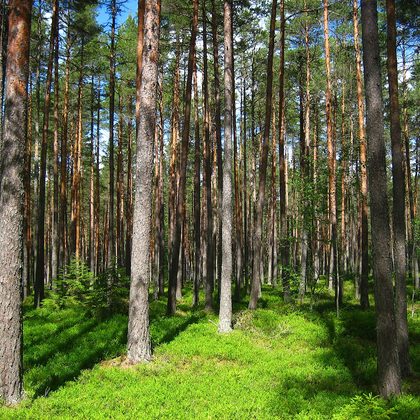
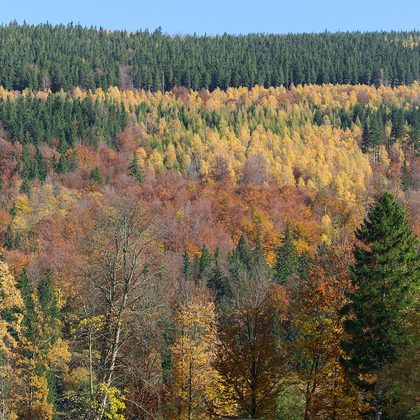
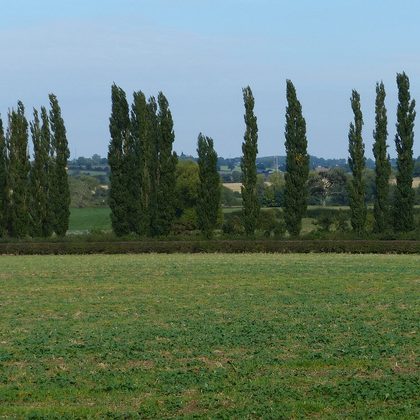
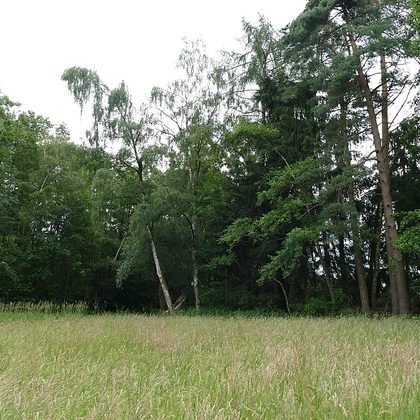
In the breeding range, open taiga: birch and larch woods, thin conifer forest with a bilberry and dwarf-shrub understorey, woodland edges and clearings, and in the south of the range birch woodland in the mountains up to well above 2,000 metres. It is a bird of the forest floor that rests and sings in trees. Vagrants in western Europe use exactly that structure in miniature: scrub and clumps of trees on the islands, gardens and churchyards, hedgerows and tree belts, tamarisk thickets, the lee behind a dune ridge and the shrubberies of a birders' village. They feed on bare ground beneath and go up into the branches when flushed.
Where the bird is most at home, classified with EUNIS — the European standard for habitats.
Range and movements
Breeds from the north-eastern edge of Europe — the western limit lies around the Pechora and the northern Urals, well outside the area of this guide — east across Siberia to Kamchatka, the Japanese islands and the Himalaya, and winters from the Indian subcontinent to south-east Asia. Within the map area it is a fixed autumn feature in small numbers: the concentration is on Shetland, Fair Isle, North Ronaldsay and the western North Sea coast, on the Wadden islands and in southern Scandinavia, with most birds between 5 October and 15 November. Further south it is a rare vagrant, with records along the Cantabrian coast, in Catalonia, the Balearics and the Canary Islands, nearly all between October and December. Since the 1990s a handful have wintered each year in western Europe, sometimes even in town parks and gardens.
- Winter
- Passage
- dark = core range, pale = thinly spread
How and when to look
Mid-October to early November on a Wadden island or an island observatory in the British Isles, after a spell of easterly winds. This is not a bird of the open field: work the sheltered corners — the lighthouse garden, the plantation behind the village, the sea-buckthorn on the inner dune — and listen for something calling as it lifts out of cover and lands in a tree. Once it is perched, stay still: these birds sit for long periods, often allow ten metres, and give you all the time you need for the view that matters, which is the sharply drawn face with the two-toned supercilium and the black-and-white spot on the ear-coverts.
Conservation status
Not globally threatened (LC): the breeding range covers a great swathe of boreal Asia, the population runs to many millions and there is no evidence of decline. For the map area the category says little, since this is a bird at the very edge of its world. What does stand out is the trend in records: autumn occurrences in western Europe have risen sharply since the 1980s, and so have winter records. Better observers and better sound recognition account for part of that, but not all of it, and a genuine westward shift in migration routes is taken seriously as an additional explanation. As long as the Siberian taiga stands, the species itself gives no cause for concern.
Scientific name
Anthus hodgsoni | Richmond, 1907
Richmond described the species in 1907 and placed it straight away in the genus where it still stands. The genus Anthus was introduced in 1805 by Bechstein. Anthus is the Latin word for a small bird of grasslands mentioned by Pliny the Elder. hodgsoni honours the British diplomat and collector Brian Houghton Hodgson (1801–1894), who served as Resident in Nepal. The specimen the first description was based on came from Bengal.