All species › Waders, gulls and terns › Sandpipers and snipes › Lesser Yellowlegs
Lesser Yellowlegs | Tringa flavipes
Kleine geelpootruiter | Archibebe patigualdo chico
The commonest Nearctic shank in Europe and, of the two yellowlegs, by far the more often recorded. A slim, grey, small-headed wader on tall canary-yellow legs, working the waterline in quick, hurried steps.

Click a thumbnail to switch the photo above.
Voice
A soft, flat, two-syllable tu-tu, sometimes reduced to a single note, without the ringing edge of Greater Yellowlegs. The tone is dull and slightly plaintive and carries far less. Two notes against three is the quickest separation of the two in the field, and it is more reliable than judging size on a lone bird.
Recording: Doug Hynes — CC BY-SA 4.0 · xeno-canto
Identification
At 23–25 cm it sits between Wood Sandpiper and Redshank, but stands far higher and looks greyer. The bill is fine, dead straight, uniformly dark and about the length of the head. The legs are bright yellow to orange-yellow, with a long bare tibia that shows well as the bird wades. Upperparts grey-brown with small white spots; head and neck finely streaked, the breast faintly streaked and fading into white with no sharp cut-off. In flight: a square white rump, a finely barred tail, plain wings without a bar, and toes projecting clearly beyond the tail.
Confusion species
Greater Yellowlegs is the main test — obviously bigger, with a bill about one and a half times head length, thicker and often grey at the base and faintly upturned, and a three-note call. Lesser has a needle-fine, dead straight, uniformly dark bill of head length and calls in twos. Marsh Sandpiper is the second candidate: olive to yellow-green legs rather than canary yellow, an even finer bill on a small round head, and in flight a long white wedge running up the back with an almost unbarred white tail, where Lesser shows a square white rump and a clearly barred tail. Juvenile Redshank also has yellowish legs, but is dumpier, has an orange bill base and shows a broad white trailing edge to the wing.
Habitat
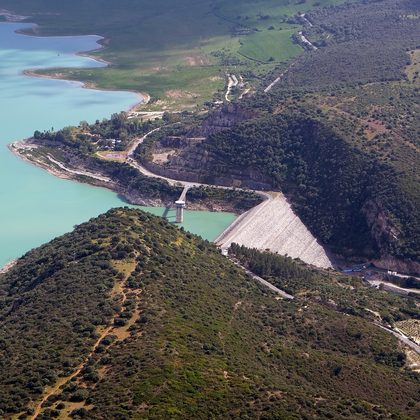
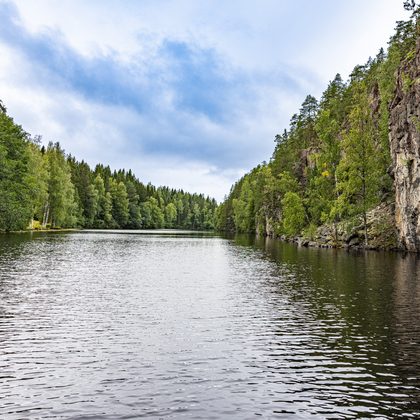
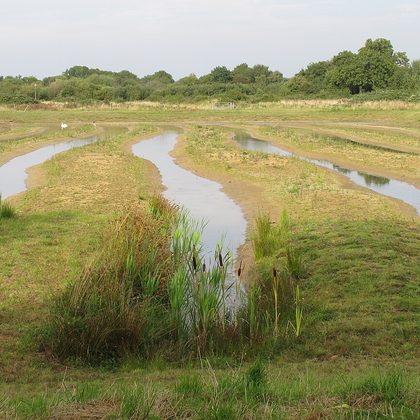
Shallow fresh and slightly brackish water with a bare muddy edge: shallow-flooded grassland, clay pits, coastal borrow pits, sewage lagoons, sludge beds and newly created wetland. It walks faster and more restlessly than a Redshank, picks from the surface and seldom wades deep. On the breeding grounds it favours burnt clearings and open muskeg in the North American boreal forest, with small ponds scattered among them.
Where the bird is most at home, classified with EUNIS — the European standard for habitats.

Range and movements
Breeds across the North American taiga from Alaska to Quebec and winters from the Gulf coast to southern South America. In Europe the most numerous Nearctic shank: annual in the British Isles, scattered along the North Sea coast and in Iberia — with some regularity in the Ebro delta, the Guadalquivir marismas and on the Cantabrian coast — mostly between July and October. Some linger for weeks; there are winter records.
How and when to look
In August and September scan the shallow floods and pit margins where Ruff and Wood Sandpipers gather; a Lesser Yellowlegs picks itself out by the yellow legs and the hurried, high-stepping gait. Watch the tail as it lifts: square white rump, finely barred tail. Record the call if you can, since a single note settles the identification.
Conservation status
Vulnerable (IUCN) since the 2024 Red List update: North American survey work indicates a heavy loss since the 1970s, of the order of more than half the population. The pressures named are the loss of shallow stopover wetlands, shooting on migration in the Caribbean and northern South America, and change across the boreal breeding range.
Scientific name
Tringa flavipes | (Gmelin, 1789)
Gmelin described the species in 1789 as Scolopax flavipes; because it was later moved to another genus, the author and year stand in brackets. The genus Tringa was introduced in 1758 by Linnaeus. Tringa is the Neo-Latin name Aldrovandi gave to the green sandpiper, after Ancient Greek trungas, a thrush-sized, white-rumped, tail-bobbing wading bird mentioned by Aristotle. flavipes is Latin, from flavus 'yellow' and pes 'foot', after the yellow legs. The specimen the first description was based on came from New York.