All species › Passerines › Thrushes › Fieldfare
Fieldfare | Turdus pilaris
Kramsvogel | Zorzal real
Fieldfare is the noisiest thrush of the northern winter: chattering flocks rolling from one hawthorn hedge to the next and then spreading over a field. As a breeding bird it has all but vanished from the Low Countries, while in Scandinavia it nests in loose colonies.

Voice
Unmistakably loud: a hard, chattering, slightly hoarse chack-chack-chack that rattles across the field as a flock lifts or a Sparrowhawk goes by. There is also a drawn-out, plaintive seeeh on migration and at dusk. The song is a disjointed squeaking and grating with no clear phrase, usually given in flight over the colony or from a treetop, from April to June.
Recording: Benoît Van Hecke — CC BY-SA 4.0 · Wikimedia Commons
Identification
Large and heavy, with the boldest pattern of any thrush: a blue-grey head and an equally grey rump, a warm chestnut mantle between them, and a black tail. The breast is deep ochre-buff with heavy black spots that merge into arrowheads along the flanks. In flight the combination decides it: snow-white underwing and white axillaries against a dark upperwing, with the pale grey rump set off by the black tail. The bill is yellow with a dark tip. Sexes near identical.
Confusion species
Mistle Thrush is the one real pitfall and can look very similar in flight because of the same white underwing. But Mistle Thrush is uniformly greyish-brown, with no grey head, no chestnut mantle and no black tail; it shows white tail corners and a pale, not grey, rump, and its call is a dry rattle rather than a raucous chatter. Blackbird is uniform black or brown and lacks all contrast; Song Thrush is far smaller and warmer brown.
Habitat
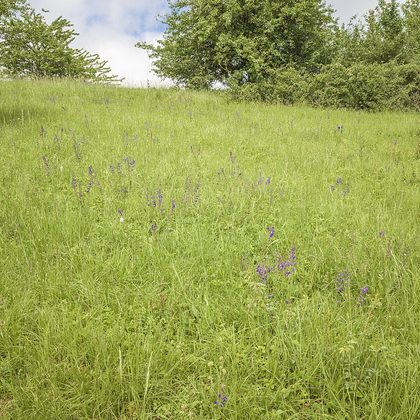
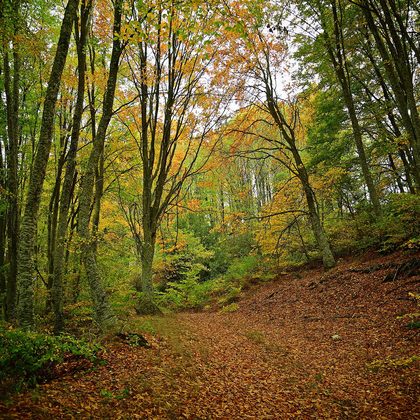
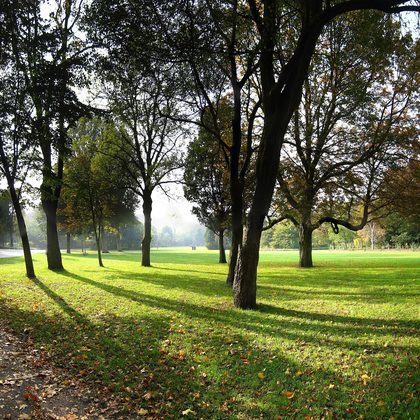
Breeds in birch woodland, parkland farmland and tree groups around farms, in Scandinavia up into the mountain birch zone. In winter in semi-open farmland: damp pasture, stubble, hawthorn and blackthorn hedges, orchards with windfall fruit and, in hard frost, holly and ivy berries in village gardens.
Where the bird is most at home, classified with EUNIS — the European standard for habitats.


Range and movements
A breeder of northern and central Europe, with its western edge in the Low Countries. As a winter visitor to north-west Europe it is by contrast extremely numerous, with hundreds of thousands of Scandinavian and eastern European birds from October to April. In Iberia it is an irregular winter visitor, appearing mainly in cold winters in the north and on the high plateaux.
- Resident
- Breeding (summer)
- Winter
- Passage
- dark = core range, pale = thinly spread
How and when to look
Drive along damp grassland with old hawthorn hedges — the Achterhoek, Twente, South Limburg or the Gelderse Poort — in November or December and listen for the chatter. The flocks are wary: stay in the car and scan the hedge. When frost sets in they shift to orchards with fallen apples, and there they will sit still at ten metres — the moment to take in the chestnut mantle and grey rump.
Conservation status
Least Concern, since the world population is large, but the European trend points downwards and the range is retreating eastwards. At the western edge of the range most breeding birds were lost within two decades without a clear explanation; loss of damp grassland, fewer earthworms and changing winters are all cited. Wintering numbers swing hugely from year to year, tracking the northern berry crop above all.
Scientific name
Turdus pilaris | Linnaeus, 1758
Linnaeus described the species in 1758 and placed it straight away in the genus where it still stands. He introduced the genus Turdus in that same work. Turdus is the ordinary Latin word for 'thrush'. pilaris is a second Latin word for 'thrush', so the scientific name says the same thing twice. The specimen the first description was based on came from Sweden.