All species › Waders, gulls and terns › Sandpipers and snipes › Eurasian Curlew
Eurasian Curlew | Numenius arquata
Wulp | Zarapito real
The Curlew is Europe's largest wader, with a long decurved bill and a plaintive, far-carrying call. Its habitat changes with the season: bog and damp grassland in the breeding season, vast tidal flats in winter.

Click a thumbnail to switch the photo above.
Voice
The name is in the call: a plaintive, far-carrying cur-lew. On the breeding grounds the male performs a song flight with a swelling bubbling trill that runs into a long, joyous rolling.
Recording: Pascal Christe — CC BY-SA 4.0 · Wikimedia Commons
Identification
Large, bulky to slender wader with uniformly brown-streaked plumage and a very long, evenly decurved bill — noticeably longer in females than in males. In flight the white wedge up the back stands out, together with the slow wingbeats.
Confusion species
Whimbrel: smaller, with a shorter and more abruptly kinked bill, obvious pale crown stripes framed by dark lateral crown stripes, and a completely different call (a fast, even ti-ti-ti-ti-ti-ti-ti). Bar-Tailed Godwit has a slightly upturned bill and a more compact build.
Habitat
Breeds on raised bog, wet heath, dune slacks and herb-rich damp grassland with a high water table. Outside the breeding season on tidal flats, mudflats and saltmarsh, roosting at high-tide roosts.
Where the bird is most at home, classified with EUNIS — the European standard for habitats.

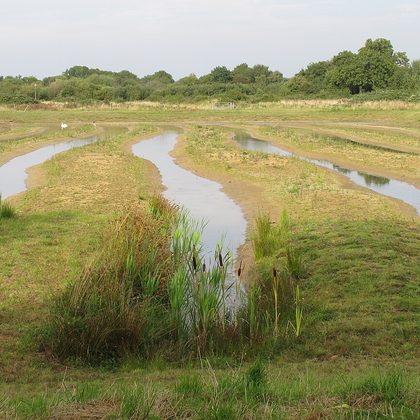
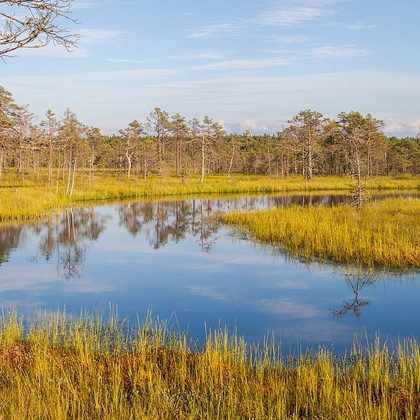
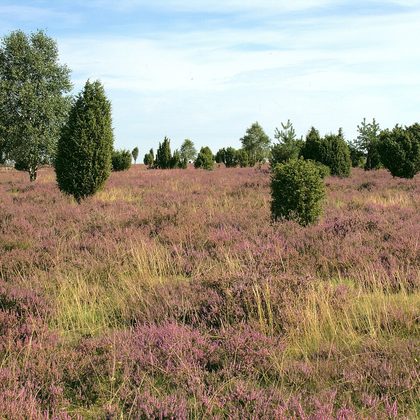

Range and movements
Breeds from western Europe to Siberia. The southern North Sea coast matters internationally above all as a wintering area: the Wadden Sea and the south-western Delta hold large numbers of birds from Scandinavia and eastern Europe in winter. It is also a regular winterer on the Iberian Peninsula, along the Atlantic estuaries and coastal marshes.
- Resident
- Breeding (summer)
- Winter
- Passage
- dark = core range, pale = thinly spread
How and when to look
For the song flight: March and April around sunrise over damp grassland and bog. For numbers: the Wadden Sea on a rising tide, when birds are pushed towards a high-tide roost — two hours before high water at a good vantage point is ideal.
Conservation status
Near Threatened globally (IUCN) and a meadow bird in steep decline in north-west Europe. Earlier and more frequent mowing, drainage, field enlargement and high predation pressure mean too few chicks fledge; conservation focuses on delayed mowing dates and raised water levels.
Scientific name
Numenius arquata | (Linnaeus, 1758)
Linnaeus described the species in 1758 as Scolopax arquata; because it was later moved to another genus, the author and year stand in brackets. The genus Numenius was introduced in 1760 by Brisson. Numenius is Greek, from neos 'new' and mēnē 'moon', after the bill that recalls a crescent moon; noumēnios is the name of a bird in Hesychius. arquata is the Medieval Latin name for this bird, from arcuatus 'bow-shaped', again after the curved bill. The specimen the first description was based on came from Sweden.