All species › Pelicans, herons and ibises › Ibises and spoonbills › African Sacred Ibis
African Sacred Ibis | Threskiornis aethiopicus
Heilige ibis | Ibis sagrado
The African Sacred Ibis is a large white bird with a bare black head and neck and a long, heavy decurved bill. It is common across Africa south of the Sahara; its European presence goes back to birds that escaped from bird parks and formed free-living populations around the Bay of Biscay and in the Po plain. There it is found in the rice fields of Piedmont and on the Atlantic coastal marshes.
Click a thumbnail to switch the photo above.
Voice
Largely silent. At the colony and at the roost it gives a hoarse, blowing kwaar and a dull croaking; feeding birds make almost no sound beyond the rush of their wings. Nestlings keep up a thin piping that carries from a distance as a hiss over the colony.
Recording: African Bioacoustics Community — CC BY-NC-SA 4.0 · Wikimedia Commons
Identification
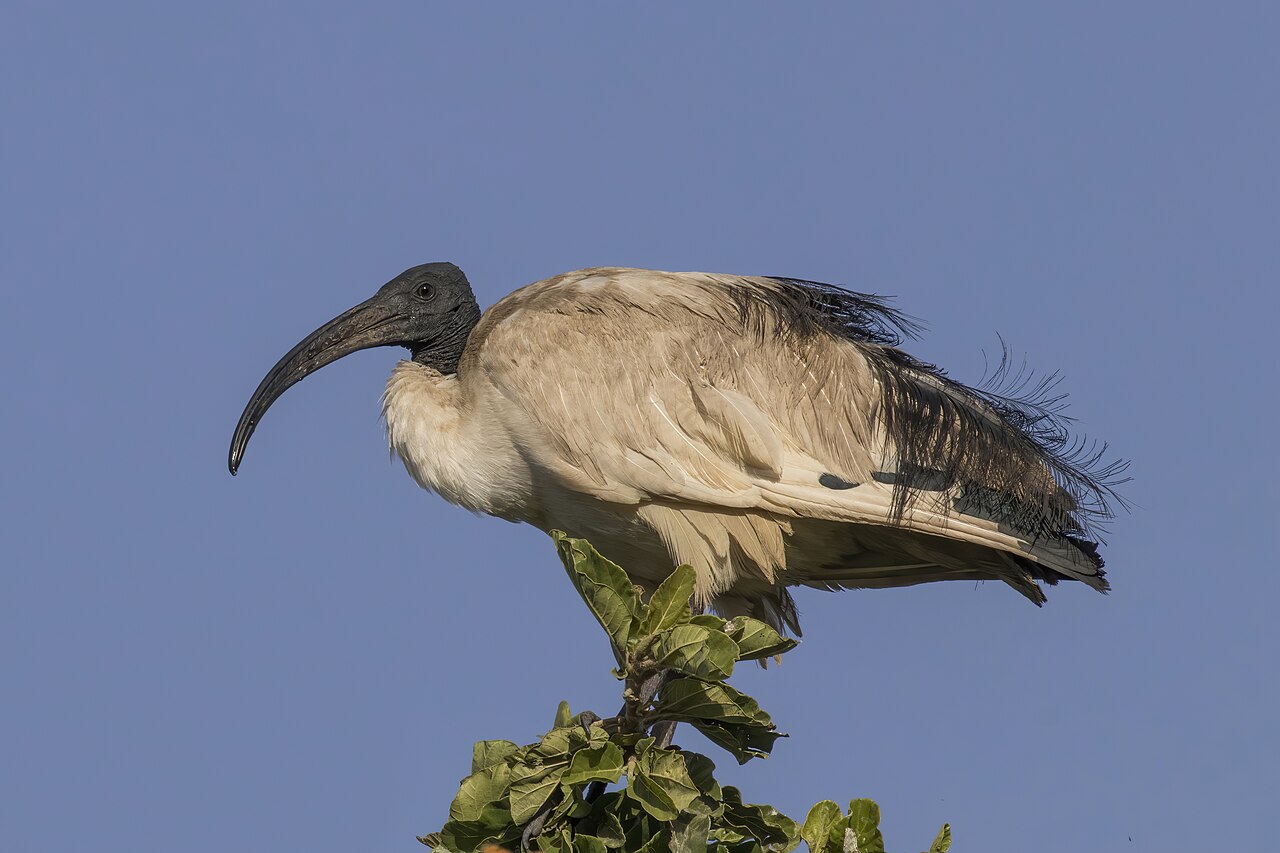
About the size of a Spoonbill, white, with a sharply contrasting, wholly unfeathered black head and neck and a long, thick, downcurved black bill. Loose, hair-fine black ornamental plumes lie along the folded wing and fall as a dark plume over the tail end. In flight a narrow black margin shows along the trailing edge of the wing and the primary tips are black; it flies with neck and legs extended, alternating quick beats with glides, often in line. Immatures have a feathered, grey-brown mottled neck, lack the ornamental plumes and look much less contrasting.
Confusion species
Eurasian Spoonbill is also large and white, but has a feathered white head and a straight bill with a spatulate tip, and is entirely white in flight. Great Egret is slimmer, has a straight pointed bill and flies with the neck drawn in rather than extended. White Stork is considerably bigger, with a red bill and red legs and a broad black wing panel instead of black tips only. The decisive feature remains the combination of a bare black head with a heavy curved bill; no other large white bird in Europe shows it.
Habitat
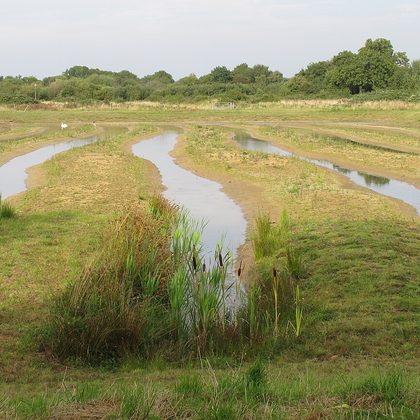
Shallow coastal and inland marsh, wet meadows, flooded arable land and rice fields, and estuary mudflats; around the Bay of Biscay also refuse tips and the surroundings of fish ponds and gull and tern colonies. It feeds by walking over short open vegetation and in shallow water and is not fussy: crayfish, insects, worms, refuse, and in colonies also eggs and young birds.
Where the bird is most at home, classified with EUNIS — the European standard for habitats.




Range and movements
The species breeds naturally across Africa south of the Sahara, with a small population beyond that in the Mesopotamian marshes; in the Nile valley, where it was venerated in antiquity, it disappeared around the middle of the nineteenth century. Its European presence goes back to birds that escaped from bird parks: from the 1970s they settled on the Bay of Biscay coast, peaking at several thousand birds, and from 1989 in the rice fields of Piedmont and Lombardy. Culling has reduced the Biscay total to a few hundred, while the Po plain population is still growing and spreading south. A small free-living nucleus near Barcelona was lost after being removed; what still turns up now, in Iberia, north-west Europe and the British Isles, is single birds, usually from the Biscay population.
- Resident
- Breeding (summer)
- Winter
- dark = core range, pale = thinly spread
How and when to look
The most reliable ground is the Po plain: in March or April drive the freshly flooded rice fields between Vercelli and Novara and you will find dozens of birds among the Black-Headed Gulls. Further west, winter in the Marais de Brouage or on the Golfe du Morbihan offers the best chance, preferably early in the morning as the birds move from roost to pasture.
Conservation status
Not globally threatened (IUCN: Least Concern); the world population is put at a few hundred thousand birds and is slowly falling. In Europe the species is not a subject of protection but of management: because free-living Sacred Ibises take eggs and chicks from colonies of terns, herons and spoonbills, they have been culled systematically around the Bay of Biscay since 2007, and the species is on the EU list of invasive alien species. In the Po plain management has stayed limited and numbers are rising.
Scientific name
Threskiornis aethiopicus | (Latham, 1790)
Latham described the species in 1790 as Tantalus aethiopicus; because it was later moved to another genus, the author and year stand in brackets. The genus Threskiornis was introduced in 1842 by Gray. Threskiornis is Greek, from thrēskos 'religious' and ornis 'bird', after the veneration of the ibis in ancient Egypt. aethiopicus means 'Ethiopian'; to classical writers the name stood for Africa south of Egypt. The specimen the first description was based on came from Egypt.