All species › Passerines › Finches, euphonias and allies › Yellow-fronted Canary
Yellow-fronted Canary | Crithagra mozambica
Mozambiquesijs | Serín frentiamarillo
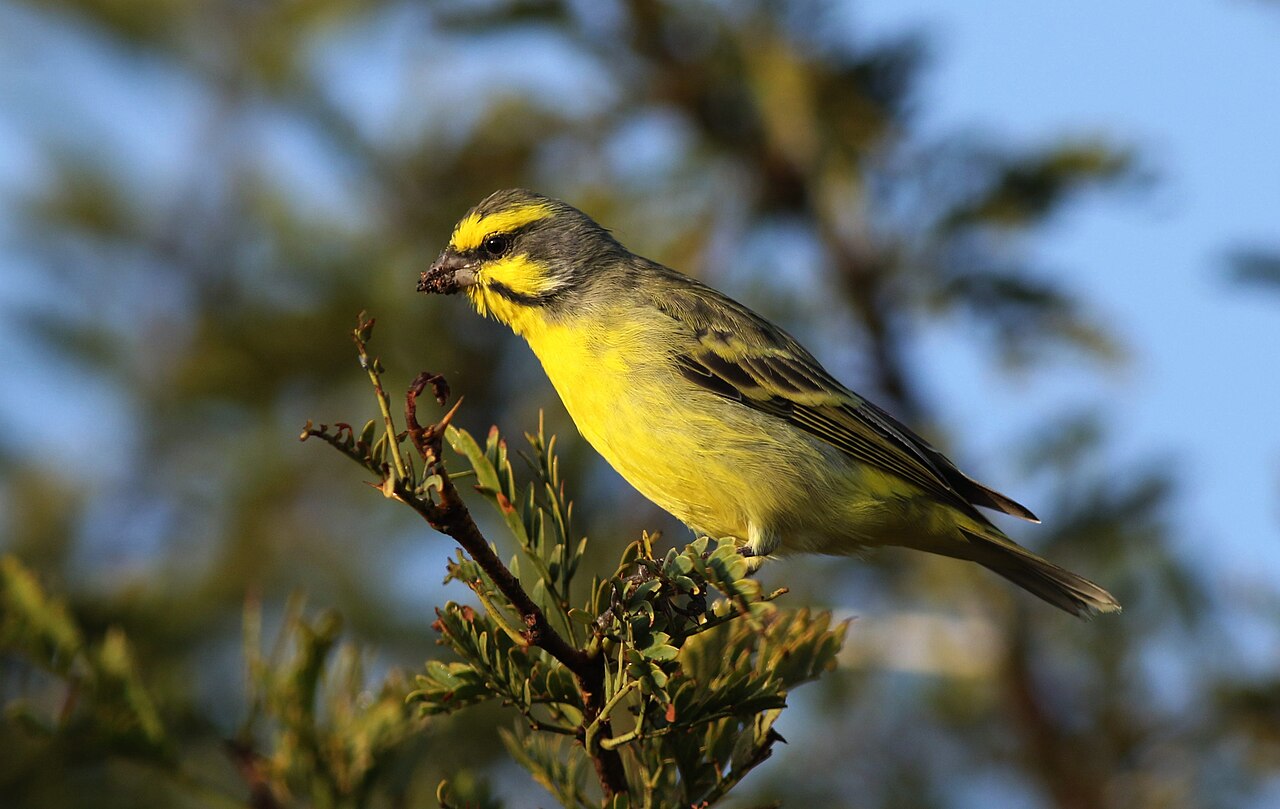
The Yellow-fronted Canary is an African finch brought to Hawaii as a cage bird, breeding there in the wild since the 1960s. Within the guide area it is established only on the Hawaiian Islands; it is recognised by the yellow face with a black stripe running from the bill base to behind the eye.
Voice
The song is a sustained, fast, high warble of clear whistled notes and trills, in phrases of a few seconds repeated after short pauses, usually from an exposed branch tip or a wire. That song is why the species is kept as a cage bird. The call is a thin, rising tsweet, repeated continuously within small parties.
Recording: Marna Buys — CC BY-NC-SA 4.0 · Roodeplaat Nature Reserve, Metsweding, Gauteng, South Africa · xeno-canto
Identification
A small, compact finch with a short conical bill and a short, slightly notched tail. The male is green-grey above, with a bright yellow rump, yellow underparts and a yellow head with a grey crown and nape. Across the yellow face run a black loral stripe passing from the bill base below the eye and a second dark stripe bounding the yellow ear coverts from below. The female is duller, with a weaker head pattern and often a greyish patch on the side of the neck; young birds are greyer and lightly streaked on the breast.
Confusion species
The Atlantic Canary, which may turn up as an escaped cage bird, is larger and has no black facial stripes. Warbling White-eye, numerous in Hawaii, is smaller, has a white eye-ring, a pointed bill and a plain green head without a yellow rump.
Habitat
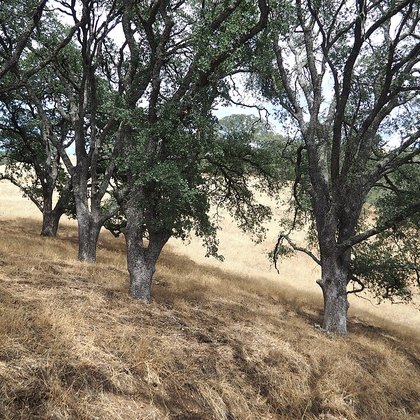
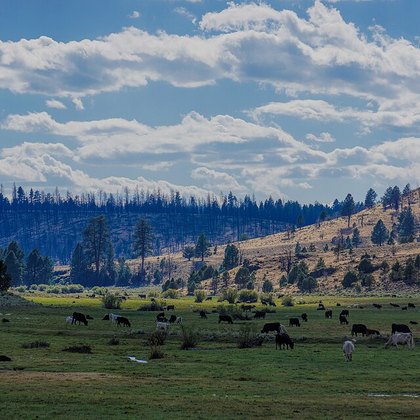
In Africa open woodland, savanna and cultivation with scattered trees. In Hawaii mainly dry, low-lying open country: grassy slopes with kiawe (Prosopis pallida, an introduced South American thorn shrub), parks, resort grounds, golf courses, roadsides and yards, usually below about 1500 metres. It forages on the ground and at grass stems, which it bends down to reach the seed heads, and comes to sown lawns in small parties.
Where the bird is most often found, arranged by the USNVC — the vegetation classification of the United States and Canada — and CMECS for sea and coast.




Range and movements
The natural range covers much of Africa south of the Sahara. Outside Africa the species is established on Mauritius, Réunion, the Cape Verde Islands and a few other islands. In Hawaii cage birds were released or escaped in the 1960s; since then it has been numerous on Oʻahu, the Big Island and Molokaʻi, and present in smaller numbers on other islands. There are established records from Puerto Rico as well. It does not migrate; birds stay in the same area year-round.
- Resident
Where and when to look
On Oʻahu or along the Kona coast of the Big Island it can be found year-round in dry grassy country and on resort grounds, often located first by song. Watch for the two dark stripes on the yellow face: that pattern separates it at once from every other yellow bird on the islands.
Conservation
In its natural African range the species is widespread and numerous, with a stable or rising trend, and the Red List rates it Least Concern (LC). In Hawaii it is an introduced species. It eats mainly the seed of non-native grasses and herbs in modified lowland and barely penetrates the native montane forest, so it has no demonstrated effect on the remaining native birds; like other introduced birds it can, however, spread the seed of non-native plants.
Scientific name
Crithagra mozambica | (Müller, 1776)
Philipp Ludwig Statius Müller described the species in 1776 as Fringilla mozambica, from a specimen from Mozambique; because it later moved to another genus, author and year stand in parentheses. The species name thus refers to that type locality and reappears in the Dutch name. The genus Crithagra was introduced in 1827 by William Swainson, from Greek krithē 'barley' and agra 'catching', hence 'grain-catcher', after its seed diet. The species stood in Serinus for a long time, but that genus proved to consist of several unrelated branches, after which the African species returned to Crithagra.