All species › Passerines › New World sparrows › Yellow-eyed Junco
Yellow-eyed Junco | Junco phaeonotus
Geeloogjunco | Junco ojilumbre
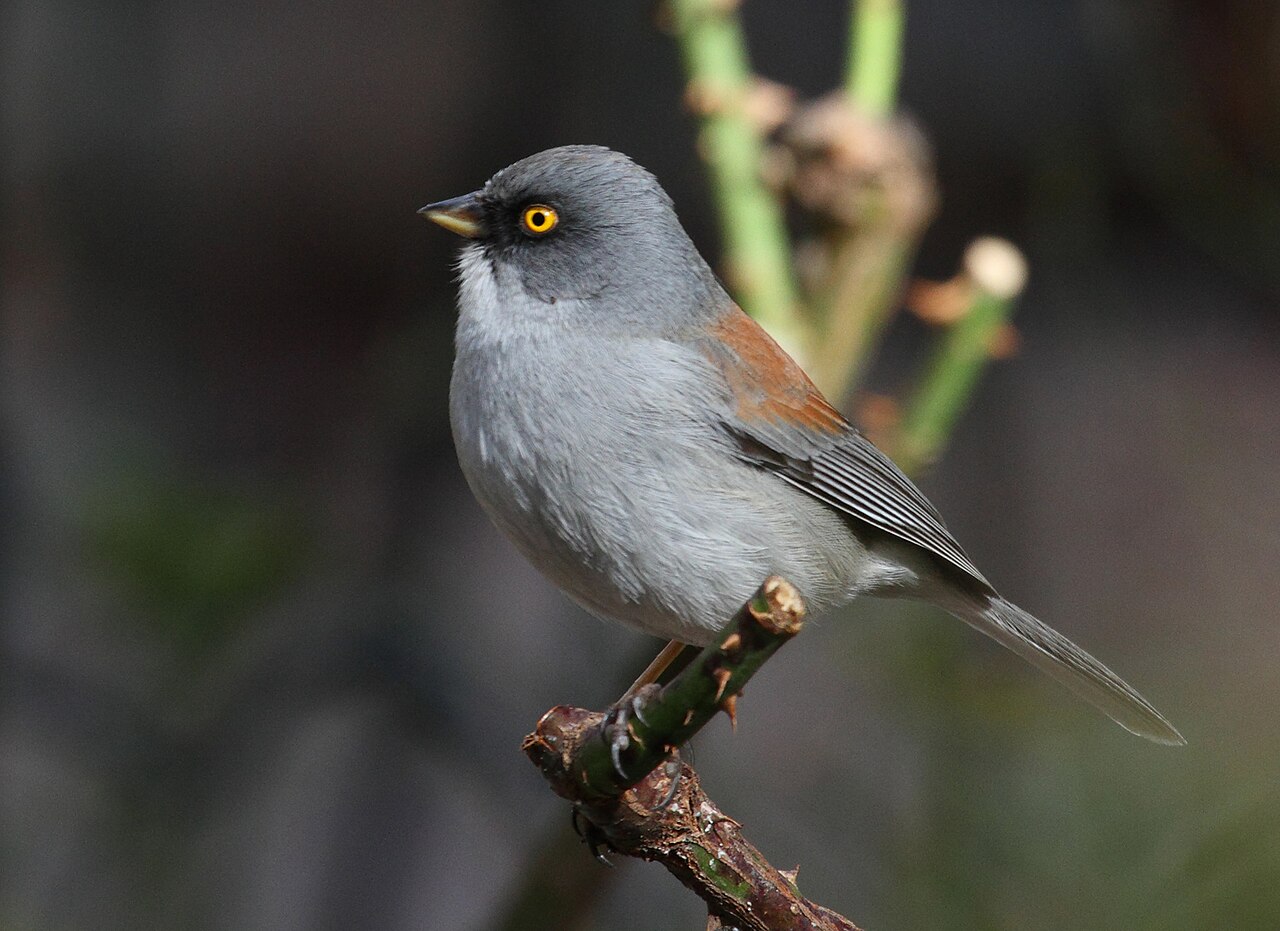
The Yellow-eyed Junco is the junco of the Mexican highlands, reaching the United States only in the mountains of southeastern Arizona and southwestern New Mexico. It has a yellow-orange iris instead of the dark eye of the Dark-eyed Junco, and a two-toned bill with a dark upper and a yellow lower mandible.
Voice
Only the male sings. The song has two or three clearly separated parts with trills, each part at its own pitch and rhythm; it is therefore more varied and less even than the flat trill of the Dark-eyed Junco. Calls are a short chip, running into a fast series when the bird is agitated, and a thin, high tsee series between birds of a flock. Song starts in late February and continues into August.
Recording: Scott Crabtree — CC BY-NC-SA 4.0 · Mt Bigelow, Pima County, Arizona, United States · xeno-canto
Identification
A junco with a light grey head and breast, a sharply defined rusty back and a white belly, with white outer tail feathers showing on take-off. The mark that matters is the iris: yellow-orange in adults, set off by a black lore that frames the eye. The lower mandible is yellow to horn, the upper dark. The shoulder feathers are often rufous, giving a second brown patch beside the back. The female is duller with an olive cast over the crown; young birds still have a brown iris and are finely streaked.
Confusion species
The Red-backed group of the Dark-eyed Junco occurs in the same Arizona and New Mexico mountains and likewise has a rusty back and a two-toned bill; the difference lies in the dark iris and, given a good view, in the black lore the Yellow-eyed carries around the eye. Behaviour differs too: the Yellow-eyed Junco walks and shuffles over the ground rather than hopping, and scratches with one foot or with a double hop. The Gray-headed group of the Dark-eyed Junco has an evenly pale bill and dark eyes.
Habitat
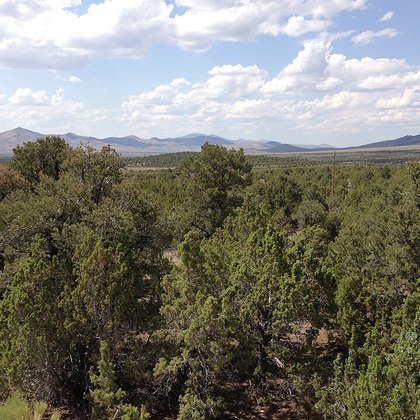
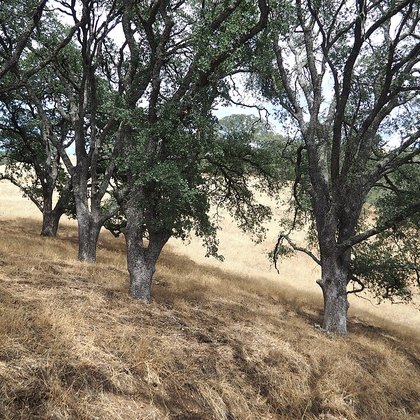
Coniferous and pine-oak forest of mountains, roughly between 1200 and 3500 metres but mostly above 2000, with ponderosa pine, Douglas-fir, spruce and oak, and open grassy patches and scrub in between. The nest sits on the ground at the base of a grass clump or under a rock. In winter the birds drop to lower oak woodland, juniper land and scrub, where flocks of up to forty gather. It also drinks sap from holes drilled by woodpeckers in tree trunks.
Where the bird is most often found, arranged by the USNVC — the vegetation classification of the United States and Canada — and CMECS for sea and coast.


Range and movements
The range runs from northeastern Sonora and western Chihuahua, and from northern Coahuila, western Nuevo León and southwestern Tamaulipas, south through both Sierra Madres and the Trans-Mexican Volcanic Belt to central Oaxaca west of the Isthmus of Tehuantepec, and on into the mountains of northern Chiapas and Guatemala. In the United States it is confined to the Sky Islands of southeastern Arizona — Chiricahua, Huachuca, Santa Rita, Pinaleño, Santa Catalina — and the Animas and Peloncillo Mountains of southwestern New Mexico. It does not migrate; the only movement is altitudinal in winter. The junco of Baja California Sur is now treated as a separate species and falls outside this range.
- Resident
- Breeding (summer)
- Winter
- Passage
- dark = core range, pale = thinly spread
Where and when to look
Look for it on the trails of Mount Lemmon or the Chiricahua Mountains above 2000 metres, where it often shuffles over the ground within a few metres of walkers. Against the light the eye colour cannot be seen; then watch the gait — shuffling and walking rather than hopping already separates it from any Dark-eyed Junco in the same forest.
Conservation
The world population is estimated at over 4 million mature birds and the trend is considered stable; the species is listed as Least Concern (LC). The United States segment is small and confined to a handful of isolated mountain tops, so large fires in the Chiricahua and Huachuca Mountains can have a strong local effect. Long-running counts are lacking for most of the Mexican range, so the trend there rests largely on estimates.
Scientific name
Junco phaeonotus | Wagler, 1831
Wagler described the species in 1831 in the same work in which he introduced the genus Junco; because it has never been moved to another genus, author and year stand without parentheses. The genus name goes back to Latin iuncus 'rush', by way of a Spanish bird name. The species name phaeonotus is from Ancient Greek phaios 'dusky' and -nōtos 'backed', thus 'dusky-backed'. The Dutch, English and Spanish names all name the eye: geeloog, Yellow-eyed and ojilumbre, literally 'fire-eye'. The specimen described came from Mexico.