All species › Passerines › New World sparrows › Dark-eyed Junco
Dark-eyed Junco | Junco hyemalis
Grijze junco | Junco ojioscuro
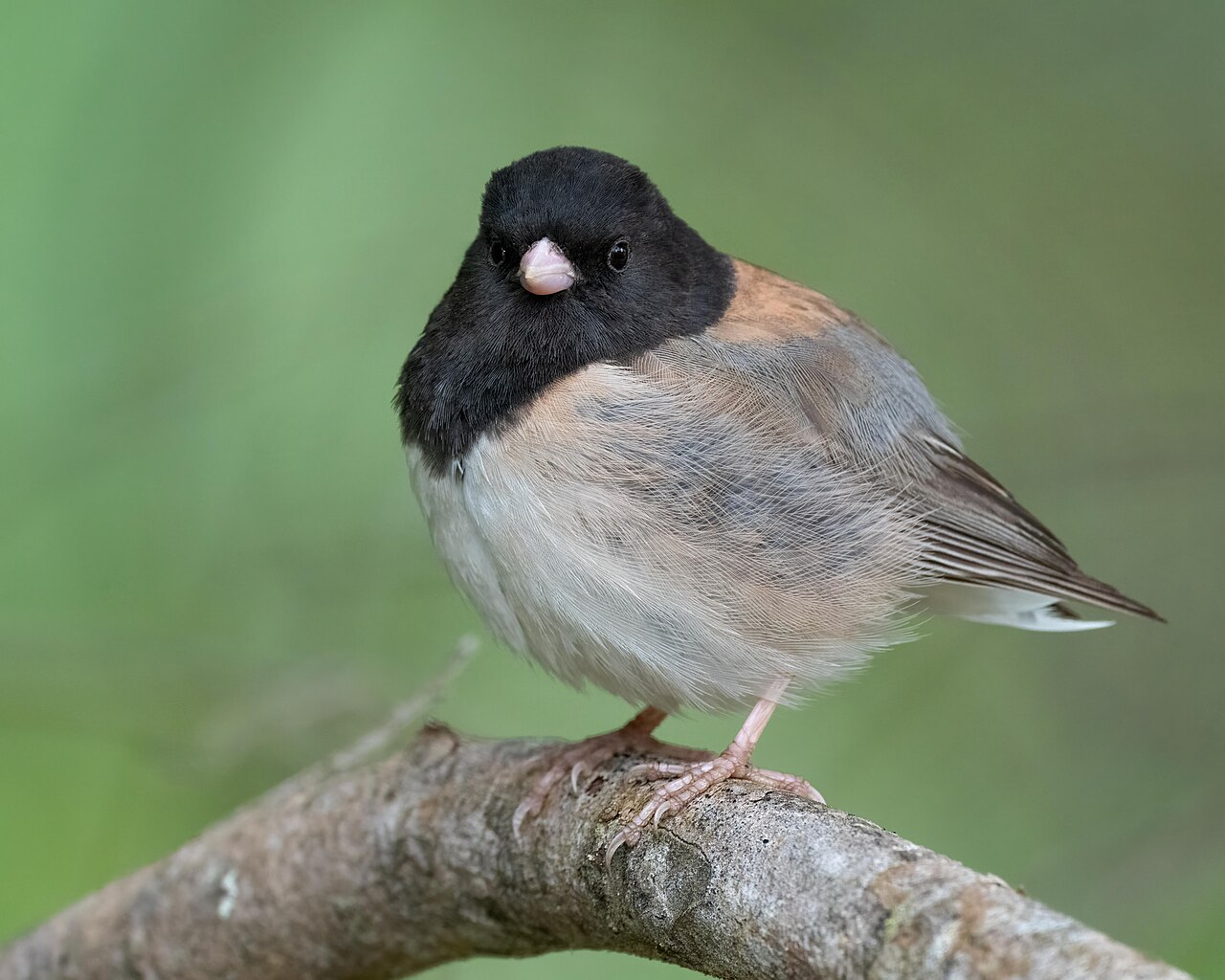
The Dark-eyed Junco is the most numerous winter visitor at North American feeders: a small, round sparrow with an even hood, a white belly, a pink bill and white outer tail feathers that flash at every flush. Six strongly differing groups fall under the one species name, from the slate grey of the east to the brown-backed type of the west coast.
Voice
The male's song is an even, musical trill of 7 to 23 notes lasting up to two seconds and carrying several hundred metres. Both sexes also give a quiet mixed song of whistles, trills and warbles audible only about ten metres away. Calls are a high, short tick, repeated fast in flight and slowly while foraging; a sharp but musical kew that enforces spacing within a flock; and a high, fast twitter of 6 to 19 notes in disputes or when flushing from cover.
Recording: Ed Pandolfino — CC BY-NC-SA 4.0 · Upper Barker Pass Rd, Placer County, California, United States · xeno-canto
Identification
A compact sparrow with a small conical bill, usually pale pink, dark eyes, and white outer tail feathers that show as two white wedges the moment the bird flies. The line between the dark breast and the white belly is sharp and straight. The Slate-colored group of the east and north is almost uniformly dark grey; the Oregon group of the west has a blackish hood, a brown back and rufous flanks; the Pink-sided group is pale grey with broad rufous on the sides; the Gray-headed group is light grey with a rusty back; the Red-backed group of Arizona and New Mexico resembles it but has a two-toned bill with a dark upper mandible; the White-winged group of the Black Hills has two narrow white wingbars.
Confusion species
Yellow-eyed Junco in the mountains of southeastern Arizona and southwestern New Mexico occupies the same forest there as the Red-backed group of the Dark-eyed Junco: Yellow-eyed has a yellow-orange iris and a lighter, more shuffling gait, Dark-eyed a dark iris. Black-chinned Sparrow has a dark bill, a long tail without white and a pale eye-ring. Between the groups themselves the colour of the back, the sharpness of the breast line and the colour of the flanks are decisive; intergrades occur where two groups meet.
Habitat
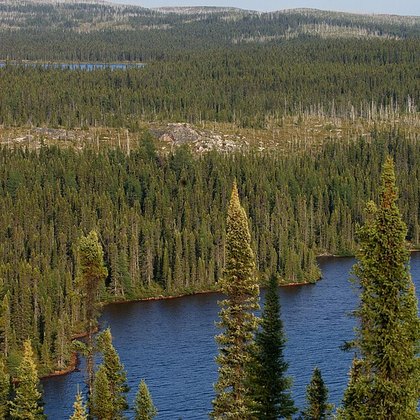
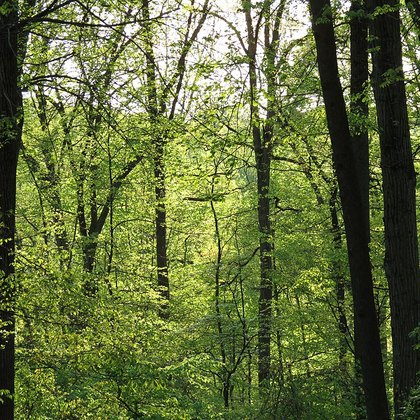
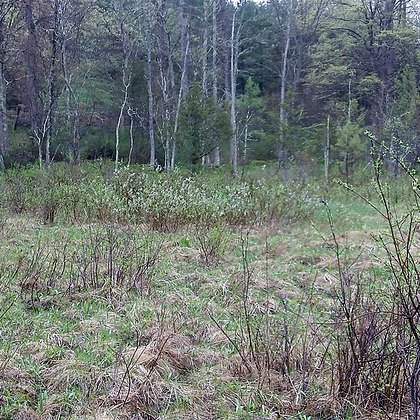
Breeds in coniferous and mixed forest from sea level to above 3400 metres, favouring openings, forest edges and clearcuts with a dense herb layer. The nest sits on the ground in a hollow on a slope or among tree roots. In winter the habitat is far broader: open woodland, field edges, roadsides, parks and gardens, where flocks take seed from the ground under shrubs and feeders. In the southwest it then also uses juniper and dry pine woodland.
Where the bird is most often found, arranged by the USNVC — the vegetation classification of the United States and Canada — and CMECS for sea and coast.


Range and movements
Breeds from western Alaska across Canada to Newfoundland and south through the western mountains into northern Mexico, and in the east along the Appalachians to northern Georgia. Over most of the western United States and southern Canada the species is present year-round, with altitudinal movement bringing mountain birds down to the valleys in winter. The southern winter limit lies at the Gulf coast and northern Florida; in Mexico flocks reach Baja California, Sonora, Chihuahua, Coahuila, Nuevo León and Tamaulipas. The split across Mexican states is derived from range description rather than a measured map.
- Resident
- Breeding (summer)
- Winter
- Passage
- dark = core range, pale = thinly spread
Where and when to look
Watch the tail rather than the colour: two white outer tail feathers flashing out of a roadside verge is the quickest mark, even on a bird visible for a second. In winter, note which group you have — across the middle of the continent three or four groups overlap, and a record of an Oregon bird far east or a Slate-colored bird far west is useful.
Conservation
Partners in Flight puts the breeding population at about 220 million birds ; the species is listed as Least Concern (LC). The Breeding Bird Survey nonetheless shows a decline of roughly 31 per cent between 1966 and 2019, a drop long masked by the size of the population. Window collisions are among the best-documented causes of death, because wintering flocks forage close to buildings. The Guadalupe Island form is now treated as a separate species and falls outside this assessment.
Scientific name
Junco hyemalis | (Linnaeus, 1758)
Linnaeus described the species in 1758 as Fringilla hyemalis; because it was later moved to another genus, author and year stand in parentheses. The genus Junco was introduced in 1831 by Johann Georg Wagler; the word goes back to Latin iuncus 'rush', by way of a Spanish bird name, and does not refer to this species' habitat. The species name hyemalis is Latin for 'of the winter', after the season in which the described specimen was taken in Virginia and the Carolinas. The English name Dark-eyed Junco sets the dark iris against that of the Yellow-eyed Junco.