All species › Passerines › New World sparrows › White-throated Sparrow
White-throated Sparrow | Zonotrichia albicollis
Witkeelgors | Chingolo gorjiblanco
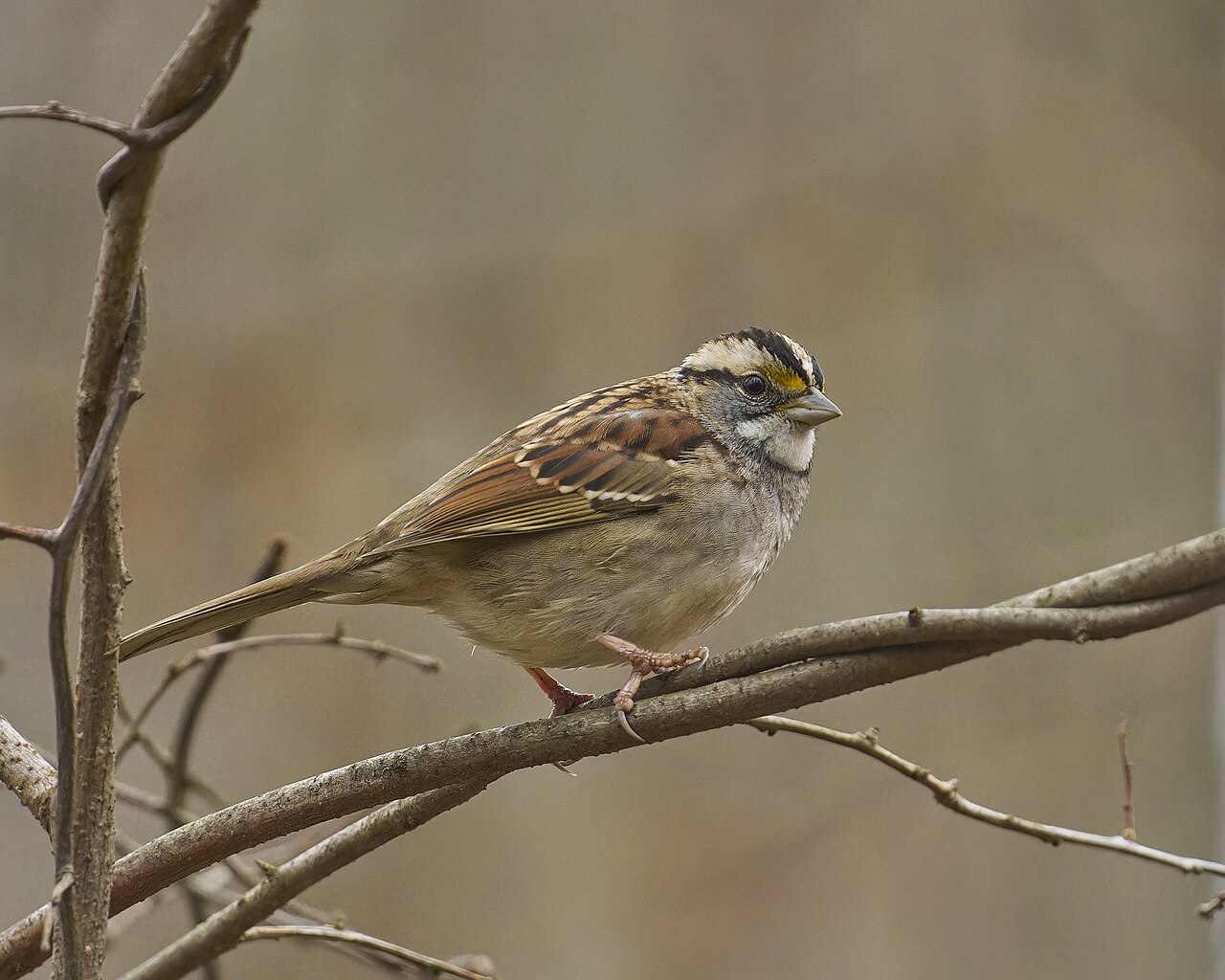
The White-throated Sparrow is separable from every other North American sparrow by the sharply bounded white throat and the yellow spot in front of the eye. The species occurs in two fixed colour morphs, white-striped and tan-striped, which almost always pair with the other morph rather than with their own.
Voice
The song is a series of clear whistles: two drawn-out opening notes followed by three quavering groups of three, rendered in Canada as oh sweet Canada Canada Canada. Since the 1990s a variant in which the closing groups hold two notes instead of three has spread eastward from British Columbia, reaching most of the continent within twenty years. The call is a hard, metallic chink, and in flight a thin, drawn-out seet. Song is heard in midwinter and at night as well.
Recording: Ray Cooke — CC BY-NC-SA 4.0 · Dromore, Prince Edward Island, Canada · xeno-canto
Identification
A sturdy, long-tailed sparrow with an unstreaked grey breast, a brown-streaked back and two narrow white wingbars. The throat is clean white and sharply cut off against the grey breast; ahead of the eye sits a yellow spot on the lore. The white-striped morph has a black crown with a white central stripe and a white supercilium; the tan-striped morph carries the same pattern in dark brown and buff, with a less sharply bounded throat. Both morphs occur in both sexes and are recognisable year-round. The bill is grey, the legs flesh-coloured.
Confusion species
White-crowned Sparrow has the same black-and-white head striping but no white throat patch, no yellow on the lore, and an orange-pink to yellow bill. Young White-crowned Sparrows have a brown-and-buff striped head and resemble the tan morph of White-throated: then watch for the absence of the sharp throat boundary and for the bill colour. Harris's Sparrow is larger, with a black throat and crown and a pink bill. American Tree Sparrow has an evenly rufous crown and a dark spot at the centre of the breast.
Habitat
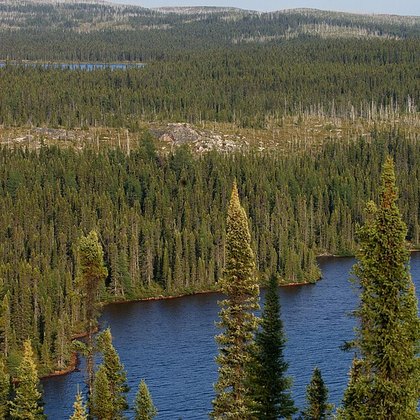
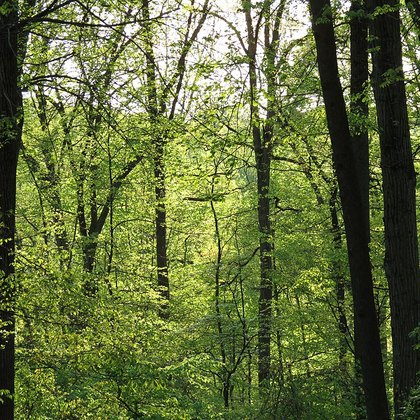
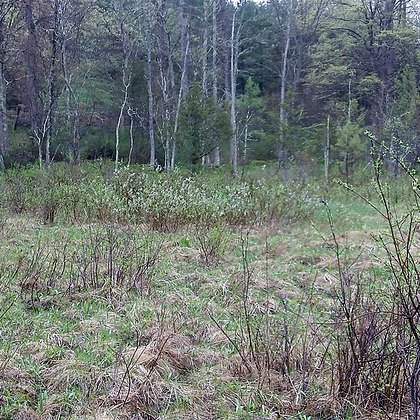
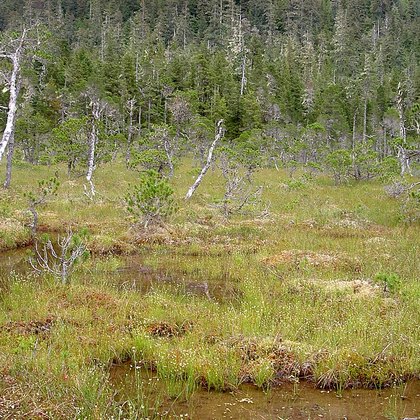
Breeds in coniferous and deciduous forest up to treeline, strongly favouring openings, forest edges, clearcuts and burns with a dense low shrub layer, and the margins of bog and muskeg (boggy spruce peatland typical of boreal Canada). The nest sits on the ground under a shrub. In winter it uses weedy fields, hedgerows, thickets, woodland edges, parks and gardens, and comes regularly under feeders, always staying close to cover.
Where the bird is most often found, arranged by the USNVC — the vegetation classification of the United States and Canada — and CMECS for sea and coast.


Range and movements
The breeding range covers the boreal forest from Yukon and northeastern British Columbia east through the prairie provinces, Ontario, Quebec and Newfoundland, and south to Minnesota, Wisconsin, Michigan, northern New York and New England. Wintering is almost wholly in the eastern and southern United States, from southern New England and the Ohio Valley to Texas, the Gulf Coast and Florida. Small numbers winter each year on the west coast in California, Oregon and Washington. In northern Mexico a few birds reach Coahuila, Nuevo León and Tamaulipas; that occurrence is poorly documented.
- Resident
- Breeding (summer)
- Winter
- Passage
- dark = core range, pale = thinly spread
Where and when to look
In winter it often gives itself away first with a single hesitant whistle from a hedgerow — half a song that breaks off after a few seconds. At a flock under a feeder, check which morphs are present: a winter flock usually holds both, and the distinction can be made with binoculars alone.
Conservation
Partners in Flight puts the breeding population at about 160 million birds and the species is listed as Least Concern (LC). Across the range the Breeding Bird Survey shows a decline of roughly 33 per cent since 1966, and within the United States a decline of 69 per cent; the bulk of the population, however, lies in Canada. The species is among the birds most often found dead beneath lit buildings: one Chicago study accumulated thousands of individuals over its run. Logging of young forest and the closing over of openings limit the breeding habitat locally.
Scientific name
Zonotrichia albicollis | (Gmelin, 1789)
Gmelin described the species in 1789 as Fringilla albicollis, on the basis of the plate Edwards published in 1760 as 'the white-throated Sparrow'; because it was later moved to another genus, author and year stand in parentheses. The genus Zonotrichia was introduced in 1832 by William Swainson, from Greek zōnē 'band' and trikhos 'hair', after the banded head. The species name albicollis is Latin for 'white-necked', from albus 'white' and collum 'neck'. The Dutch, English and Spanish names all name that same white throat. The type locality is Pennsylvania.