All species › Pelicans, herons and ibises › Ibises and spoonbills › White Ibis
White Ibis | Eudocimus albus
Witte ibis | Ibis blanco
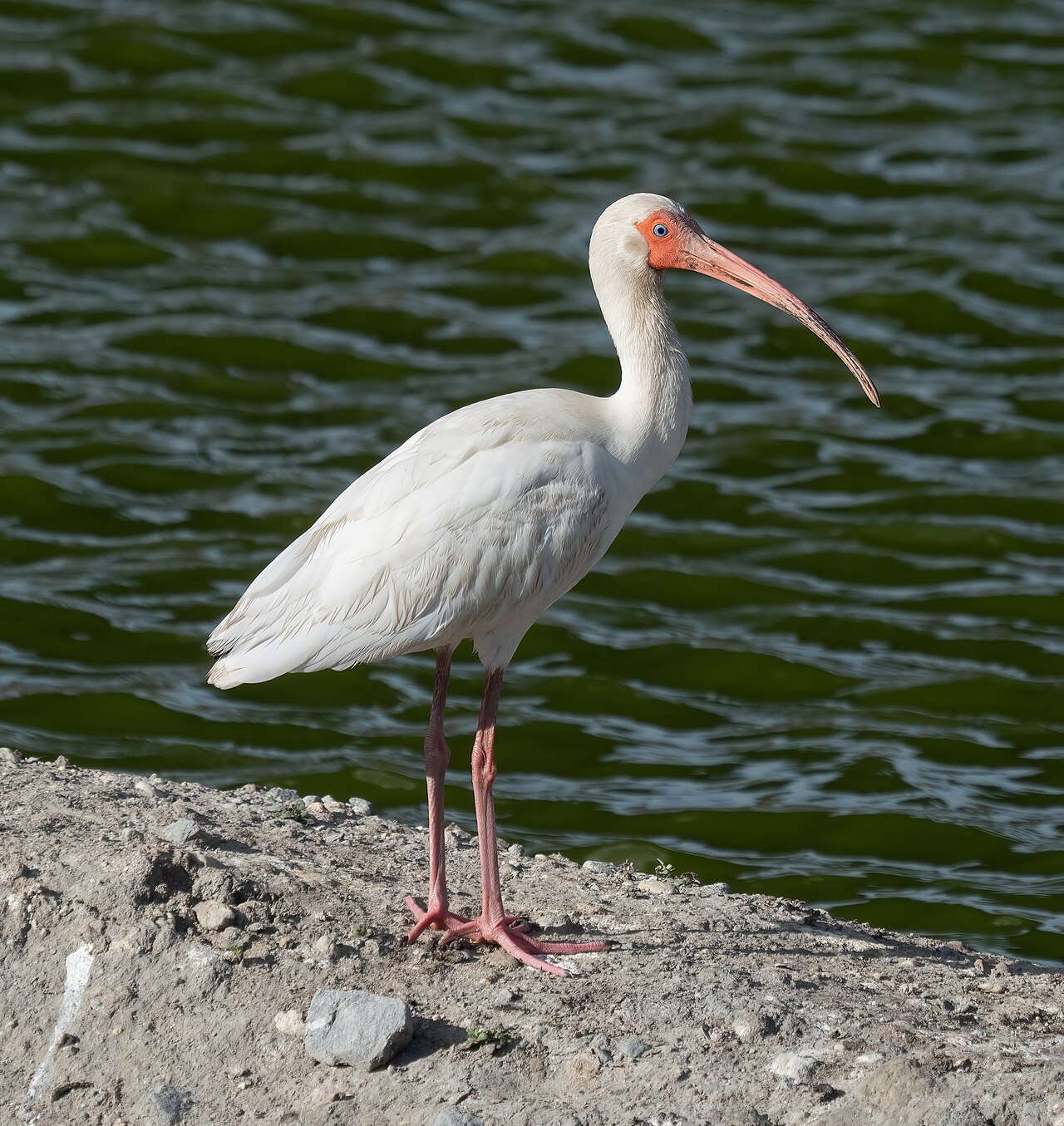
The White Ibis is the commonest ibis of the southeastern coastal plain: entirely white, with a long, down-curved red bill, red legs and black wingtips that show only in flight. It feeds by touch, in flocks that spread out over shallow water, salt marsh and mown grass. Towards evening it flies in long ribbons to communal roosts, often several hundred birds at a time.
Voice
A feeding flock is nearly silent; at most you hear a soft, nasal hunk with which the birds keep track of one another on the ground. In flight and at the roost this grows louder and quicker, a series of hunk-hunk-hunk that sounds like someone talking through the nose. In the colony the grunting keeps up all day, and above it the young beg with a high, shrill squealing. Away from a colony or a roost the species is seldom heard.
Recording: Daniel Parker — CC BY-NC-SA 4.0 · Shark Valley, Everglades National Park, Miami-Dade County, Florida, United States · xeno-canto
Identification
Adults are entirely white with black tips to the outer four primaries; on a perched bird these usually stay hidden under the wing, and only in flight do they form four black spots at the end. The bare face, the bill and the legs are pink to red and turn scarlet in the breeding season, when the male also swells a pouch beneath the throat. Male and female are marked alike, but the male is larger and has a noticeably longer and heavier bill. Young birds are dark brown on head, neck, back and wings with a sharply set-off white belly and white rump, and look piebald in their second year as the white breaks through in patches. In flight neck and legs are held straight out and quick beats alternate with short glides; flocks travel in a line or a V, often low over the water.
Confusion species
Wood Stork (Mycteria americana) is nearly twice the size, has black along the whole trailing edge of the wing instead of only at the tips, and carries a bare dark grey head with a heavy bill that curves down at the end. Young Roseate Spoonbills (Platalea ajaja) are also mostly white with some pink, but their bill runs out into a flat spoon and is straight rather than curved. Young White Ibises in their turn are taken for Limpkin, which is larger, dark brown with white drops over the whole body, and lacks the sharply set-off white belly. If in doubt, wait until the bird takes off — four black wingtips on an otherwise white bird settle it.
Habitat
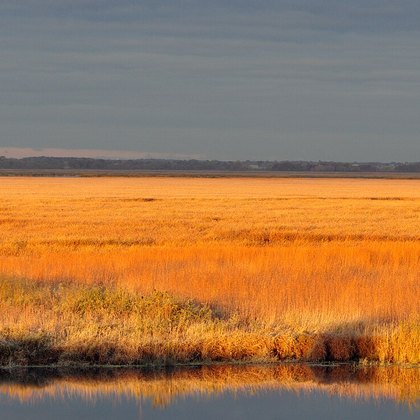
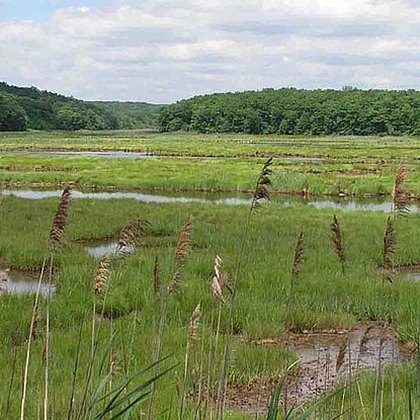
Shallow fresh and brackish water with a soft bottom: freshwater marsh, salt marsh, mangrove, mudflats, ditches, drains and pond margins. It fishes by touch, with the half-open bill through the mud, and so depends on water it can wade in — a hand's breadth is enough, knee-deep is already too much. The young are fed on freshwater prey, above all crayfish, so a colony in the mangrove succeeds only if fresh marsh lies within flying distance. In Florida and along the Gulf Coast it also walks over lawns, golf courses and town parks, probing the grass for leatherjackets and worms.
Where the bird is most often found, arranged by the USNVC — the vegetation classification of the United States and Canada — and CMECS for sea and coast.



Range and movements
Resident on the coastal plain from North Carolina and Virginia south along the Atlantic and the Gulf to Texas, along both coasts of Mexico, through Central America and on Cuba and the Bahamas; further south the range continues into Colombia, Venezuela and Peru. It does not migrate but wanders widely: after nesting, birds regularly appear north to Maryland and New Jersey. Within the range the colonies shift from year to year with the water, standing wherever a marsh happens to be drying and concentrating the prey. During the twentieth century the great Everglades colonies emptied once the water there came to be steered by canals and levees, and the centre of gravity moved to the coast and northwards.
- Resident
- Breeding (summer)
- Winter
- Passage
- dark = core range, pale = thinly spread
Where and when to look
Go in the last hour before sunset to a mangrove island or a line of tall trees at a marsh edge: the flocks come in from every side, low over the water, and settle by the hundred in the same crown. By day the surest place is a ditch that has just begun to dry or a drawn-down pond, where the birds work along the edge in a close rank. On young birds watch the white rump: it stands out in flight while the rest of the bird is still brown.
Conservation
The Red List treats the species as Least Concern (LC); the world population is put at over a million birds and numbers in the United States have been stable to increasing in recent decades. The totals swing widely from year to year, because a colony fails as soon as the marsh floods at the wrong moment or dries out too fast. The loss of freshwater marsh is therefore the heart of the matter: there is nesting room enough on the coast, but without fresh water within flying distance the young are not raised.
Scientific name
Eudocimus albus | (Linnaeus, 1758)
Linnaeus described the species in 1758 as Scolopax alba, among the snipes; because it was later moved to another genus, author and year stand in parentheses. The genus Eudocimus was introduced by Wagler in 1832; that name comes from the Greek eudokimos, 'held in good repute'. albus is the Latin word for 'white'. Linnaeus gave the type locality as Carolina.