All species › Waterfowl › Ducks, swans and geese › Tundra Bean-Goose
Tundra Bean-Goose | Anser serrirostris
Toendrarietgans | Ánsar campestre de la tundra
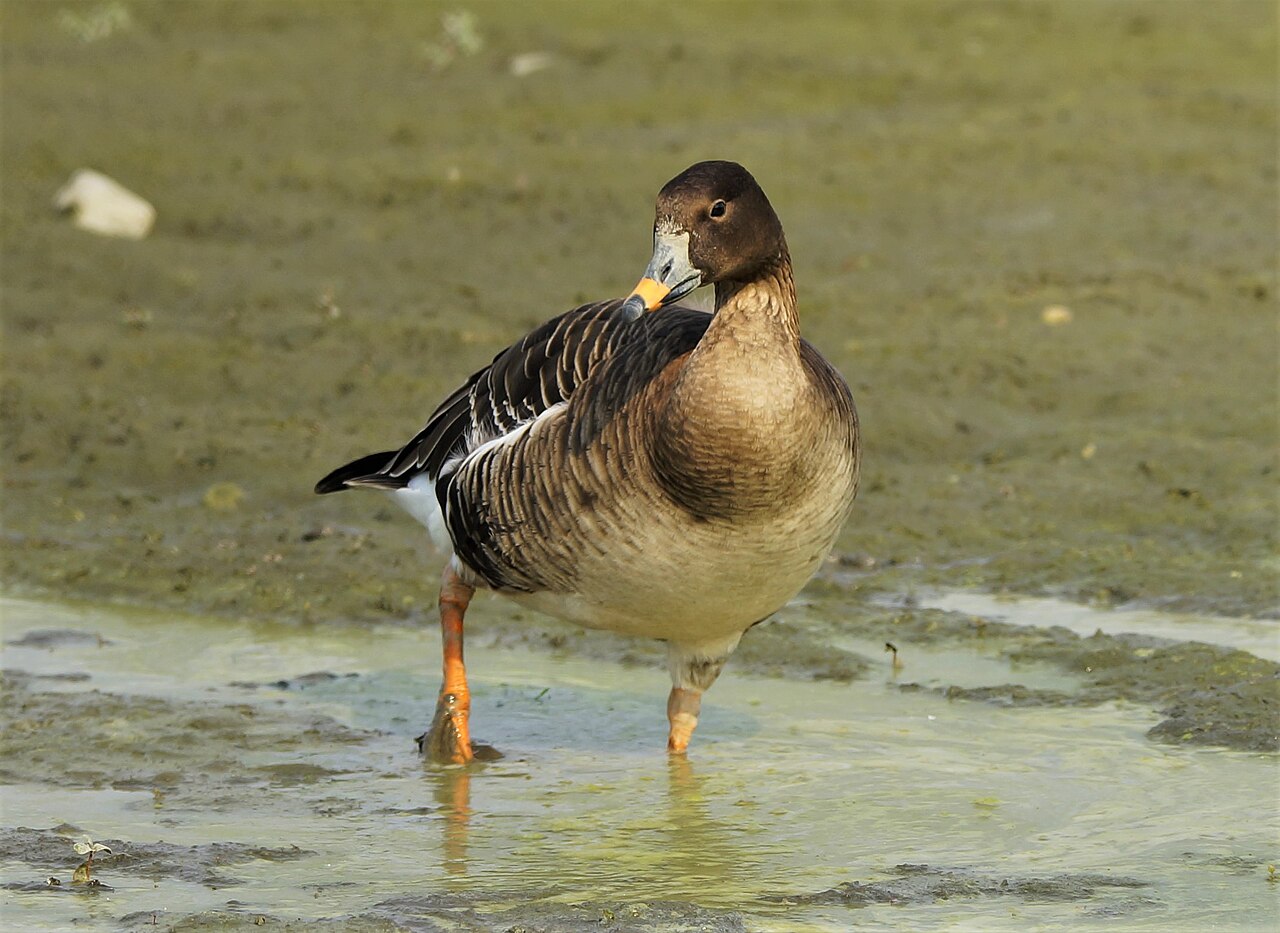
The Tundra Bean-Goose breeds on the flat tundra of northern Siberia, from the Pechora to beyond the Kolyma, and normally migrates to Europe and East Asia for the winter. In North America it is a scarce vagrant: a handful of birds turn up most years among the Snow Geese and Greater White-fronted Geese of the Bering Sea islands, usually in May. Its short, heavy bill with a narrow orange band sets it apart at once from the closely related Taiga Bean-Goose.
Voice
The call is a deep, carrying honk, higher and more penetrating than a Greylag Goose's but lower than a Greater White-fronted Goose's: a repeated hank-hank or wink-wink, often given in flight. The species is generally quieter than other grey geese and is more often heard than seen as a flock passes overhead at night. On the ground, foraging birds exchange a soft, nasal chattering. An alarmed bird raises its neck and gives a shorter, sharper note before taking flight.
Recording: Stanislas Wroza — CC BY-NC-SA 4.0 · Soppavann, Finland · xeno-canto
Identification
A heavy, dark grey goose with an evenly dark brown head and neck, a greyish-brown back with pale feather fringes that give a scaled pattern, and white undertail coverts. The bill is short, deep at the base and mostly black, with a narrow, sharply defined orange band; the legs are orange. The sexes are alike, the male slightly larger. Juveniles are duller and lack the crisp division between black and orange on the bill. In flight the heavy, somewhat compact build stands out, with relatively short, broad wings.
Confusion species
Taiga Bean-Goose (Anser fabalis) is the main confusion risk: it is longer-necked and longer-billed, with more and more diffusely bordered orange on the bill, and looks slimmer in flight. Pink-footed Goose (Anser brachyrhynchus) is smaller and more compact, with pink rather than orange on bill and legs. Greater White-fronted Goose (Anser albifrons), the grey goose of this region, has an entirely orange bill with no black and, in adults, a white blaze around the bill base. At long range, among flocks of Snow Geese, the Tundra Bean-Goose's dark, evenly toned head and neck are the feature that catches the eye first.
Habitat
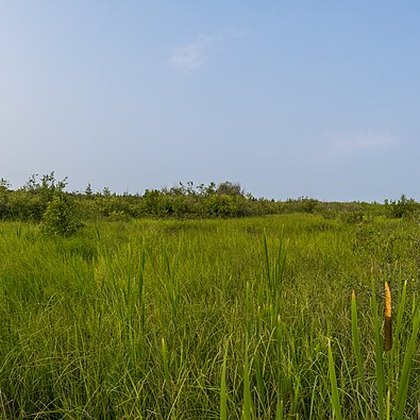
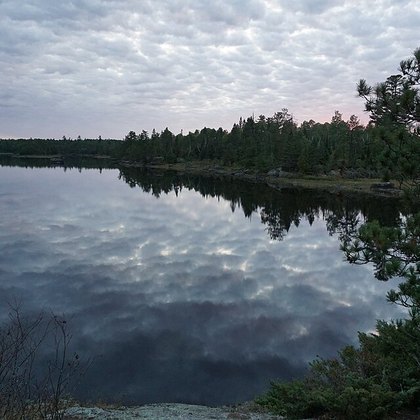
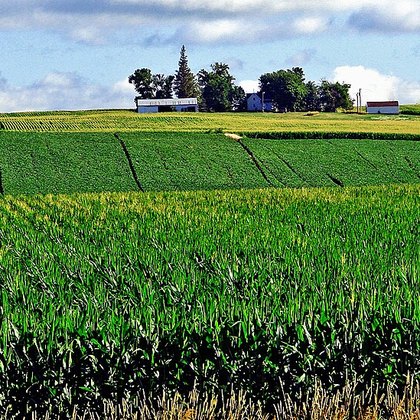
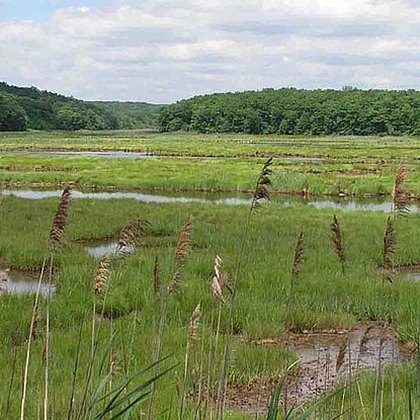
Breeds on open, wet tundra with hummocks, pools and slow-moving water, nesting on a dry rise among the wet hollows. Outside the breeding season it seeks short grassland and harvested cropland, often in mixed flocks with other grey geese, and roosts on open water or sheltered coastal waters. It avoids dense taiga forest and mountainous terrain, staying at or below the treeline. In Alaska and on the Bering Sea islands, where it occurs as a vagrant, it seeks the same combination of coastal grassland and shallow pools.
Where the bird is most often found, arranged by the USNVC — the vegetation classification of the United States and Canada — and CMECS for sea and coast.

Range and movements
Breeds across the Siberian tundra, from the Pechora Delta in the west to Chukotka in the east, divided between two subspecies that replace one another geographically. It winters across western, central and eastern Europe and in East Asia; that range does not normally reach North America. Since the 1990s it has been reported in small numbers almost every year on the Bering Sea islands and the western Aleutians, nearly always in the second half of May and occasionally in autumn — traces of birds that overshot to the east during their spring migration toward Siberia. Further east on the continent it remains an exceptional record.
Where and when to look
Look for it not as a lone bird but among flocks of Snow Geese and Greater White-fronted Geese on the coastal grassland of St. Paul Island or St. Lawrence Island, in the second half of May. Watch for the short, dark head-and-neck pattern and the heavy bill with its narrow orange band — if a Taiga Bean-Goose happens to stand alongside, the direct comparison is the quickest way to tell them apart. A single bird among hundreds of geese is often missed; work the edge of the flock systematically.
Conservation
This guide's data list the species as Not Evaluated (NE), because the international Red List still assesses status at the level of the former, broader species Anser fabalis, from which the Tundra Bean-Goose was only later split off. The combined Asian and European breeding populations are estimated at several hundred thousand birds and are not considered threatened, though the trend of the eastern subspecies is less well documented than that of the western one. In North America the species does not count as an established breeder, and conservation status here has no practical meaning.
Scientific name
Anser serrirostris | Gould, 1852
John Gould described the species in 1852 as Anser serrirostris, based on a bird from the Shanghai area; because it has remained in the same genus ever since, author and year are not placed in parentheses. The genus Anser was introduced by Brisson in 1760 and is the Latin word for 'goose'. serrirostris combines Latin serra, 'saw', and rostrum, 'bill', after the saw-like lamellae along the cutting edge of the bill. The type locality lies in what is now Shanghai, far from the breeding range: Gould knew the species only from birds wintering in Chinese markets when he described it.