All species › Waterfowl › Ducks, swans and geese › Pink-footed Goose
Pink-footed Goose | Anser brachyrhynchus
Kleine rietgans | Ánsar piquicorto
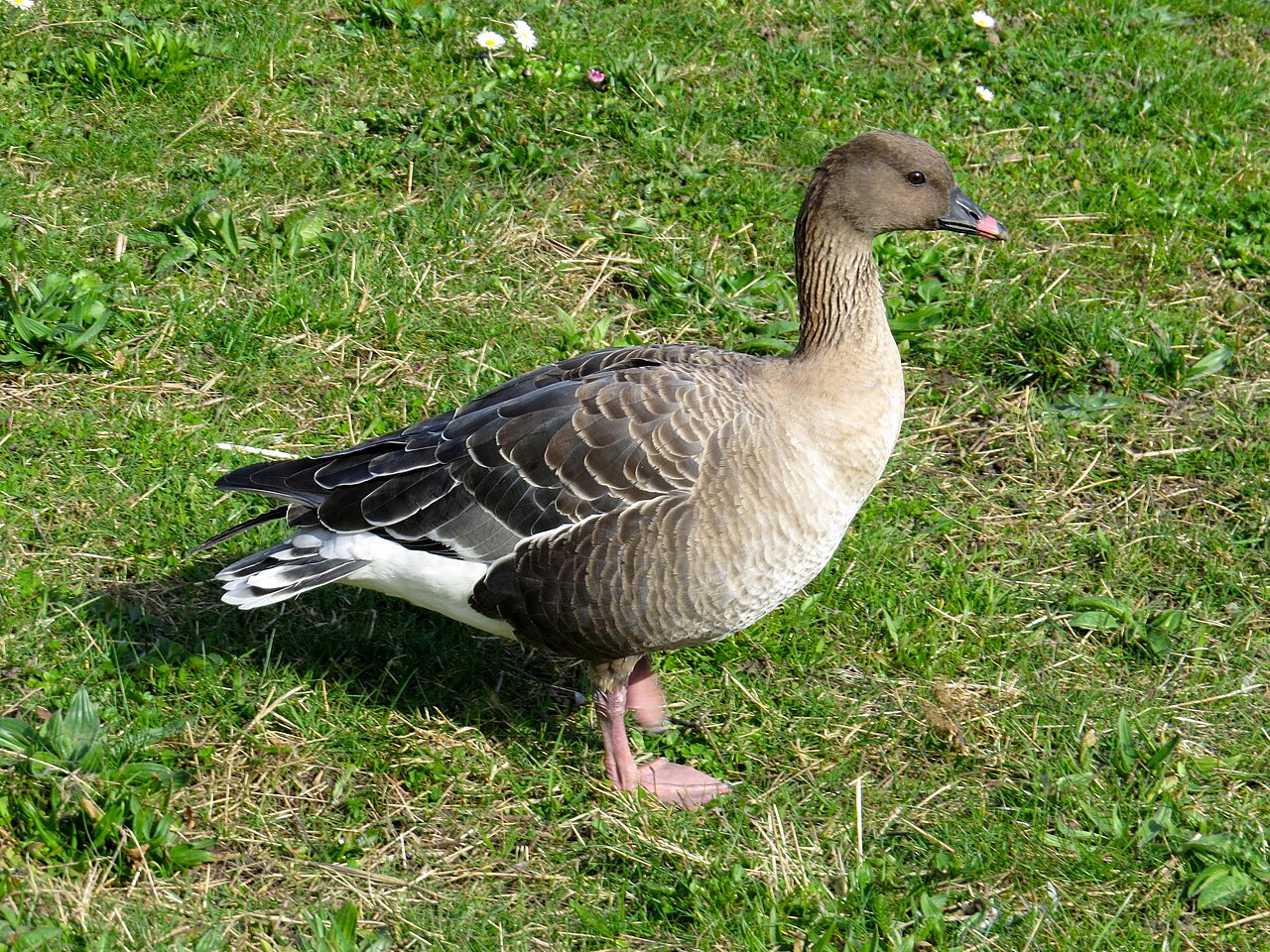
The Pink-footed Goose breeds on the tundra and bare uplands of Iceland, Greenland and Svalbard and winters in dense flocks on the farmland of Britain, Denmark and the Netherlands. In North America its regular breeding range extends into eastern Greenland, making it one of the few European geese that also counts as a breeder on this continent. A compact, short-billed goose with pink rather than orange on bill and legs — the source of its English name.
Voice
The call is higher-pitched and more musical than that of the Greylag Goose or the bean geese: a series of sharp, two- or three-syllable wink-wink or ang-ang notes, often overlapping when a large flock calls together. Flying flocks are vocal and can form clouds of thousands of calling birds above the wintering grounds. Alarm on the ground brings a short, piercing note that sets the whole flock moving.
Recording: David Darrell-Lambert — CC BY-NC-SA 4.0 · Spurn Bird Observatory, Kilnsea, United Kingdom · xeno-canto
Identification
A medium-sized, compact goose with a dark brown head and upper neck contrasting sharply with the blue-grey back and the salmon-pink wash on the lower neck and breast. The flanks are dark brown, the lower underparts white, and in flight the upperwings show a pale blue-grey against darker underwings. The bill is short and mostly dark, with a narrow pink band near the tip; the legs are pink. The sexes are alike.
Confusion species
The bean geese — Taiga Bean-Goose (Anser fabalis) and especially Tundra Bean-Goose (Anser serrirostris), which is closest to Pink-footed Goose in build — have orange rather than pink on bill and legs and lack the sharp division between head and neck colouring. Greater White-fronted Goose (Anser albifrons) has an entirely orange bill and, in adults, a white blaze around the bill base. In mixed flocks in Europe, the combination of size — larger than a Mallard, smaller than a Greylag Goose — and the pink legs is usually enough.
Habitat
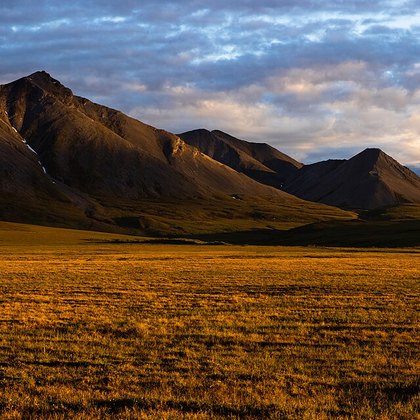
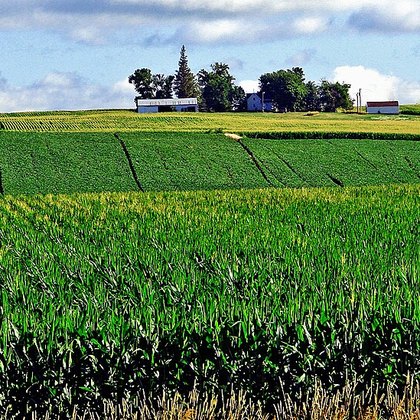
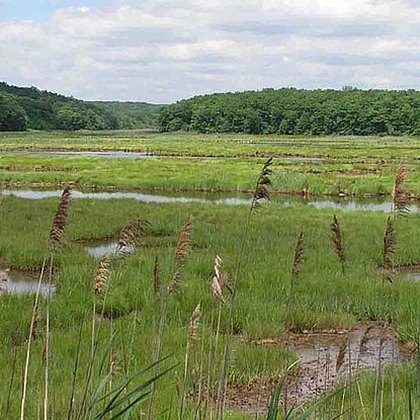
Breeds on damp tundra, rocky uplands and along mountain river valleys, often on small islands in lakes where ground predators struggle to reach. Outside the breeding season, harvested farmland — above all potato and sugar-beet fields, and cereal stubble — is the key habitat, supplemented by salt marsh and coastal grassland for roosting and resting. It avoids woodland and dense scrub entirely and, more than most geese, has come to depend on land worked by people.
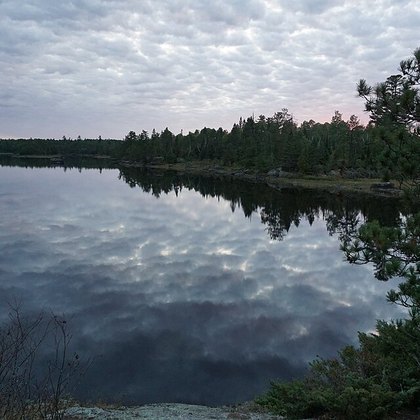
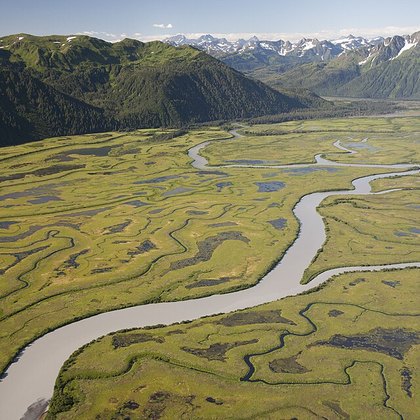
Where the bird is most often found, arranged by the USNVC — the vegetation classification of the United States and Canada — and CMECS for sea and coast.
Range and movements
Breeds in central and western Iceland, on Svalbard, and in eastern Greenland, and winters almost entirely in Britain, with smaller numbers in Denmark, the Netherlands and Belgium. That wintering range lies outside the guide area. In North America the species is best known as a breeder in Greenland; as a vagrant it appears irregularly, with increasing frequency since the 1980s, along the Atlantic coast from Newfoundland to Virginia, usually a single bird among a flock of Canada Geese. Those records remain too irregular to count as an established range.
- Resident
- Breeding (summer)
- Winter
- Passage
- dark = core range, pale = thinly spread
Where and when to look
In Greenland the best chance is in the mountainous interior of the east, where the species breeds on islets in lakes; elsewhere in North America it is scarce enough that the only way to find one is to work through every flock of Canada Geese along the Atlantic coast in autumn and winter. Watch for the pink legs and bill tip and the sharp break between the dark head and the blue-grey back — features that catch the eye at a distance before the rest of the pattern is visible.
Conservation
Least Concern (LC): the Iceland–Greenland population has grown strongly in recent decades thanks to protection on the breeding grounds and abundant winter food on British farmland, and now numbers well over four hundred thousand birds. That growth has a downside too: the flocks cause substantial local crop damage, for which Britain has introduced a management cull to stabilise numbers. The Svalbard sub-population, which winters in Denmark, the Netherlands and Belgium, is considerably smaller and more vulnerable.
Scientific name
Anser brachyrhynchus | Baillon, 1834
Baillon described the species in 1834 as Anser Brachyrhynchus, in the same genus it still stands in today, hence no parentheses around author and year. The genus Anser was introduced by Brisson in 1760 and is the Latin word for 'goose'. brachyrhynchus is Greek for 'short-billed', after the noticeably short bill compared with the other grey geese. The type locality lies at Abbeville on the lower Somme in France — Baillon knew the species only from birds wintering on the French coast; its breeding range in the high north was not mapped until decades later.