All species › Waterfowl › Ducks, swans and geese › Stejneger's Scoter
Stejneger's Scoter | Melanitta stejnegeri
Stejnegers zee-eend | Negrón de Stejneger
Stejneger's Scoter is the Asian counterpart of White-winged Scoter, treated as the same species until 2019 and recognised as its own species only since that split. In North America it reaches only the west coast of Alaska, where it occurs in small numbers, probably breeds and forages along the shores of the Bering Sea. Outside this area it is an Asian bird, ranging from Siberia to Japan and Korea.
Voice
As in White-winged Scoter, both male and female give a high, piping whistle in intense courtship, unusual for a scoter. On the water the species is usually silent, and what stands out most is the whistling sound of the wings in flight, a feature it shares with all scoters. Around the breeding grounds on the Bering Sea coast, that wing sound is often the first sign of a flock lifting off.
Recording: Martin Billard — CC BY-NC-SA 4.0 · Bayandelger, Töv, Mongolia · xeno-canto
Identification
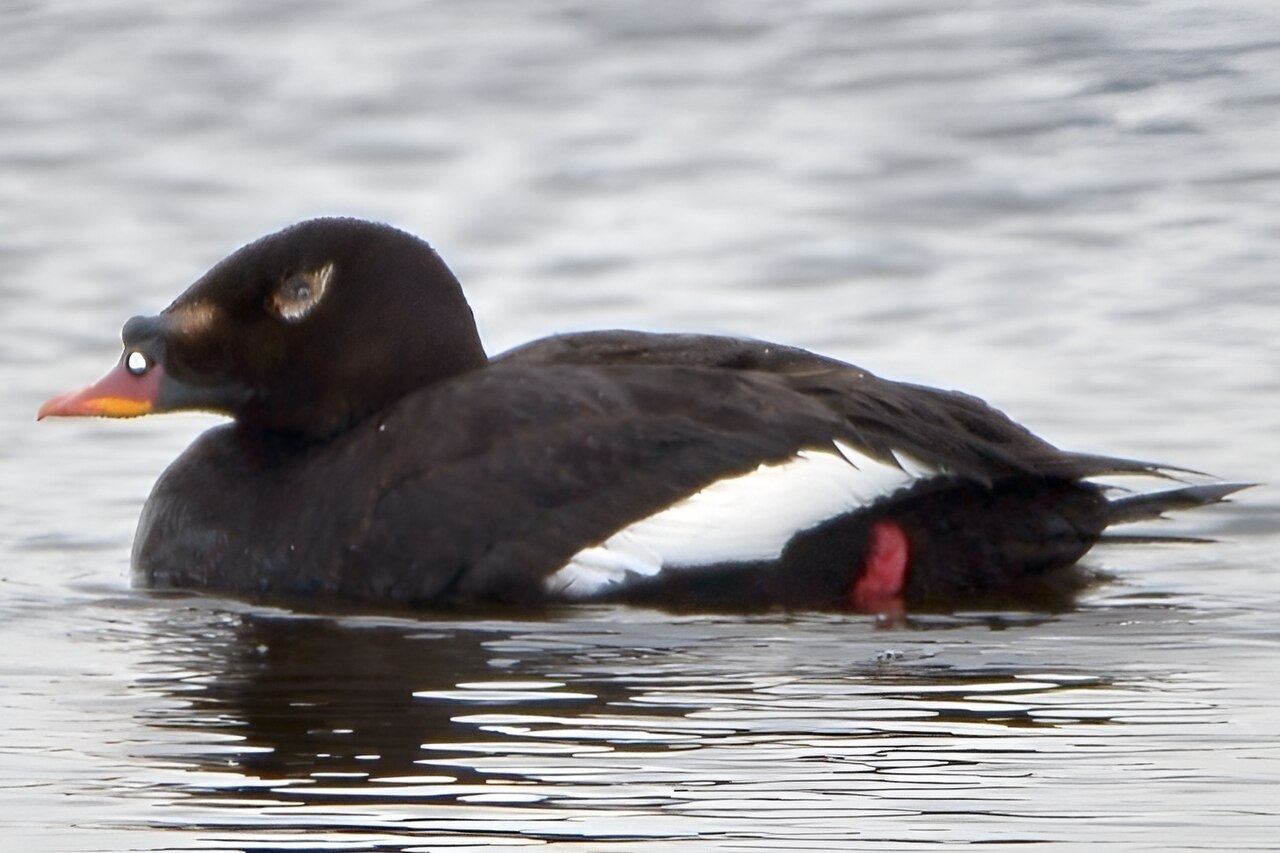
The male is black with a small, comma-shaped white spot behind the eye, a large white wing patch, and a black, strongly swollen knob at the base of the bill with a bright orange tip. The flanks of Stejneger's Scoter are almost always solidly black, without the brownish wash White-winged Scoter often shows, and the head looks slightly fuller and more angular. The female is dark brown with a rounded head and a relatively short bill and is barely separable in the field from the female White-winged Scoter. Juveniles resemble the female. In flight the species, like its American counterpart, is recognisable by the broad white wing patch.
Confusion species
White-winged Scoter (Melanitta deglandi) is by far the main source of confusion: until 2019 it was treated as the same species, and females and immatures are often not safely separable in the field. In males, Stejneger's Scoter's solidly black flanks, fuller, steeper head, and brighter orange bill tip give the best clues. In Europe and western Asia lives the closely related Velvet Scoter (Melanitta fusca), which does not overlap with Stejneger's Scoter. Surf Scoter and Black Scoter, the region's other two scoters, are told apart at once by the white wing patch, which both entirely lack.
Habitat
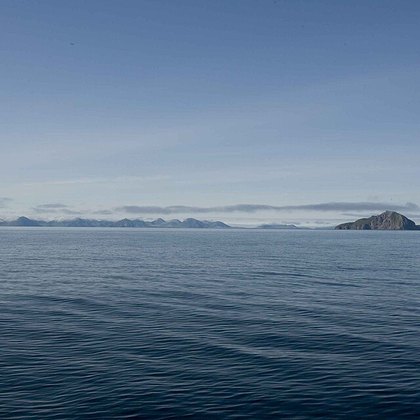
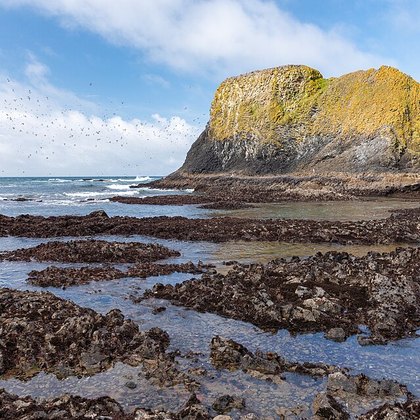
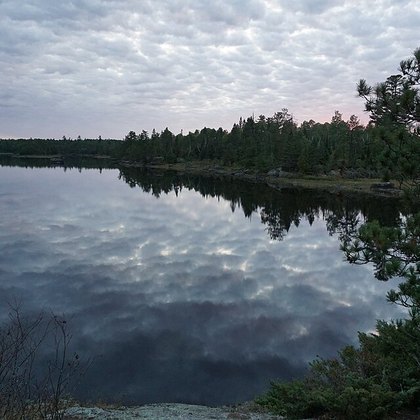
Breeds at shallow tundra pools and lakes close to the coast in the extreme northeast of Siberia. In Alaska it is seen almost exclusively on the sheltered coastal waters and bays of the Bering Sea shore, where, like the other scoters, it dives for mussels and other shellfish. It makes little use of open, deep water without shellfish beds, and stays away from the interior.
Where the bird is most often found, arranged by the USNVC — the vegetation classification of the United States and Canada — and CMECS for sea and coast.

Range and movements
Breeds from the Yenisey basin to Kamchatka and winters around the Kuril and Commander Islands, along the coast of Japan, and on the northeastern Korean Peninsula. In North America the species was first confirmed only in 2002, on Saint Lawrence Island; since its recognition as a separate species in 2019 it has proven to occur regularly in small numbers around Cape Nome on Alaska's Seward Peninsula, where it almost certainly breeds too. Scattered winter records elsewhere in North America, as far as California and Montana, are too sparse and irregular to count as an established range.
- Breeding (summer)
- Passage
- dark = core range, pale = thinly spread
Where and when to look
The best chance in North America is late spring and summer around Cape Nome, Alaska, among flocks of White-winged Scoters: watch for solidly black flanks and a bright orange bill tip on the male. Females can rarely be identified with confidence; identification rests on males and on place and season.
Conservation
Least Concern (LC), though little is known about the precise size and trend of the population, partly because the species has only been counted separately from White-winged Scoter since 2019. Most of the range lies in remote parts of Siberia, where regular survey work is scarce; no separate trend has yet been established for the small, recently discovered breeding population in Alaska.
Scientific name
Melanitta stejnegeri | (Ridgway, 1887)
Robert Ridgway described the species in 1887 as Oidemia stejnegeri; because it was later placed in another genus, author and year stand in parentheses. The genus Melanitta was introduced in 1822 by Friedrich Boie, from the Greek melas, 'black', and netta, 'duck'. The species name stejnegeri honours the Norwegian-American naturalist Leonhard Stejneger (1851–1943), who in the 1880s carried out fieldwork for the Smithsonian Institution on the Commander Islands, in the same borderland between Siberia and Alaska where this scoter occurs. As type locality Ridgway gave the area from Kamchatka to Japan.