All species › Waterfowl › Ducks, swans and geese › Bufflehead
Bufflehead | Bucephala albeola
Buffelkopeend | Porrón albeola
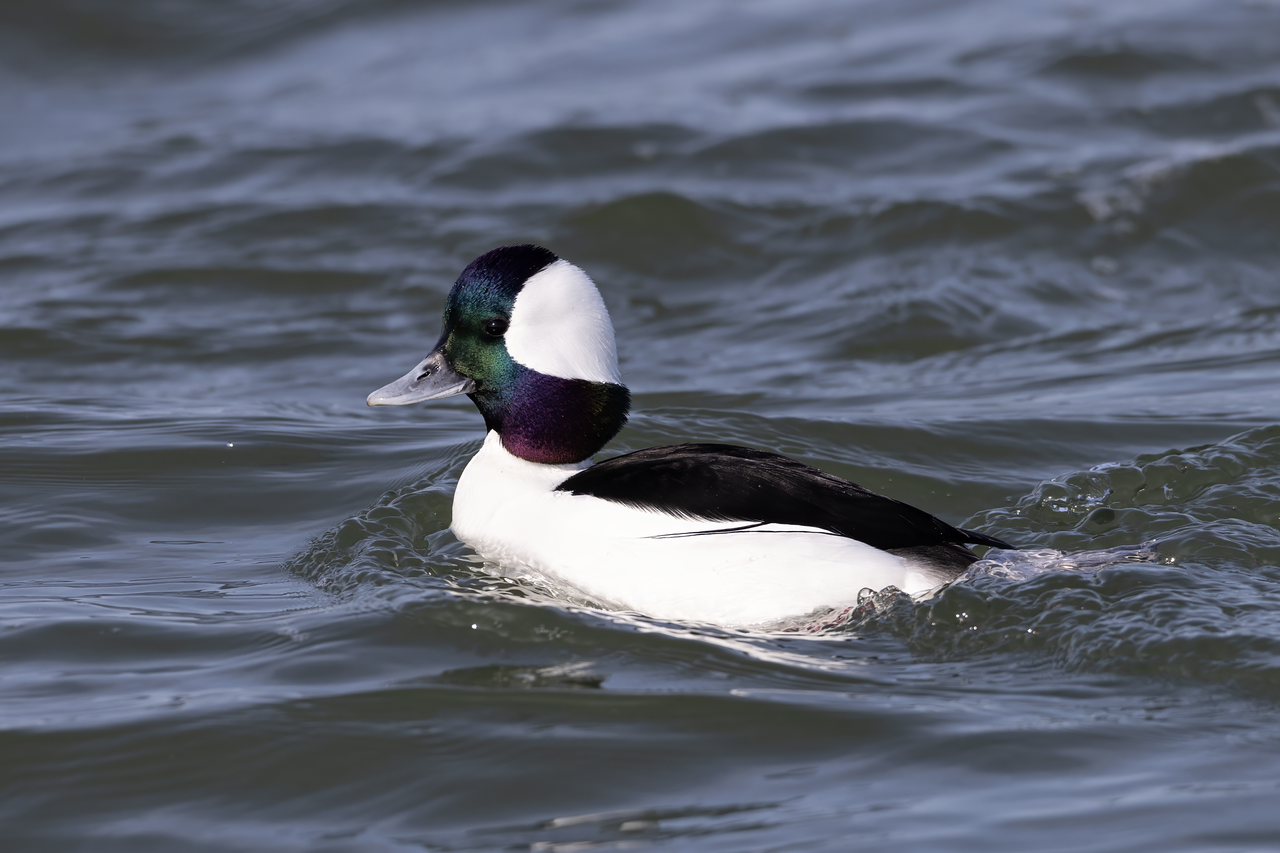
The Bufflehead is North America's smallest diving duck: a compact little ball with a large, rounded head. On that head the male carries a large, triangular white patch running from the eye into the nape, set against an otherwise glossy green-and-purple ground. It nests almost exclusively in old Northern Flicker holes, being the only North American duck small enough to fit inside one.
Voice
The Bufflehead is a quiet duck. In courtship the male gives a soft, growling or squeaky note, often in short repeated bursts, while the female gives a hoarse cuk-cuk-cuk when disturbed. In flight the small, rapid wings produce a soft whirring sound, much fainter than the whistling wingbeat of the goldeneyes to which it is related.
Recording: Richard E. Webster — CC BY-NC-SA 4.0 · San Bernardino National Wildlife Refuge, Cochise County, Arizona, United States · xeno-canto
Identification
The male is mostly white with a black back and a glossy green-and-purple head bearing a large, triangular white patch running from behind the eye into the nape. The female is uniformly grey-brown with a small oval white patch on the cheek, below and behind the eye. Juveniles resemble the female, with a slightly less sharply defined cheek patch. In every plumage the small size, the large, rounded head, and the fast, low flight over the water stand out, unlike the larger goldeneyes.
Confusion species
The male Long-tailed Duck in winter plumage also shows a lot of white on the head, but entirely lacks the triangular patch, has no rounded head, and carries the diagnostic long tail feathers; the female Long-tailed Duck has a finer bill and a less rounded head. Common Goldeneye and Barrow's Goldeneye are considerably larger, with a round rather than triangular pale patch placed by the bill rather than behind it. The rare Smew, known in North America only from the western Aleutians, can confuse from afar because its male is likewise mostly white, but it entirely lacks the triangular head patch and instead shows a narrow black mask around the eye. A non-breeding male Ruddy Duck can suggest a Bufflehead at a distance, but it lacks the sharp head patch and often holds its tail cocked upward.
Habitat
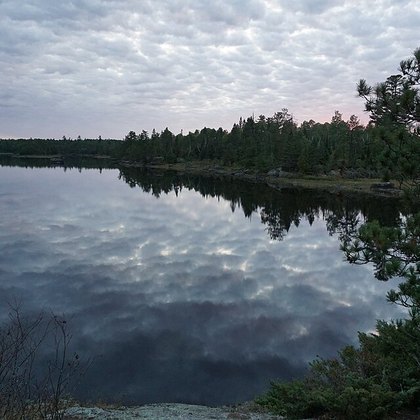
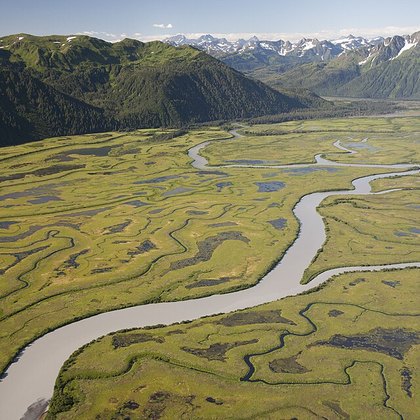
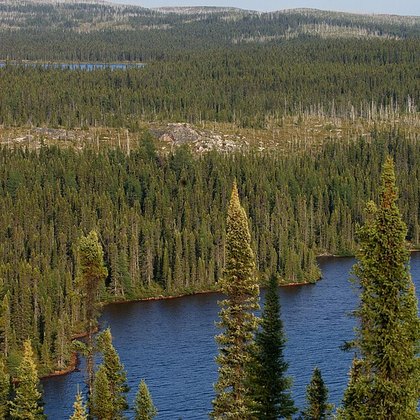
Breeds at small, fish-free lakes and pools in open conifer and aspen woodland, always within a few tens of metres of a suitable Northern Flicker cavity. Outside the breeding season it uses a wide range of waters: sheltered coastal bays and estuaries, but also lakes, ponds and reservoirs far inland. It avoids fast-flowing rivers and the fully open, rough sea.
Where the bird is most often found, arranged by the USNVC — the vegetation classification of the United States and Canada — and CMECS for sea and coast.

Range and movements
Breeds across the contiguous boreal forest and aspen parkland of central Alaska, Yukon, British Columbia, Alberta, Saskatchewan, Manitoba and the southern Northwest Territories, with scattered breeding records in the adjacent northwestern United States. It winters across nearly the whole continent: along both coasts, on the Great Lakes, and on countless lakes and rivers inland, south to central Mexico and northern Florida. Unlike many other sea ducks, the population has grown steadily since the mid-twentieth century.
- Resident
- Breeding (summer)
- Winter
- Passage
- dark = core range, pale = thinly spread
Where and when to look
Look for it in winter on a quiet, sheltered cove, pond or bay: a Bufflehead dives constantly, stays under only briefly, and keeps popping up in a slightly different spot each time. Its tiny size and the male's large, brilliant white head patch set it apart from every other small diving duck on the continent.
Conservation
Not threatened; the population has grown by more than one and a half per cent a year since the 1960s, an unusual trend for a sea duck. Because it depends on existing woodpecker cavities in dead or dying aspens, forest management that leaves such trees standing remains important for breeding success; nest boxes are used far less by this species than by the goldeneyes.
Scientific name
Bucephala albeola | (Linnaeus, 1758)
Linnaeus described the species in 1758 as Anas Albeola, among the ducks; because it was later placed in another genus, author and year stand in parentheses. The genus Bucephala was introduced in 1858 by Spencer Fullerton Baird, from the Greek bous, 'ox', and kephale, 'head' — 'ox-headed', after the large, rounded head of these ducks; the English name Bufflehead, 'buffalo head', is a direct translation of the same image. The species name albeola is a diminutive of Latin albus, 'white', 'little white one', after the male's large white head patch. As type locality Linnaeus gave 'America = Newfoundland', based on an eighteenth-century plate by George Edwards.