All species › Waterfowl › Ducks, swans and geese › White-winged Scoter
White-winged Scoter | Melanitta deglandi
Amerikaanse grote zee-eend | Negrón aliblanco
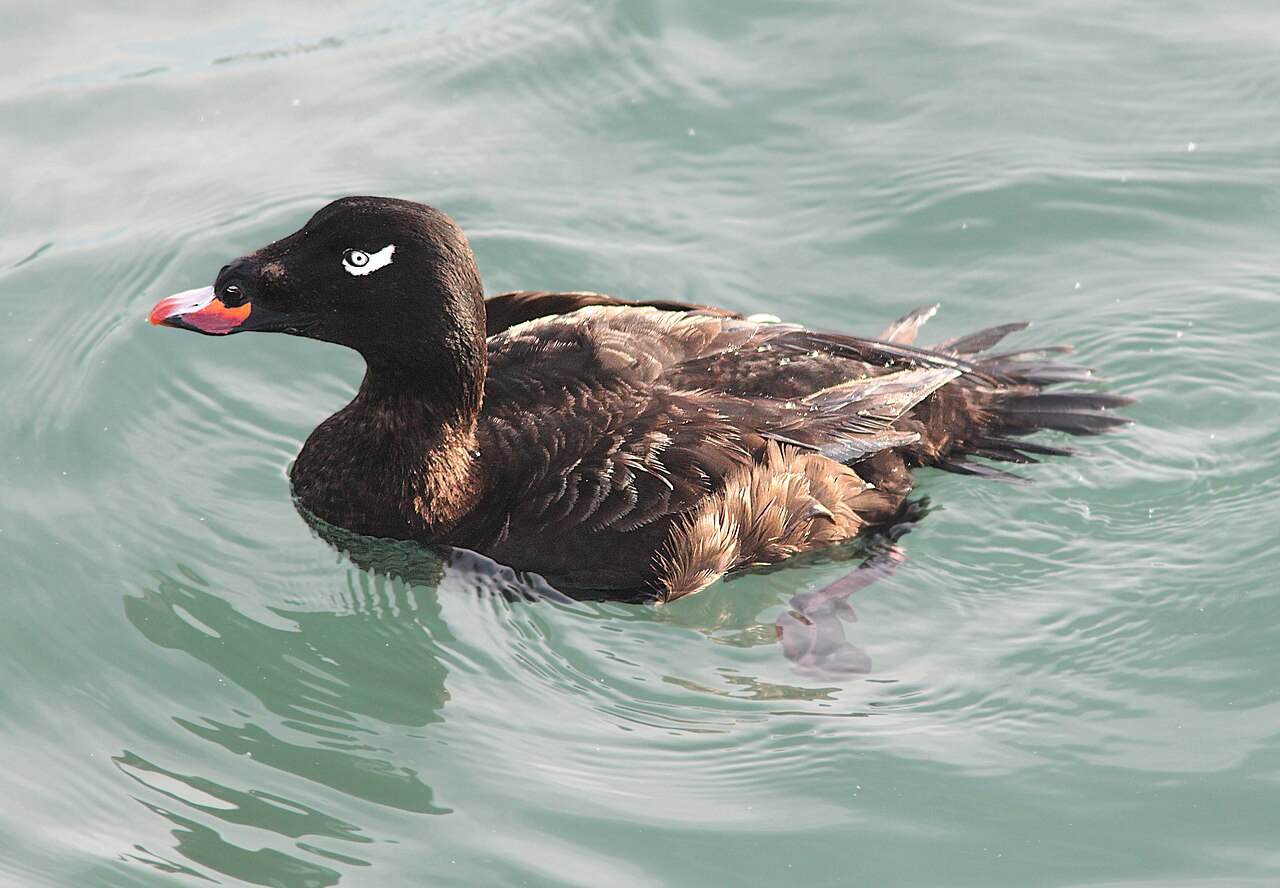
White-winged Scoter is the largest of the three scoters in this chapter and the only one with a sharp white wing patch, which flashes as a double streak across the black body in flight. The male also carries a large, dark-edged black knob at the base of the bill and a small, comma-shaped white spot behind the eye. Until 2019 it was still treated as one species together with the Eurasian Velvet Scoter and Siberia's Stejneger's Scoter, until research into appearance and genetics split the three apart.
Voice
In intense courtship both the male and the female give a high, piping whistle, unusual for a scoter and different from the flatter sound of the other two species in this chapter. In distress the female gives a low, hoarse kaak-kaak-kaak. At sea the species is usually silent; what stands out then is mainly the whistling sound of the wings in flight, a feature it shares with the other scoters.
Recording: Andrew Spencer — CC BY-NC-SA 4.0 · Dempster Highway KM 594, Northwest Territories, Canada · xeno-canto
Identification
The male is black with a small, comma-shaped white spot just behind the eye and a large white wing patch visible in flight and sometimes on the water too; the bill carries a black, dark-edged knob at the base. The female is dark brown, with a rounded head and a relatively short bill, and shows the same white wing patch as the male, which is her best field mark too. Juveniles resemble the female, with a less sharply defined eye spot and a paler belly. The species is the largest of the three scoters in this chapter, with a heavier, broader body and a slower wingbeat.
Confusion species
The white wing patch is the best field mark against the other two scoters: Surf Scoter and Black Scoter both lack white in the wing entirely. Sitting on the water, when the wing patch is not visible, the female most resembles the female Surf Scoter; look then at the rounder head and the shorter bill. In Europe and Asia live the closely related Velvet Scoter (Melanitta fusca) and Stejneger's Scoter (Melanitta stejnegeri), still counted as the same species until 2019; they do not overlap with White-winged Scoter.
Habitat
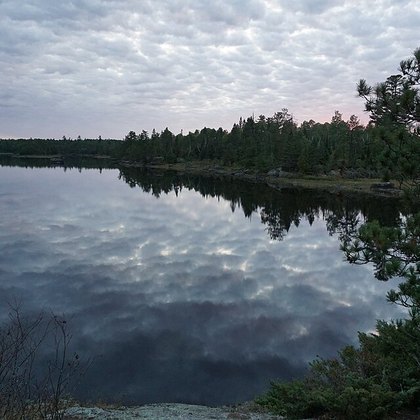
Breeds at freshwater lakes and pools, both in the boreal conifer forest of Alaska and western Canada and on the pothole lakes of the northern prairies, provided there is enough dense shoreline vegetation for the nest. Outside the breeding season it is a scoter of sheltered coastal waters, bays and reefs, and unlike the other two scoters in this chapter it also winters in substantial numbers on the Great Lakes, where it dives for mussels and other shellfish. It makes little use of fully open, deep water without shellfish beds.
Where the bird is most often found, arranged by the USNVC — the vegetation classification of the United States and Canada — and CMECS for sea and coast.



Range and movements
Breeds from subarctic western Alaska eastward to the east coast of James Bay, with an additional, isolated breeding population on the prairie potholes of Alberta, Saskatchewan, Montana and North Dakota. Winters along the Pacific coast from the Aleutians to central California, along the Atlantic coast from the Gulf of St. Lawrence to New Jersey, and in substantial numbers on the Great Lakes, especially Lake Michigan. Until 2019 the entire white-winged scoter group counted as a single species together with the Eurasian Velvet Scoter and Stejneger's Scoter; research into appearance, call and genetics led that year to the recognition of three separate species.
- Resident
- Breeding (summer)
- Winter
- Passage
- dark = core range, pale = thinly spread
Where and when to look
Look for it among mixed flocks of scoters on open water, and watch for the white wing patch that flashes as soon as a bird stretches or lifts its wings — on a sitting bird it is often just visible as a narrow white edge along the flank. On the Great Lakes, especially around Lake Michigan, the species is often closer in winter than along the open sea coast.
Conservation
Not threatened (LC), with a population considered stable, although the species' recent split into three has left relatively little research specifically on White-winged Scoter itself. Oil pollution in the wintering areas and the loss of suitable coastal shellfish beds are seen as the main risks; the prairie population is also vulnerable to drought, which can dry up the breeding potholes.
Scientific name
Melanitta deglandi | (Bonaparte, 1850)
Charles Lucien Bonaparte described the species in 1850 as Oedemia deglandi; because it was later placed in another genus, author and year stand in parentheses. The genus Melanitta was introduced in 1822 by Friedrich Boie, from the Greek melas, 'black', and netta, 'duck'. The species name deglandi honours the French ornithologist Côme-Damien Degland (1787–1856). As type locality Bonaparte gave only 'North America', without further detail.